


Business continuity planning starts long before a site goes dark or a crowd becomes unsettled. It starts when a venue manager asks a simple operational question: if one critical thing fails tonight, who does what in the first five minutes, the first hour, and the rest of the shift?
That question matters more in physical environments than most templates admit. A delayed guard arrival, failed access reader, storm cell moving toward an outdoor event, or outage in staff comms can turn a manageable disruption into a safety issue. On a commercial site or major event, continuity isn't only about restoring systems. It's about keeping people safe, keeping operations compliant, and keeping the site under control while conditions change.
Many generic plans over-focus on office recovery and IT restoration. They matter, but they don't tell a venue supervisor how to secure an entry point when power drops, how to keep patron movement orderly when ticket scanning stalls, or how to maintain coverage when two guards are stuck in traffic and a crowd is already forming. That is where practical business continuity planning earns its value.
Why Business Continuity Planning is Non-Negotiable
A common failure sequence at a major event doesn't begin with a catastrophe. It begins with a small operational fault.
The ticket scanners slow down at the main gate. Queues start backing up. Staff switch to manual checking, but nobody has printed attendee lists in the right location. Guests push for answers. Radios are overloaded. A side entrance is opened to relieve pressure, but the guard allocation doesn't change. Suddenly the issue isn't just entry delay. It's crowd control, access integrity, staff confusion, and public perception happening at once.
That is a continuity incident.


Minor incident or continuity threat
Not every disruption deserves full plan activation. A late supplier delivery may be annoying but containable. A single damaged fence panel may be easy to isolate. The line is crossed when the disruption threatens a critical function such as safe entry, secure perimeter control, incident response, payment processing, or emergency communication.
For physical-security-dependent operations, the warning signs are usually operational, not theoretical:
- Coverage starts thinning: One supervisor begins covering two roles, or a patrol is skipped to fill a gate position.
- Controls become manual: Staff prop open doors, record visitors on paper, or share phones because the primary process has failed.
- Decision-making stalls: Teams wait for approval because authority wasn't defined in advance.
- The public notices first: Patrons, contractors, or tenants see disorder before the management team has stabilised it.
Practical rule: If a disruption affects safety, compliance, or public confidence at the same time, treat it as a continuity issue, not a routine hiccup.
The financial case is already clear
In Australia, the case for business continuity planning isn't abstract. The median cost of a cybercrime report for Australian small businesses was A$49,600 in FY2022 to 2023, and there were more than 94,000 cybercrime reports in that period, according to the Australian Signals Directorate figures cited here. For sites and venues, that isn't just an IT problem. A cyber incident can affect access systems, rostering, communications, payment flows, and trust.
Ransomware being the most reported category among larger organisations in that same cited summary matters for operational teams too. If your systems are unavailable, your continuity plan must answer how the site still functions safely.
A useful starting point is to build a resilient plan around realistic operating conditions, not ideal ones. The strongest plans assume something important will fail at the worst possible time, then work backwards from that reality.
What good planning changes on the ground
A solid plan doesn't eliminate disruption. It stops the disruption from spreading.
At a venue, that usually means the team already knows which gates can switch to manual operation, which backup radios are issued, which supervisor can authorise contractor substitution, and when to pause admissions instead of forcing throughput. Those decisions shouldn't be invented under pressure.
Assessing Your Risks and Impacts
A useful continuity plan begins with a business impact analysis, not a binder full of generic emergency text. If you run a venue, festival, retail site, or construction project, the first task is to identify which functions must keep operating even when conditions are poor.
Guidance from Travelers recommends starting with a formal BIA that ranks critical functions, then documenting alternate sites, secondary suppliers, and off-site copies of vendor contacts before moving into testing and review, as outlined in this business continuity planning workflow.
Start with functions, not hazards
Most weak plans start by listing threats. Storm. Cyber attack. Staff shortage. Power outage. That approach creates a long risk register but doesn't tell the team what must be recovered first.
Start here instead:
List the functions that can't fail for long
At a music festival, that might include gate control, crowd monitoring, incident escalation, radio communications, medical access routes, and payment processing at bars.Set a tolerable outage point for each function
Don't chase perfect precision. Decide when the function becomes unsafe, non-compliant, or commercially damaging. For example, a temporary loss of one CCTV camera may be acceptable. Loss of radio comms during ingress probably isn't.Rank by recovery order
Recovery order matters because teams never have unlimited people, vehicles, or supervisors during a disruption.
Map what each function depends on
A critical function usually relies on more moving parts than people expect. Entry control, for example, may depend on:
| Function | Depends on people | Depends on systems | Depends on suppliers |
|---|---|---|---|
| Gate entry | Licensed guards, supervisors | scanners, radios, lighting | ticketing vendor, labour hire |
| Perimeter patrol | patrol officer, control room | CCTV, access control, vehicles | fuel, maintenance |
| Incident reporting | supervisors, managers | phones, radio channels, reporting platform | telecoms, software support |
This dependency view is where practical business continuity planning gets sharper. The failure isn't always the obvious item. A venue may have backup scanners but no printed contractor list. A construction site may have generators but no licensed relief guards available after hours.
When one function fails, check the dependency behind it. That's usually where the real weakness sits.
Use site-specific scenarios
A generic office template won't help much if your operation depends on people being physically present. Use scenarios your team faces:
- Outdoor event: storm warning, delayed supplier access, lost lighting in a bar precinct, mobile network congestion
- Hospitality venue: point-of-sale outage, patron surge after another venue closes, intoxicated crowd at entry, lift failure affecting movement
- Construction site: fence breach overnight, transport disruption affecting shift start, power loss at gatehouse, subcontractor no-show
- Retail centre: loading dock access issue, protest activity nearby, security roster gap, alarm monitoring communication failure
Document current controls and obvious gaps
Don't overcomplicate the first pass. Ask four blunt questions:
- What already works: Which controls can the team rely on under pressure?
- What is manual: Which tasks can continue without the primary system?
- What is single-threaded: Which function depends on one person, one vendor, or one access point?
- What is missing entirely: Which scenario has no written fallback?
A credible BIA produces a prioritised list. It tells you what must be protected first, what can pause, and what can operate in a degraded mode until full recovery is possible.
Designing a Security-Focused Continuity Plan
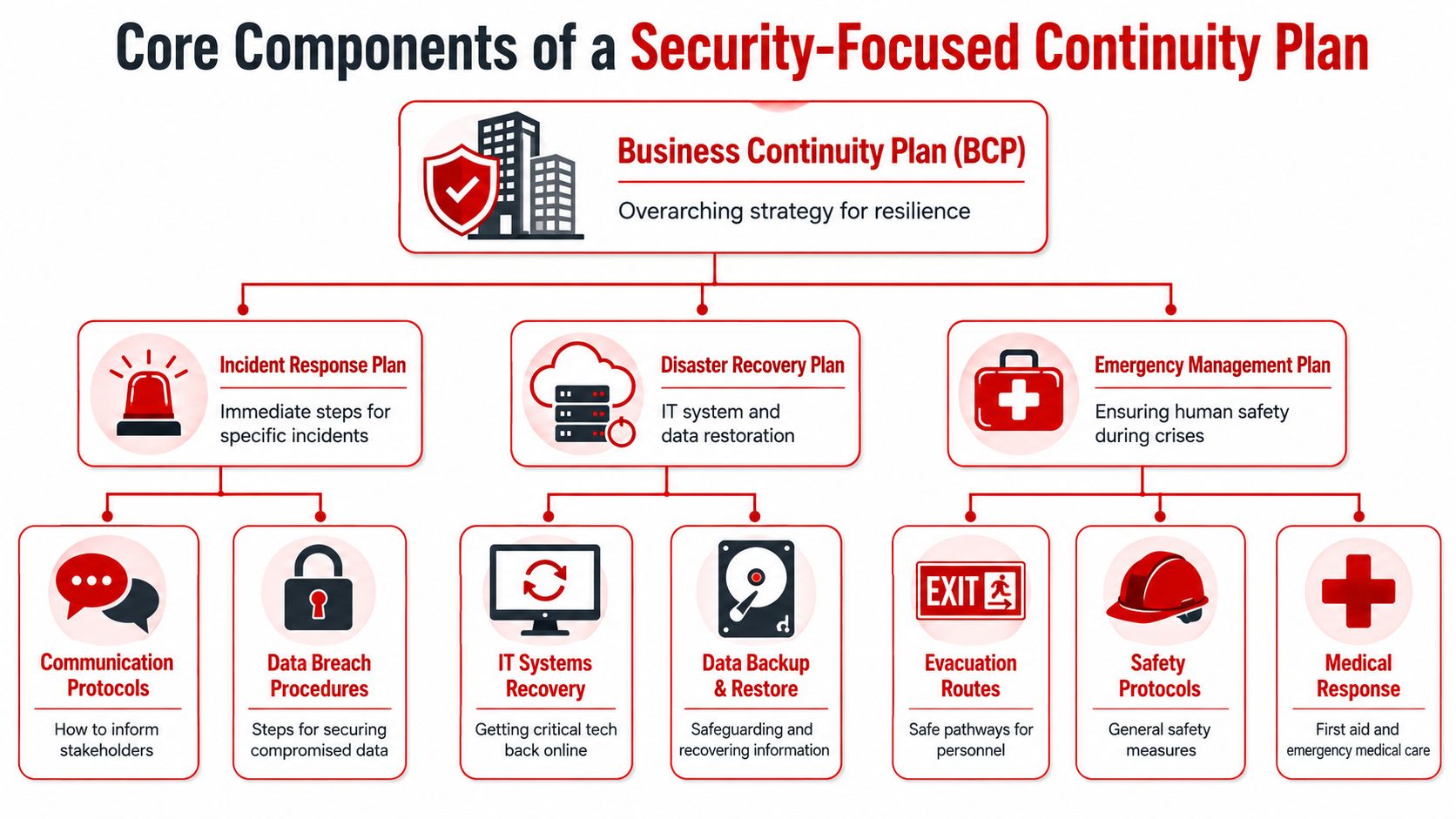
Most business continuity planning advice treats physical security as a supporting service. For venues, events, retail environments, and construction sites, that's backwards. Physical security is often the operating foundation that allows every other function to continue.
If you can't control entry, maintain patrols, protect staff, and escalate incidents properly, the rest of the continuity plan becomes theoretical. You may have working servers and backup files, but the site still isn't stable.
A major gap in mainstream BCP content is its failure to address physical-security-dependent operations, especially the practical question of how venues and sites in NSW, VIC, QLD, and the ACT maintain safety and compliance when staffing, transport, or site conditions are disrupted, as discussed in this overview of continuity planning best practices.
Build the plan around control points
On a live site, continuity usually depends on a small number of control points staying operational:
- Entry and exit management
- Perimeter integrity
- Staff and contractor verification
- Reliable communications
- Incident escalation
- Emergency access routes
If one of those breaks, the plan should specify exactly how the site moves to a degraded but controlled mode.
Take a power outage at a hospitality venue. A poor plan says, "follow emergency procedures". A useful plan says:
- switch access control points to manual staffing
- assign one supervisor to front entry and one to internal circulation
- secure plant and back-of-house doors physically
- move incident logging to paper or mobile notes
- hold patron counts at entry if accurate occupancy status is uncertain
- notify management, technical support, and emergency contacts through the backup channel
That is the difference between policy language and an operational plan.
Plan for staffing disruption first
In physical environments, the most common continuity strain is often people, not hardware. Transport disruption, illness, fatigue, contractor absence, and delayed relief staff can all weaken the site before any dramatic incident occurs.
Good plans define what happens when staffing drops below the preferred roster:
| Situation | Wrong response | Better response |
|---|---|---|
| Two guards unavailable before gate opening | keep all posts open with thin coverage | collapse non-critical posts and protect key control points |
| Supervisor delayed in transit | wait and hope arrival is soon | activate delegated authority and reassign reporting line |
| Patrol vehicle unavailable | cancel patrol cycle | switch to foot patrol zones and shorten reporting interval |
Field advice: Don't promise full service under reduced staffing. Define what must still be protected, and downgrade lower-priority activity early.
Write fallback procedures for physical systems
Your security-focused continuity plan should include plain-language fallback procedures for:
- Access control failure: manual sign-in, badge verification alternatives, keyed access control, extra static guard deployment
- Radio or phone failure: backup channel list, spare devices, runner system, supervisor check-in intervals
- Lighting failure: portable lighting locations, unsafe area closures, escorted movement rules
- Crowd surge conditions: temporary hold points, barrier adjustments, additional visible guard presence, public messaging approval
- Supplier disruption: alternate labour contacts, substitute barriers, emergency consumables, backup transport options
Not every site needs the same level of detail, but every critical control does need a clear fallback.
For facilities dealing with structural damage, water ingress, or major contamination after an incident, looking at specialist response models like Phoenix disaster cleanup can be useful for understanding how external recovery support fits into a broader continuity chain. The lesson isn't the geography. It's the operational principle: define who restores the environment once the immediate incident is contained.
Security continuity isn't separate from customer experience
Venue managers sometimes split continuity into "operations" and "security". On the ground, they are intertwined. A poor queue plan creates aggression. Poor communications create rumours. Weak perimeter control creates unauthorised access. The best continuity plans protect safety and preserve the guest experience at the same time.
Defining Roles and Communication Protocols
A continuity plan fails fast when nobody knows who can make the next decision.
In practice, business continuity planning needs named leaders, backup decision-makers, and a communication structure that still works when normal channels are congested or unavailable. ZenGRC notes that a robust business continuity policy defines maximum tolerable outage durations and assigns accountable recovery leaders, with each critical process paired to a named owner and documented recovery protocol in this guide to developing a robust business continuity policy.
Build a clear command structure
For a venue or commercial site, keep the command model simple enough to use under pressure. A practical structure often includes:
Incident lead
Activates the continuity response, sets priorities, and approves major operational changes.Security lead
Reassigns guards, secures control points, manages patrol coverage, and escalates site threats.Operations lead
Handles venue operations, suppliers, facilities, and service continuity.Communications lead
Coordinates staff messaging, stakeholder updates, and approved public statements.Safety or compliance lead
Tracks obligations, logs decisions, and confirms actions remain compliant with site requirements.
If the same person holds two roles on a smaller site, document that openly. Hidden overlap creates confusion.
Match each role to a real trigger
Roles are only useful when the activation point is obvious. For each critical process, document:
- Who owns it
- What triggers action
- What they can approve without further permission
- Who takes over if they're unavailable
- Which contact list or run sheet they use
A strong communication tree doesn't just list names. It tells people what information they must pass on. That should include the nature of the disruption, affected functions, current site status, immediate control measures, and the next review time.
The first message in a disruption should reduce uncertainty. "We are assessing" is rarely enough on its own. State what has failed, what remains operational, and who is in charge.
Use layered communication channels
Single-channel plans break quickly. If the site relies only on radios, one equipment issue can blind the team. If the venue relies only on mobile phones, network congestion can slow decisions.
Use a layered model:
Primary channel
Routine operations channel, such as radios or internal comms app.Secondary channel
Backup phones, alternate talkgroup, or supervisor direct-call list.Tertiary method
Physical runner, fixed muster point updates, printed contacts, or whiteboard in a control room.
For major events, pre-drafted message templates help. Keep them short and role-specific. Staff need operational instructions. Contractors need access or timing changes. Patrons need calm, accurate direction. Executives need impacts, actions, and decision points.
Keep contact data outside the main system
One common weakness is storing every key contact in the system that may be unavailable during the incident. Critical numbers, vendor contacts, escalation lists, and role backups should also exist in an accessible offline format. If your platform is down, the response still needs to move.
Testing Your Plan and Ensuring Compliance
A continuity plan that hasn't been tested is only a draft. Teams don't discover weak escalation paths, missing keys, dead batteries, outdated contact lists, or unrealistic recovery sequences by reading a document in a meeting room. They discover them in exercises.
Australian regulatory expectations are also moving toward evidence, not intention. APRA's CPS 230 standard was issued in July 2023 and takes effect on 1 July 2025 for APRA-regulated entities. It requires entities to maintain and test a business continuity plan, and scenario testing of severe but plausible disruptions must occur at least every 12 months, according to this summary of APRA CPS 230 and continuity obligations. Even if your organisation isn't directly regulated by APRA, that benchmark is a practical signal of where resilience expectations are heading.
Choose the right test for the right problem
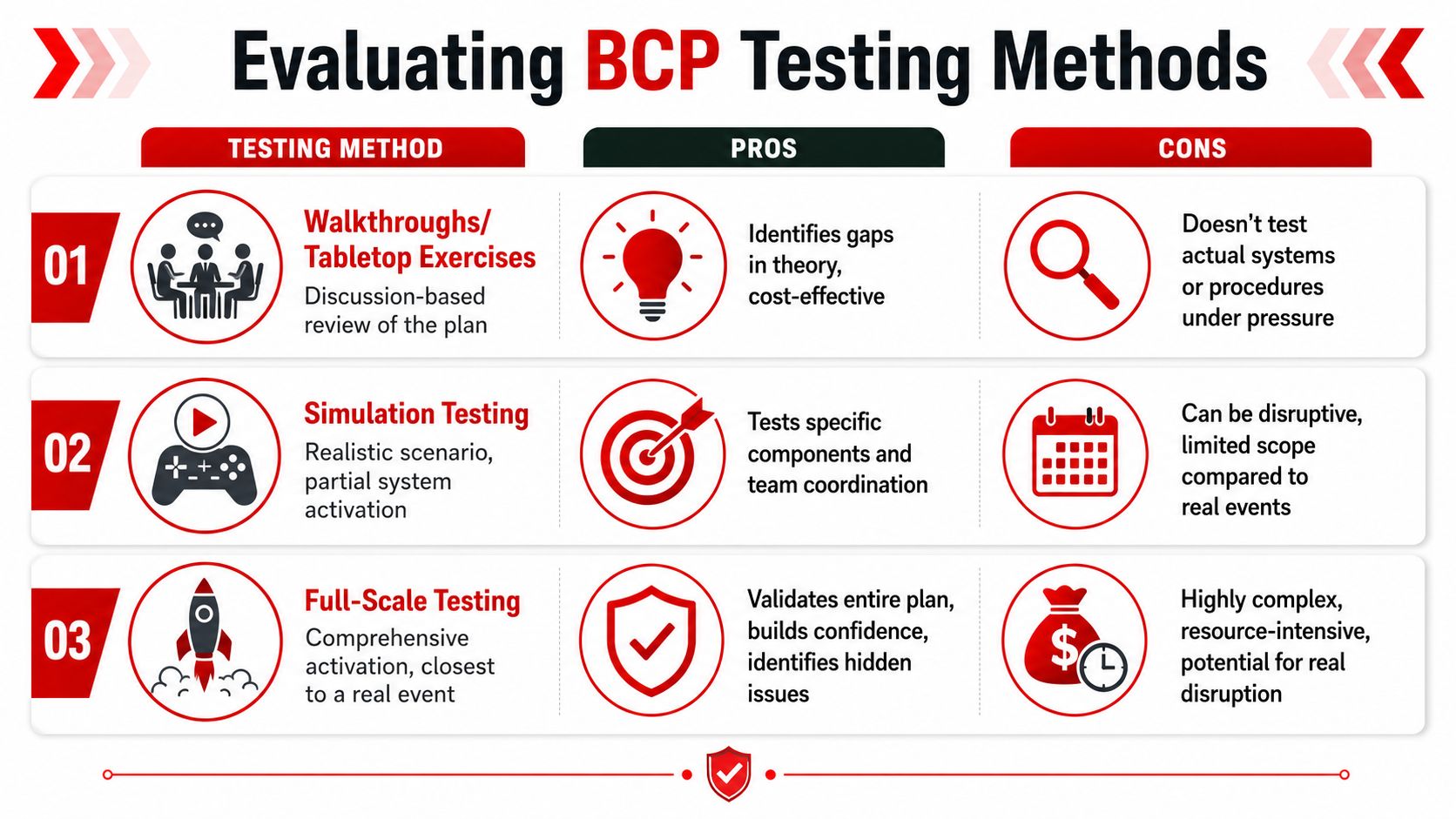
Different testing methods answer different questions.
| Test type | Best for | Limitation |
|---|---|---|
| Tabletop exercise | decision-making, escalation, communication flow | doesn't prove field execution |
| Simulation | validating selected processes under realistic conditions | can miss broader interdependencies |
| Full operational drill | checking whether the full plan works on the ground | disruptive and resource-heavy |
A tabletop is ideal when you want to test judgement. For example, an event leadership team can walk through a scenario where entry systems fail during peak arrival and decide whether to pause admissions, open manual lanes, or reroute patrons.
A simulation is better when you need to test a component, such as backup radio distribution, manual access logging, or temporary guard redeployment.
A full drill is the closest thing to reality. Use it carefully. It can expose hidden friction between security, venue operations, contractors, and management, which is exactly why it's valuable.
Record findings in operational language
Avoid vague post-exercise notes like "communication could improve". Document what happened:
- who was notified late
- which decision needed approval but had no owner
- what equipment wasn't available
- what fallback process was too slow
- where staff interpreted the same instruction differently
A test is successful when it reveals a weakness early enough to fix it before a real disruption does.
Tie testing to review and change
Testing should trigger plan updates. So should site changes, new event formats, changes in supplier arrangements, altered layouts, or revised staffing models. A continuity plan written for last year's operating model can fail this year's event.
For venues and sites, the practical standard is simple. Test against severe but plausible scenarios, record what broke, update the plan, and retest the areas that changed.
Your Business Continuity Planning Questions Answered
How often should business continuity planning be updated
Update it whenever your operation changes in a way that affects recovery. That includes new layouts, revised entry flows, supplier changes, new communication tools, changed guard coverage, or different event formats. Even without major change, a regular scheduled review keeps the plan usable.
What's the difference between a business continuity plan and an emergency plan
An emergency plan focuses on immediate life safety actions such as evacuation, first response, and emergency services coordination. A business continuity plan is broader. It covers how the site keeps operating, or resumes priority functions quickly, after the immediate incident is controlled. On a venue site, you need both.
How do smaller venues handle business continuity planning without a large team
Keep it lean. You don't need a complex document set to be effective. Identify your most critical functions, assign named owners, define backup communications, keep offline contacts available, and write a short fallback procedure for the few scenarios most likely to disrupt trade. Small sites usually benefit from clarity more than complexity.
What should be in a continuity plan for a security provider or venue security team
At minimum, include post priorities, relief arrangements, backup communications, supervisor escalation authority, access control fallback steps, incident logging method, emergency contact lists, and procedures for reduced staffing. If the site has alcohol service, high patron turnover, or public-facing risk, make sure crowd control and incident handover arrangements are explicit.
How do you involve contractors and third parties
Bring them into the planning early if they support a critical function. That includes labour hire, traffic control, cleaners, technical crews, ticketing teams, and facilities contractors. They need to know trigger points, call-out expectations, alternate contacts, and who has authority to redirect their work during a disruption.
What scenarios matter most for events and physical sites
Use realistic, repeatable scenarios first. Staffing gaps, weather disruption, transport issues, access control failure, communications outage, supplier delay, and localised power loss usually deserve more attention than highly cinematic disasters. Frequent operational friction causes more continuity failures than dramatic edge cases.
What's the most common planning mistake
Writing a plan that assumes ideal staffing, ideal technology, and full management availability. Real continuity planning starts by accepting that a disruption usually arrives with incomplete information, reduced time, and limited personnel.
If you need outside support to strengthen site resilience, event security coordination, or continuity-ready operational coverage across NSW, VIC, QLD and the ACT, GM GROUP Services can help you turn a paper plan into a practical, site-based response model that protects people, property, and business operations.