


Brand reputation protection starts long before a bad review appears. It starts at the gate, at the bar, at the loading dock, at the customer service counter, and anywhere a small incident can turn into public evidence in minutes.
A venue manager knows the pattern. One patron argues with security. Someone films the last ten seconds, not the ten minutes that led up to it. A queue stalls outside. Guests post that the event is disorganised. A contractor leaves a messy frontage on a construction site and nearby residents start sharing photos in local groups. By the time management hears about it, the issue is no longer operational. It's reputational.
That's why brand reputation protection matters in practical, day-to-day terms. It isn't a marketing add-on. It's the discipline of stopping trust from breaking when your team is under pressure. In Australia, 99.5% of all businesses were small businesses in 2023, which makes reputation risk a mainstream business issue, not a corporate-only problem, as noted in this ZeroFox overview. For event organisers, hospitality operators, retailers and site managers, one visible mistake can affect bookings, repeat trade and staff confidence.
The hard part is that most operators still split the problem in two. Physical teams handle incidents. Marketing teams handle comments. IT handles fraud. That division doesn't match how damage happens. The customer experiences one brand. If your on-site response, online messaging and security controls don't line up, people notice fast.
Introduction The Unseen Threat to Your Brand
Reputation problems often start as small, unmanaged operational issues.
At a festival, that might be a delayed entry line and a refusal handled poorly in front of a crowd. In a pub, it can be an RSA decision delivered without enough control, followed by an argument and a phone camera. On a construction site, a neighbour can raise a safety concern, post photos before the supervisor closes the incident log, and turn a local site issue into a public trust issue within the hour.
For event organisers and site managers, the risk is rarely the incident alone. Exposure sits in the gap between what happened on the ground, what was captured on a screen, and how quickly your team can prove it acted properly. Physical incidents now create digital consequences. If your staff lose control of the scene, you often lose control of the story next.
Brand reputation protection closes that gap. It gives operators a practical system for protecting trust before, during and after an incident. The standard is simple. When a problem becomes visible, your team needs a calm response, clear documentation, and one version of events that management, customer-facing staff, security, and digital teams can all support.
Practical rule: If an incident can be filmed, reviewed, reposted or misrepresented, it belongs in your reputation plan before it reaches your crisis plan.
Small operators feel this pressure fastest. They do not have the margin for repeated complaints, public arguments, or local social posts that make the venue, site, or business look unsafe or badly managed. One messy incident can affect bookings, neighbour relations, subcontractor confidence, staff morale, and repeat trade at the same time.
The trade-off is real. Tight enforcement without communication can make your team look hostile. Fast customer service without proper escalation can make you look disorganised. Reputation protection turns that balancing act into an operating discipline. It tells teams what to watch, who responds, what gets recorded, and when an on-site problem has crossed into a brand risk that needs management, legal, IT, or communications involved.
Defining Brand Reputation Protection Beyond Reviews
Reputation is often reduced to reviews. That's too narrow.
Brand reputation protection is the active protection of trust across everything the public can see, experience or question. Reviews are only one output. The actual inputs are staff behaviour, queue management, signage, incident handling, payment integrity, online communications, privacy practices and how quickly leaders respond when something goes wrong.

Trust works like structural integrity
A good way to think about reputation is to compare it to a building's frame. When the structure is sound, nobody talks about it. They feel safe inside it. When it fails, every surface above it becomes a problem.
Your reputation works the same way. Customers don't usually praise “trust architecture”. They notice whether your team seems organised, whether instructions are clear, whether staff look in control, and whether your business acts consistently under pressure. If those basics slip, a review issue is just the visible crack.
That's also why public image and operational reality must match. A polished brand can't compensate for poor floor control. A strong security posture can't compensate for confusing customer communication. If your bookings team says one thing, your guards do another, and your social channels stay silent, the market reads that as disorder.
It includes digital and physical controls
For operators in public-facing environments, reputation protection sits across multiple disciplines:
- Frontline conduct: Staff tone, escalation decisions, incident de-escalation and customer-facing professionalism.
- Operational discipline: Entry flow, service speed, site cleanliness, signage, access control and complaint handling.
- Digital trust: Verified accounts, consistent public messaging, fraud awareness and fast handling of impersonation or fake listings.
- Security response: Clear records, preserved evidence, aligned communication between supervisors, management and technical teams.
If you want a broader strategic framing, Sift AI's piece on what is reputation management in 2026 is useful because it helps distinguish reputation work from simple review chasing.
A strong reputation doesn't mean nothing ever goes wrong. It means your organisation looks controlled and credible when something does.
That's the benchmark worth using. Not perfection. Control.
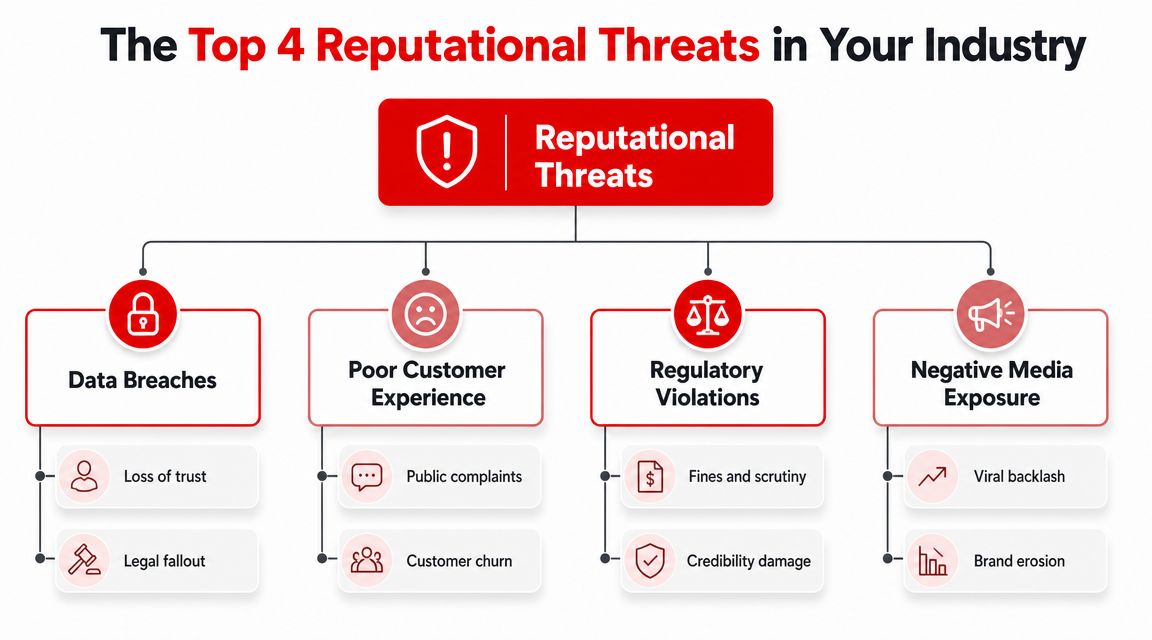
The Top 4 Reputational Threats in Your Industry
Some threats are obvious. Others are underestimated until they hit. In events, hospitality, retail and construction, the biggest reputation risks usually come from four directions.
On-site incidents that become public content
This is the most neglected category.
Most operators still think of physical incidents as local matters. They're not. In Australian operating environments, the bigger risk often starts on-site, where one altercation, safety failure or queue breakdown can rapidly become a reputation event across social platforms, reviews and local media, as highlighted in this Seekr analysis.
A door dispute at a venue doesn't stay at the door. A customer ejection with poor communication becomes a clip. A messy evacuation becomes a thread. A delayed opening becomes “management chaos” if nobody explains what happened. The camera in every pocket changes the risk model. Good incident handling now has to survive both eyewitnesses and replay.
Impersonation and scam activity
Brand harm also comes from people pretending to be you.
In 2023, Australians lost A$2.74 billion to scams and the Australian Competition and Consumer Commission received 601,803 scam reports. The ACCC also noted that business email compromise was the highest-loss scam type that year, with losses of around A$91 million, according to this summary of brand protection and scam exposure. For businesses that send invoices, booking updates, roster messages or urgent payment requests, that matters directly.
When a scammer uses your business name, logo or staff identity, the damage isn't limited to the victim. Every customer who sees the fake message becomes less trusting of your authentic messages. Hospitality venues, event teams and contractors are vulnerable because their communications are often time-sensitive and transactional.
Internal conduct failures
Some of the most expensive reputation hits come from your own people handling a moment badly.
That doesn't always mean deliberate misconduct. More often, it's poor judgement under pressure. A supervisor speaks too sharply. A cashier argues instead of resolving. A contractor dismisses a complaint instead of acknowledging it. The public rarely separates an individual from the brand on their shirt.
Watch for patterns like these:
- Inconsistent enforcement: One guard applies the rules calmly, another applies them aggressively.
- Weak escalation discipline: Staff debate with customers instead of moving issues to a trained supervisor.
- Unclear accountability: Nobody owns the final decision, so the customer experiences delay and contradiction.
Compliance failures that look like negligence
A compliance issue is never just a compliance issue once the public sees it.
If a venue appears to mishandle RSA, if a site looks unsafe, or if staff ignore obligations in a visible way, the audience doesn't call it “a process gap”. They call it carelessness. That interpretation spreads quickly because it's easy to understand and easy to share.
The public judges what they can see. They infer the rest.
That's why compliance controls matter to reputation. They create visible order. Clean logs, clear signage, trained staff, documented refusals and disciplined incident records all help if someone later challenges your conduct online or through a complaint channel.
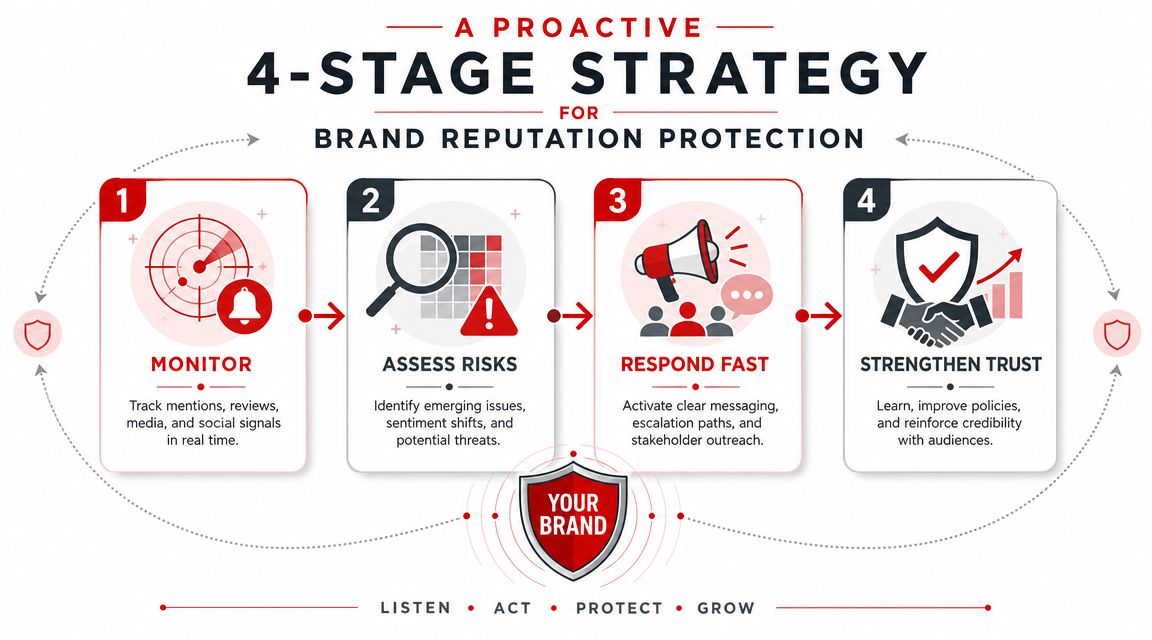
A Proactive 4-Stage Strategy for Brand Reputation Protection
A reputation problem often starts on the ground, then spreads online before management has the full story. A patron is refused entry, someone films the exchange, a partial clip hits social media, and your team is still arguing over what happened. The practical answer is a four-stage control cycle. Detect, verify, enforce, report. Analysts at BlueVoyant outline a similar four-stage model, and the logic fits high-exposure environments such as venues, retail floors and active worksites.
Detection
Early detection starts long before a complaint is posted.
For event organisers and site managers, the first warning sign is often physical, not digital. Radio traffic changes. Queue pressure builds. Staff at entry start calling for support. A customer pulls out a phone and begins filming. Those are reputation signals as much as security signals, because public perception is being formed in real time.
Online monitoring still matters, but it should mirror what happens on site. Track fake event listings, impersonation accounts, scam payment messages, venue name variations and sudden complaint spikes. On site, set clear watch points at gates, bars, exits, service counters and other choke points where tension is visible first.
Verification
Verification prevents two expensive mistakes. Responding too slowly, and responding to the wrong version of events.
A short video clip rarely shows the lead-up. A staff member's account may be accurate but incomplete. A complaint in your inbox may refer to another site, another contractor or another event using a similar name. Verification means locking down the facts fast. Confirm who was involved, what time it happened, what CCTV shows, what transactions or access logs support the account, and which staff statements are consistent.
One rule helps more than any software tool. Give one person control of the incident record. If operations, marketing and management each build their own timeline, your public response will look confused even if your conduct was reasonable.
Build one source of truth for each incident. In physical security terms, this is your incident log. In reputation terms, it is the file that stops a bad moment becoming a credibility problem.
Enforcement
Once the facts are confirmed, action needs to be visible, proportionate and documented.
That may mean removing a disruptive patron, correcting a false post, sending a takedown request, locking a compromised account, warning customers about scam payment instructions, or issuing a short public statement. The trade-off is simple. Act too aggressively and you can inflame the issue. Act too slowly and other people define the story for you.
Use different enforcement paths for different risks:
- On-site incident: Secure the area, protect staff and patrons, preserve footage, and make sure one trained person speaks for the business.
- Impersonation or scam activity: Capture evidence, report the account or listing, notify affected customers through verified channels, and brief frontline staff on what to say.
- False public claim: Correct the record with evidence and avoid an argument thread that gives the claim more reach.
For a practical outside perspective on managing your brand's reputation, that resource reinforces the value of process over improvisation.
Reporting
Reporting is where a one-off response becomes an operating standard.
After any serious incident, record what was detected, when it was escalated, how verification was completed, what action was approved, what evidence was preserved, and what needs to change. Keep it usable, not bloated. A report nobody reads will not protect the brand next time.
Good reporting also does defensive work later. If a complaint escalates to media, a client, an insurer or a regulator, your notes show sequence, judgement and control. In brand terms, reporting is the equivalent of preserving a crime scene. It protects the facts before opinion gets there first.
Sector-Specific Protection Checklists
Theory helps, but checklists change behaviour. Different sectors face different exposure points, so the controls should fit the operating environment.
Events and venues
At live events, reputation often rises or falls on transition points. Entry, refusals, queue movement, bag checks, alcohol service, exits and post-event dispersal all create visibility. A clean event isn't just one with no incidents. It's one where guests can see organised control.
Focus on pre-event briefings, escalation roles and rapid fact capture. If an incident occurs, the supervisor, client representative and communications lead should all know who confirms facts and who speaks.
Retail
Retail reputation is shaped by consistency.
Customers notice loss prevention, returns handling, suspected theft interventions, refund explanations and staff tone. A store can have good products and still look unsafe or poorly managed if staff challenge people in the wrong way or if incidents unfold in front of other shoppers without control.
Construction
Construction has a different public interface but the same trust problem.
Noise, dust, fencing, deliveries, worker conduct and site presentation affect how neighbours, clients and visitors talk about the project. Reputation issues often start with disruption, then spread through local complaints and visible imagery. Tight access control and a community-aware response plan matter more than most site teams expect.
Brand Reputation Protection Checklist by Sector
| Sector | Prevention | Monitoring | Response |
|---|---|---|---|
| Events and Venues | Brief staff before doors open on refusals, RSA boundaries, queue messaging and filming risk. Set escalation roles so guards, supervisors and organisers know who owns incidents. | Watch choke points such as entry lanes, bars, amenities and exits. Track public chatter around delays, cancellations, line movement and safety concerns. | Secure facts fast with incident notes, footage markers and witness names. Issue one aligned message to staff and patrons where needed. |
| Retail | Train on customer contact standards for returns, theft suspicion and conflict handling. Protect brand channels so fake promotions or account misuse are noticed quickly. | Review repeat complaints by location, shift or team. Monitor mentions involving service quality, counterfeit claims or payment confusion. | Move disputes off the shop floor where possible. Document interventions clearly and correct false information through verified channels. |
| Construction | Control site presentation with clean boundaries, signage and visitor procedures. Brief workers on neighbour interactions and unauthorised photography risks. | Track community complaints about disruption, access and safety perception. Review access logs and perimeter issues for incidents that could become public. | Acknowledge concerns promptly and assign one site contact. Preserve evidence with logs, photos and supervisor notes before responding publicly. |
A checklist only works if someone owns it. Put a name next to each control. If responsibility is shared by everyone, it's usually held by no one.
Measuring Success with the Right KPIs
The wrong metrics make teams feel busy without showing whether trust is getting stronger. Follower counts and raw impressions don't tell a site manager much. Operational indicators do.

What to measure
For brand reputation protection, useful KPIs usually combine frontline, digital and management signals:
- Incident response speed: How quickly supervisors were notified, verified facts and acted.
- Complaint quality: Not just volume, but whether the same issue repeats by shift, location or event type.
- Public sentiment patterns: Themes in reviews and social comments, especially around safety, professionalism, waiting time and trust.
- Training completion and application: Whether staff finished required training and whether supervisors observe it on the floor.
- Escalation accuracy: Whether teams raised issues at the right level instead of hiding, arguing or overreacting.
Leading indicators beat vanity metrics
A smart KPI set includes signs of future trouble, not just evidence of past damage.
If queue friction is increasing, if refusals are being handled inconsistently, or if customer support is receiving more “is this message really from you?” queries, those are early warnings. They tell you where trust is weakening before public criticism hardens.
Measure whether your controls worked, not whether your brand looked popular for a week.
Use a monthly review format that compares incidents, response quality, repeat complaint themes and corrective actions. That gives management something usable. It also helps justify training, staffing and process changes with evidence rather than guesswork.
Conclusion Your Reputation is Your Greatest Asset
Reputation isn't separate from operations. It's the public result of how your people perform when conditions aren't ideal.
That's why brand reputation protection has to connect floor control, digital monitoring, incident response and clear reporting. If you only manage comments after the fact, you're too late. If you control the incident, verify the facts quickly and respond with evidence, you protect more than image. You protect trust, continuity and future revenue.
For organisers, venue managers and site leaders, the message is simple. Treat reputation like a security function. It's too important to leave to improvisation.
Frequently Asked Questions
Does brand reputation protection only matter for large businesses
No. It matters sharply for smaller operators because they usually have less margin for public trust damage. A local venue, retailer or project site can feel the impact of a single visible incident much faster than a large national brand with a broader buffer.
How does a physical security provider affect online reputation
Physical teams shape the moments that later appear online. The way staff manage queues, refusals, incidents, intoxication, access control and complaints often determines whether the public sees professionalism or disorder. Security also contributes the records, timelines and evidence needed for a credible response after an incident.
Security and reputation are also connected through cyber and privacy events. The Office of the Australian Information Commissioner reported 527 data breach notifications in the first half of 2024, with 69% caused by malicious attacks, which is why many organisations now align brand monitoring with breach and incident response playbooks, as discussed in this Doppel summary.
What's the first step I should take this week
Run one incident pathway from start to finish.
Pick a realistic scenario for your environment. For example, a filmed refusal at a venue door, a fake invoice sent to customers, or a neighbour complaint about a construction site. Then test who detects it, who verifies facts, who approves the response, what evidence is captured and what public message goes out. Most businesses find the gap immediately. It's usually not intent. It's role clarity.
If you need practical support turning security operations into a reputation protection system, GM GROUP Services works across events, venues, retail, hospitality and construction environments with guarding, risk assessments, incident reporting and site-based response structures that help businesses protect both safety and trust.