


Back to base alarm system adoption needs careful interpretation: in 2024, 22.7% of surveyed Australian households reported having an alarm system or live monitoring, up from 18.1% in 2022, according to Budget Direct's survey of 1,003 Australian adults. That combined category doesn't tell you whether anyone will attend an activation. For a venue or event operator, the important purchase isn't an alarm connection. It's a documented response when something happens.
What a Back to Base Alarm System Is
A back to base alarm system sends events from your premises to a staffed monitoring centre through a communications link. An operator assesses the information and follows your site's agreed instructions, rather than leaving an activation to sound locally until someone notices.
Think of a local siren as a doorbell that rings only inside a building. A monitored alarm is more like a doorbell connected to a staffed switchboard. Someone receives the signal, but they still need to know which door it came from, whether anyone should be there and who can act.
The equipment behind the connection
The basic arrangement needs:
- Detection devices: Door contacts, motion detectors and other suitable sensors identify activity in protected areas.
- A control panel: The panel manages armed areas, interprets detector inputs and prepares event reports.
- A communications path: A telephone, internet or mobile connection carries reports to the monitoring centre.
Those components need to match the way the premises operates. A restaurant's occupied kitchen, an unattended bottle shop and a festival's equipment compound shouldn't automatically share the same arming schedule or response instructions.
Monitoring doesn't guarantee police attendance. The centre follows an escalation procedure, which might involve contacting a duty manager, checking available camera footage, requesting a patrol or notifying emergency services when appropriate.
Buy the response procedure alongside the equipment. A received signal isn't the same thing as a resolved incident.
For licensed venues, festival promoters, retailers and construction managers, the strongest reason to consider monitoring is an unattended period with a clear exposure. Identify what needs protecting, when people leave and who can safely respond. That gives the installer and monitoring team a useful specification, rather than a vague instruction to protect everything.
How a Back to Base Alarm System Works Step by Step
The NSW Environment Protection Authority's intruder-alarm guidance describes continuously monitored systems as combining an internal alarm with a connection to a customer-care centre. It also recommends arranging for the alarm company to control or disable an alarm that keeps sounding, helping avoid prolonged neighbourhood disturbance.
The signal chain looks simple, but each handover needs usable information.
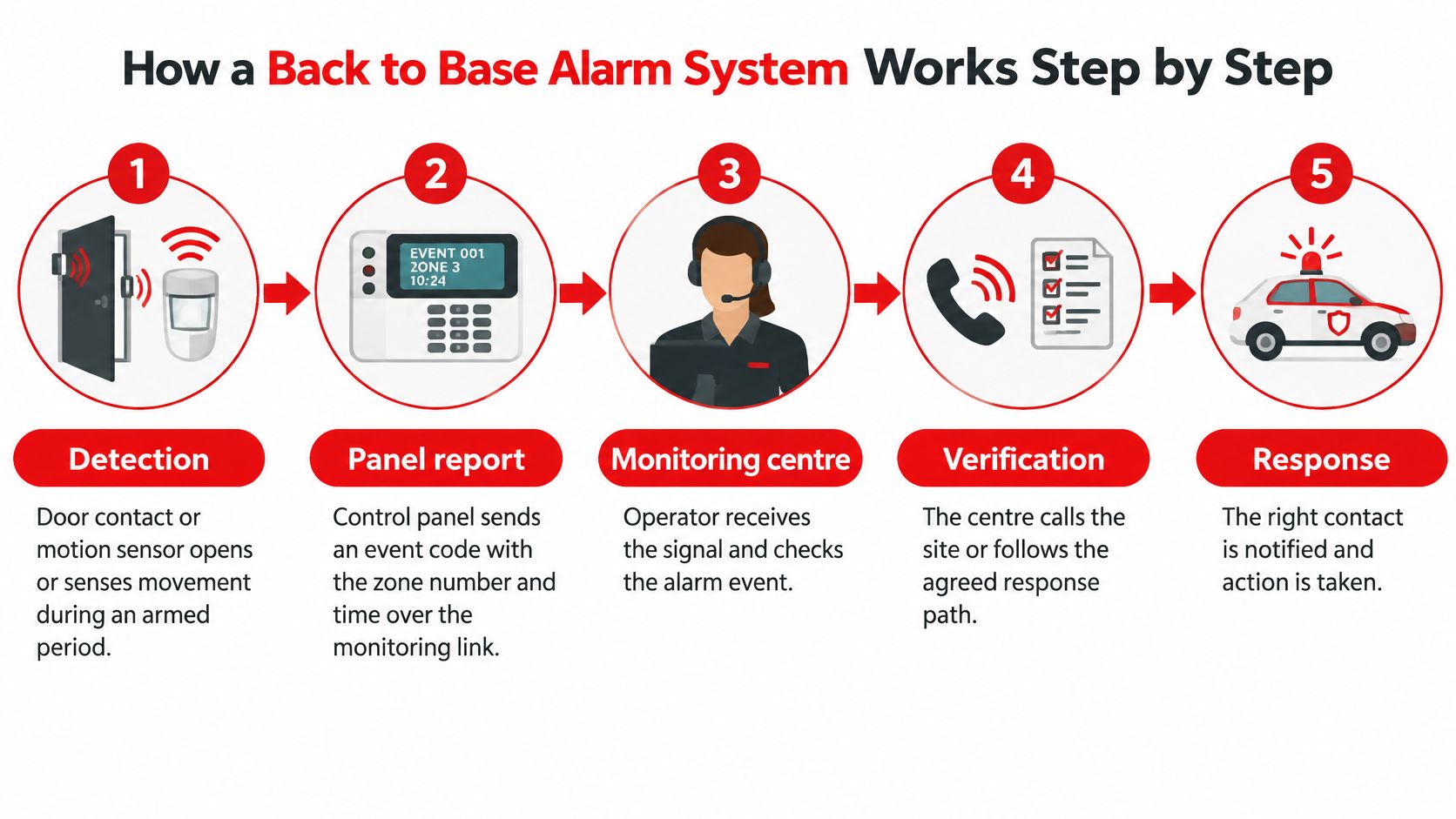

From activation to a recorded outcome
Detection. A door contact changes state or a motion detector senses movement while its area is armed. The zone description should identify a real location, such as the loading-dock pedestrian door, rather than an unexplained detector label.
Panel report. The control panel sends the relevant event code and zone information through the configured communicator. Event records should retain usable timestamps so the activation can be reconstructed later.
Monitoring-centre receipt. The centre logs the report and checks relevant status information, including opening schedules where configured. An unexpected opening needs different handling from an authorised employee arriving for work.
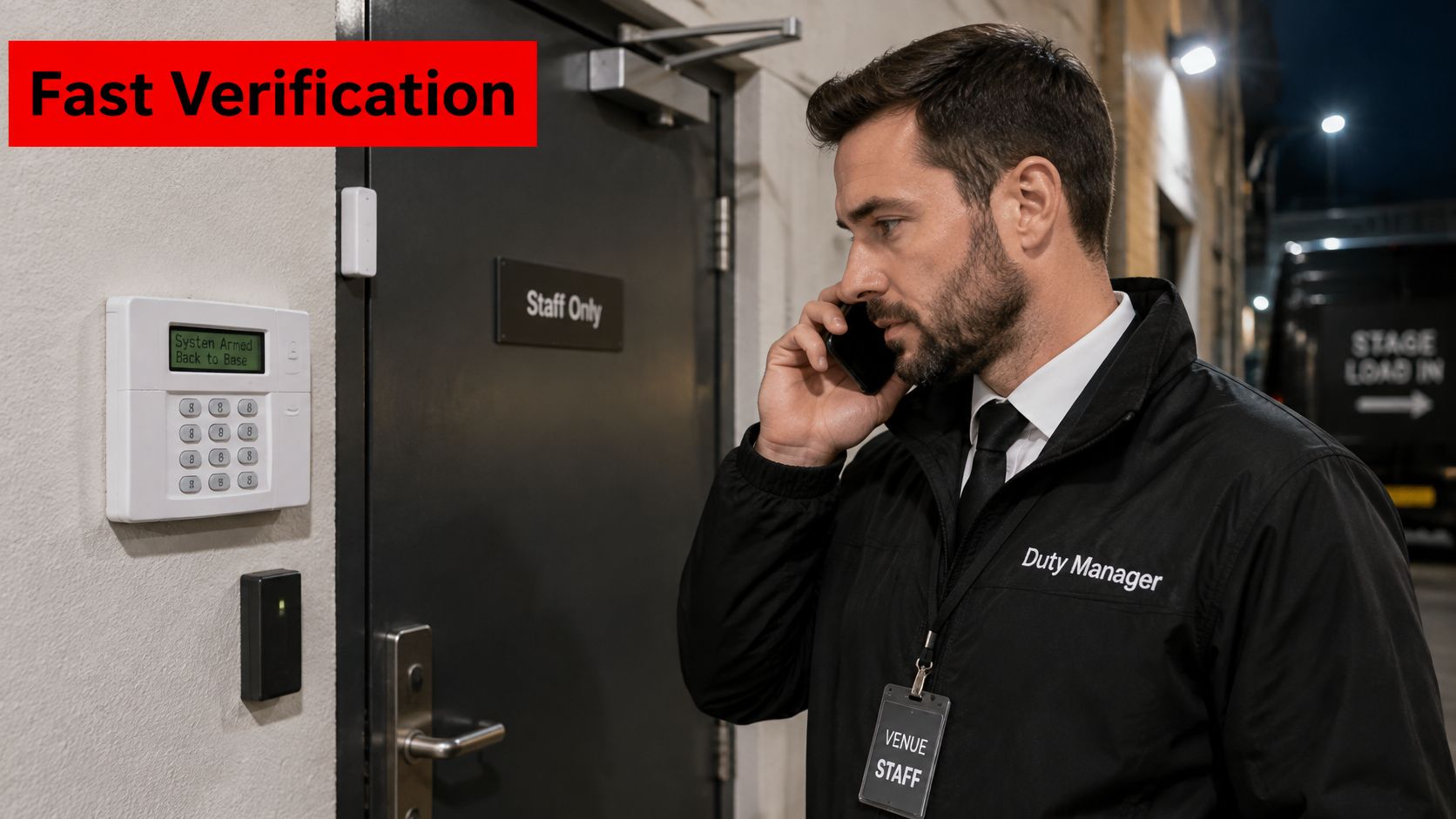
Verification. The operator may telephone the premises or a keyholder, or review authorised video or audio where that capability is installed and agreed. Verification helps distinguish an incident from an employee entering through the wrong door.
Escalation. The operator follows the site's contact order and response instructions. A keyholder, contracted patrol or emergency service may be contacted, but the procedure must say what happens when the initial contact doesn't answer.
Closure. The operator records the reported cause, actions taken and unresolved faults. Don't close a recurring activation as user error without assigning someone to investigate why it keeps happening.
Say a retail shop arms its back to base alarm system after closing. A rear-door activation reaches the centre while nobody's onsite, but the operator still needs to know whether a cleaner has authorised access and whether a patrol has been arranged.
Keep different emergency functions distinct
A manual call point is another input with a different purpose. Neasden Hardware's emergency call point for property managers is a useful product reference when discussing manual emergency hardware, but it shouldn't be assumed compatible with an intrusion panel or Australian site requirements.
Before go-live, confirm how activations are verified, who gets called first and what happens if nobody answers. Test the actual response instructions, not just whether the keypad beeps.
Costly Mistakes That Trigger Fees and Failed Alarms
A monitored alarm works like a conveyor belt. Detection, signalling, verification and escalation have to move in order, and a fault at the premises stops the whole line even when the centre is staffed and ready. A Perth survey of 451 domestic and commercial intruder-alarm systems found 17.52% of control panels outside the alarmed area, 14.86% at the entry or exit point, 45.90% without dual end-of-line supervision and 58.75% with only single end-of-line supervision.
Those figures describe older installations. They still show why panel position and circuit supervision need checking before monitoring starts. A panel an intruder can reach first, or a cable fault the panel cannot see, leaves the operator with nothing to respond to.
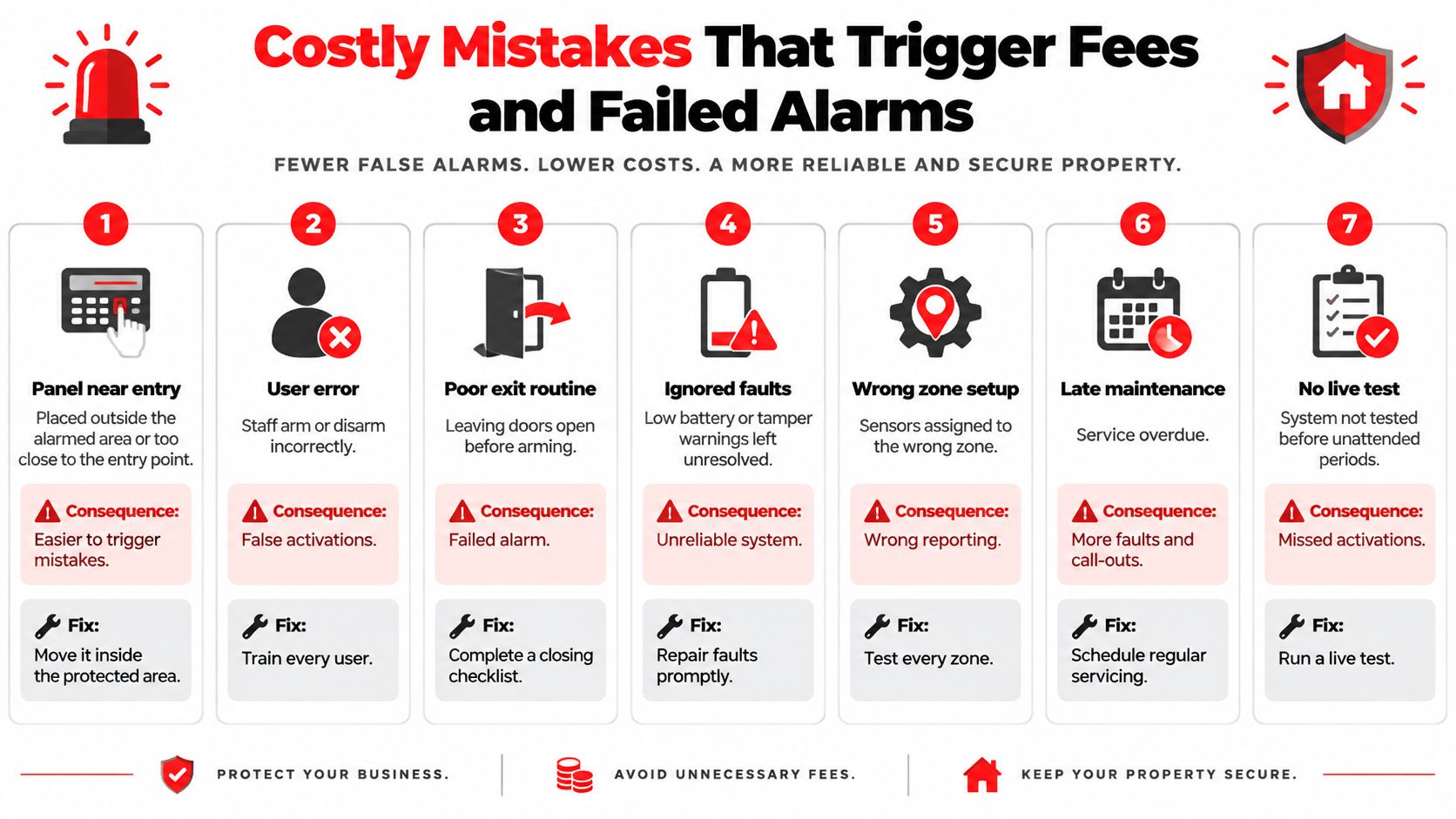
Seven avoidable mistakes
Leaving the panel exposed. Access to critical equipment before protected-area detection occurs defeats the purpose of the system. Ask the installer to assess the location and keep it inside appropriate protection, rather than choosing the spot by keypad convenience.
Skipping verification. Passing every activation straight to a keyholder or patrol creates avoidable callouts. Agree which events need immediate action and which can be checked safely before dispatch.
Ignoring a carrier change. An old communicator can stop reporting after a telecommunications migration while the panel still looks healthy. Include a received alarm and fault test in the handover.
Relying on a single communications path. One failed connection can prevent the centre receiving an activation. Specify suitable backup signalling and confirm the remaining path carries events when the primary drops.
Keeping stale keyholder details. Escalation stalls when the roster names someone who left or cannot attend. Give one role clear responsibility for updating names, availability and access authority.
Forgetting contractors. Fit-out crews and cleaners trigger armed areas during legitimate work. Notify the centre of authorised work and use controlled temporary access instead of sharing permanent codes.
Skipping checks after building work. Moved partitions, damaged contacts and unresolved battery warnings weaken detection. Walk-test affected zones, inspect doors and rectify faults before the premises sits unattended.
False-alarm charges for monitored premises
These charges belong to emergency services in specific circumstances. They sit outside the monthly monitoring fee.
| Situation | When it applies | Amount | Who is charged |
|---|---|---|---|
| NSW police false alarm | More than one police response within 28 days from the same security device at a non-dwelling; each response after the first may be charged | Amount set by regulation under the NSW Police Act charging framework | Building owner; the alarm is treated as false unless the owner establishes otherwise |
| Victoria fire false alarm | Preventable false alarm attended by Fire Rescue Victoria; maintenance beyond minimum Australian Standard requirements may be needed | Fire Rescue Victoria publishes a 2026–27 rate of $675 per truck per 15 minutes | The business |
Check the current rate and charging conditions when you review an incident. Keep evidence of genuine activations, including photographs, access records and the monitoring-centre log. A low connection price saves nothing when weak zoning, poor maintenance and vague instructions produce repeat callouts.
Monitoring Models Compared for Venues and Events
| Monitoring model | What happens after activation | Best fit | Main trade-off |
|---|---|---|---|
| Unverified escalation | Centre calls the keyholder immediately | Low-risk sites with few keyholders | Greatest exposure to unnecessary calls when no verification filters events |
| Phone or audio verification | Centre checks with the premises or uses agreed audio verification before escalating | Licensed venues with staff onsite during trading | Staff must answer, or the alternative escalation must take over |
| Video verification | Centre reviews available camera clips before escalating | Retail and offices with existing cameras | Privacy, access and retention controls need attention |
| Guard or mobile patrol dispatch | An officer attends and inspects the site | Festivals, construction sites and last-person-out periods | Attendance arrangements and patrol costs |
| Emergency-service notification | Centre notifies police or fire services of appropriately assessed events | Sites with high-risk assets or occupants | Emergency-service assessment and false-activation charging rules |
A monitoring model describes the agreed action after receipt, not the make of the alarm panel. A back to base alarm system can use different models for different zones or operating periods.
Choose the response for the operating conditions
Unverified escalation suits a straightforward site where an available keyholder can assess the report without an unnecessary verification stage. It's less useful if that person is routinely asleep, out of coverage or unable to attend.
Phone or audio verification can suit a trading venue because an authorised employee may quickly explain an activation. Establish an authentication procedure so an operator doesn't accept reassurance from an unidentified person.
Video verification can help an operator distinguish an unauthorised entry from a harmless activation where cameras have a useful view. A camera facing the wrong direction, obscured by temporary stock or unavailable to the centre adds little.
Patrol dispatch suits an unattended compound or event site when someone needs to inspect the location. Document gate access, hazards, inspection limits and who authorises further action.
Emergency-service notification suits circumstances requiring an emergency response, but isn't a promise that an external agency will attend within a nominated period. Keep intrusion, fire and personal-safety instructions distinct.
Test the plan against a changing event site
During festival bump-out, the same gate might serve cleaners, production crews and plant operators. Give the centre current zone names and authorised access information, and identify when the final contractor hands control back to security.
For teams coordinating contractor duties and escalation ownership, Opus Safety's outsourced health and safety service offers a useful reference for discussing external safety support. It doesn't replace the site's Australian legal obligations or a locally suitable emergency plan.
Ask what verified action should have occurred after five, fifteen and thirty minutes in a tabletop exercise. Treat those as planning checkpoints, not promised attendance times.
Write down whether each checkpoint means a completed call, reviewed footage, requested patrol or confirmed attendance. Match the model to the consequences of a missed event and the cost of a false one, rather than applying the most expensive response everywhere.
Benefits of a Back to Base Alarm System for Venues
The benefit becomes clearer when you follow an activation through to its outcome. These are hypothetical operating scenarios, not promised response times.
Late-night bar close with an avoided patrol call
Say a back-door contact activates at 2 a.m. after a bar closes. The monitoring operator calls the authorised duty manager, who confirms a scheduled delivery and checks that the door is secured again.
The named outcome is verified authorised access. The venue avoids requesting a patrol unnecessarily, while the manager still has to correct any closing or delivery instruction that caused the confusion.
Festival bump-out with a documented inspection
After gates close during bump-out, a suitably protected storage tent remains armed while crews work elsewhere. An activation prompts the contracted patrol to inspect within the agreed service arrangement and record what they find.
The outcome is a documented site inspection, not merely a notification on an organiser's phone. Clear boundaries matter because nearby authorised activity shouldn't automatically disarm equipment storage.
Unattended construction plant with an incident record
Before the next morning's start, a vibration detector on protected plant reports an activation. The centre follows the compound's instructions, contacts the authorised site manager and retains the event timestamp and actions taken.
The outcome is a traceable escalation. The record may assist an insurer or incident reviewer, although it doesn't prove theft, damage or policy coverage by itself.
Together, these scenarios show what a well-configured back to base alarm system can provide:
- Detection during absence: Activity can reach a staffed centre when site employees aren't present.
- A recorded response: Operators can document the event, contacts and reported outcome.
- Less reliance on informal checks: A defined process replaces hoping someone notices a message.
- Evidence for review: Logs can support investigations and help identify recurring causes.
These benefits depend on maintained equipment, accurate zoning and achievable instructions. Write the first action for each zone in plain language so the operator doesn't have to interpret a generic instruction during an activation.
Choose a Back to Base Alarm System Provider
Run a provider check before signing, and repeat the relevant acceptance tests when the building, network or operating arrangements change. At GM GROUP Services, we work closely with clients to understand their sites, customers and security requirements, so site instructions should reflect how the premises operate.
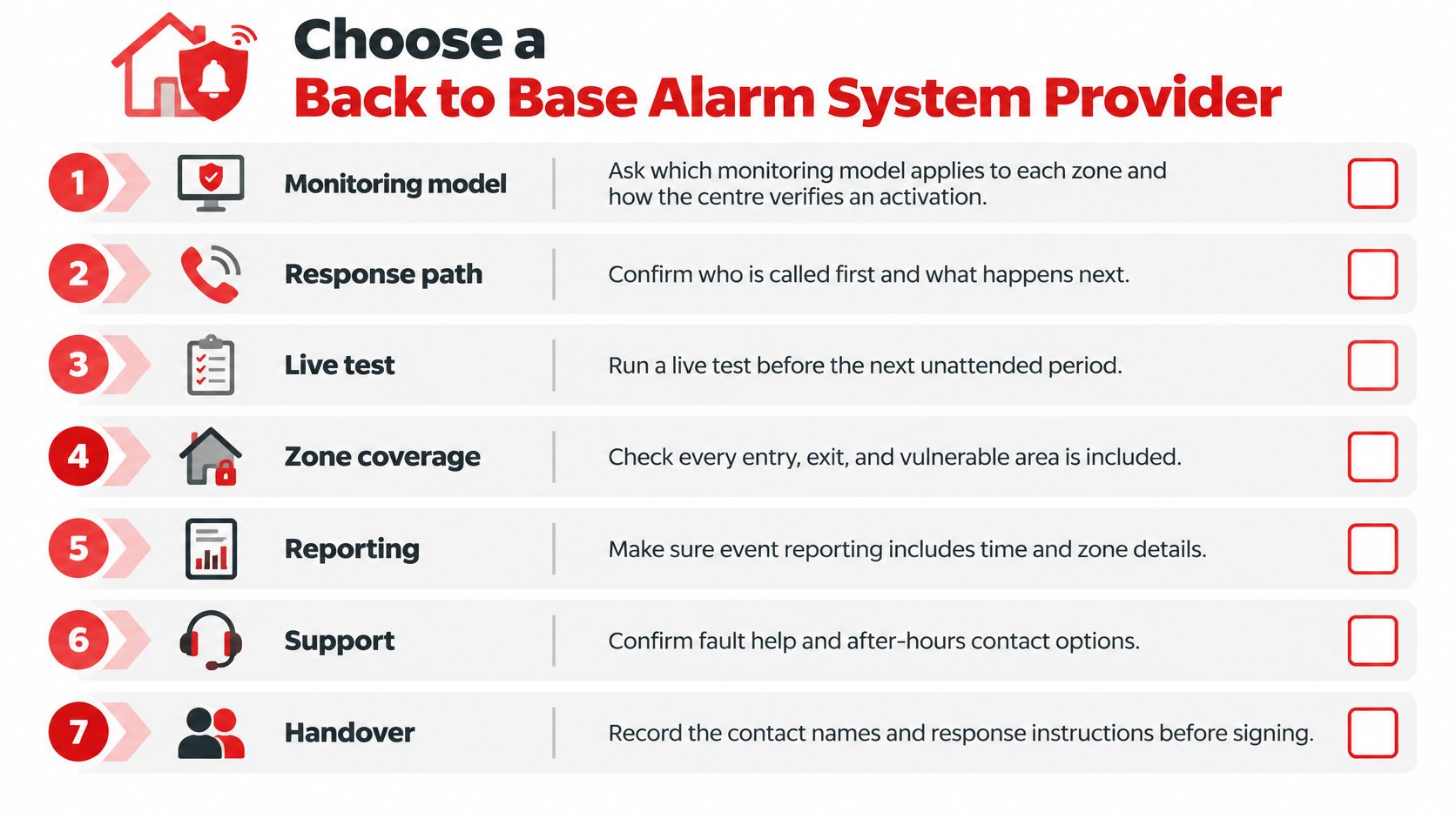
Provider acceptance checklist
Document the monitoring model. Identify the response for each protected area, including verification permissions and different trading or unattended arrangements. Keep zone descriptions consistent across the panel, site plan and response instructions.
Set the call order. Record the initial contact, the fallback when that person doesn't answer and any contracted patrol arrangement. Include safe access instructions without distributing unnecessary credentials.
Check telecommunications compatibility. ACMA's NBN consumer-information standard%20Industry%20Standard%202018.docx) requires telecommunications providers to warn that monitored alarms may be incompatible with an NBN service and that customers should check compatibility with their alarm provider. After a carrier change, confirm receipt of both alarm and fault signals.
Separate panel power from network power. Treat FTTN, FTTB and FTTC connections as unavailable during mains failure unless an appropriate independent alternative maintains signalling. A working panel battery doesn't establish that the modem, network connection or communicator can still deliver an alarm; specify a separately powered secondary path where continuity is required.
Witness failure tests. With the installer and centre coordinating the test, simulate NBN equipment power loss, modem restart, internet connection failure and mobile failover. Save the centre's timestamps, restore normal operation and resolve faults before accepting the installation.
Verify credentials and support. GM Group is a Security Master Licence Holder in NSW and a member of the Australian Security Industry Association Limited. Our published security licence numbers are NSW 000105362, QLD 4824061, VIC Z63-250-905 and ACT 1750266; check current status with the relevant regulator and record after-hours fault contacts.
Control access to verification material. Set who may view clips, how long they're kept and how authorised exports occur. Don't give contractors standing access merely because they need temporary entry to the building.
Make the handover usable
If access control is part of the project, the GoAccess company comparison offers a separate reference for comparing features, pricing and support. Keep those purchasing questions distinct from the alarm centre's response obligations.
Acceptance rule: A successful installation test proves receipt, interpretation and the agreed next action, not just detector operation.
This week, arrange a controlled sensor test with the centre, update keyholders and authorised cleaners or contractors, and file the result. If your tabletop exercise still leaves the first verified action unclear after fifteen minutes, revise the response model before the next close.
Back to Base Alarm System Questions
Is it only a siren with a phone line?
No. A back to base alarm system is an operational connection between premises, monitoring staff and responders. The Edith Cowan University study of police-attended Perth alarm activations in 1989 examined activation patterns and causes, illustrating why the attended outcome matters alongside the signal itself.
Which standard covers the transmission path?
AS/NZS 2201.5:2008 sets general requirements for alarm transmission over dedicated paths, switched networks, digital networks and wireless systems. Select communications based on the site's threat, network availability and failure modes, with suitable fault reporting and effective alternative signalling where required.
What changes for temporary sites?
Temporary layouts need temporary instructions. Before bump-in, fit-out or compound relocation, update zone names, authorised work areas and last-person-out responsibilities, then remove obsolete access permissions when the work finishes.
How do cameras and audio affect privacy?
The Department of Home Affairs describes electronic-surveillance regulation as balancing security, privacy rights and oversight. For alarm verification, minimise what the centre can access, establish retention periods, use appropriate signage and check applicable recording laws before enabling audio.
What helps establish that an activation was genuine?
Keep the centre log with the time, zone, reported cause, contacts called and communications faults or failover. Preserve relevant footage, photographs and site observations as well, because a sensor activation alone doesn't establish what caused it.
GM GROUP Services offers back-to-base monitoring, vehicle patrols, emergency response and risk assessments for venues, events and business premises. Visit GM GROUP Services to request a quote, or call 1300 14 14 41 or 0499 020 304 for a confidential discussion about your zones, unattended periods and response requirements.