


Back to base alarm monitoring price in Australia is typically about $25–$60 a month for standard monitoring, excluding installation, communications and physical response. Choosing the cheapest monthly plan isn't necessarily the cheapest way to protect a venue or site.
The usual advice is to compare subscriptions. A more useful comparison starts with what happens when the alarm activates, whether the signal can leave the premises, and who pays when someone attends.
For a venue manager, construction supervisor or event organiser, those details determine whether you're buying a useful response arrangement or a service that rings your phone.
Back to Base Alarm Monitoring Price at a Glance
A low monthly fee can still lead to a higher bill. The subscription is only one line item; installation, communications and attendance charges may sit outside it. For standard monitoring, Castle Security's 2025 guide gives a range of $30–$60 a month, or $360–$720 a year.
| Cost item | Published range | What it usually covers | Left out |
|---|---|---|---|
| Standard monitoring | $30–$60 per month ($360–$720 a year) | Signal reception and escalation | Install, hardware, patrol fees |
| Three-year monitoring only | $1,080–$2,160 | The same monthly band over 36 months | Equipment and call-outs |
| Ten-year monitoring only | $3,600–$7,200 | Long-run subscription exposure | Hardware replacement |
| 24/7 professional monitoring | $30–$60 per month | Staffed monitoring centre | Full system hardware |
| Commercial monitoring | Service-dependent | Monitoring for a business site | Response attendance unless included |
| Basic residential monitoring | $30–$60 per month | Standard monitoring plan | Venue or site complexity |
| Full alarm system | $1,200–$3,000 | Panel, detectors and installation | Ongoing monitoring |
| Worked install plus monitor | About $2,100 install and $40 a month | One published installed example | Later call-out fees |
The same Castle Security guide lists $1,200–$3,000 for a full alarm system. Its example of about $2,100 upfront plus $40 a month shows how to combine setup and subscription costs. At $40 monthly, monitoring adds $480 a year, before any separately charged attendance.
These figures are planning ranges, not a quote for a particular property. Compare what each plan includes before judging its price: the signalling path, response arrangements and false-alarm exposure can change the total.
Separate the security and electrical work
Keep alarm monitoring and electrical work as separate quote lines. If a switchboard, power supply or circuit needs attention, ask who will do that work and whether it has a separate price. For electrical enquiries in Northern Utah, contact a licensed electrician in Northern Utah.
Ask each monitoring supplier to list:
- Monitoring fee: The recurring subscription and its inclusions.
- Contract length: The commitment and cancellation conditions.
- Connection or setup charge: The work needed to activate the account.
- Communications path: How signals reach the control room.
- Per-attendance response fee: What you pay if someone is dispatched.
How Back to Base Alarm Monitoring Price Works
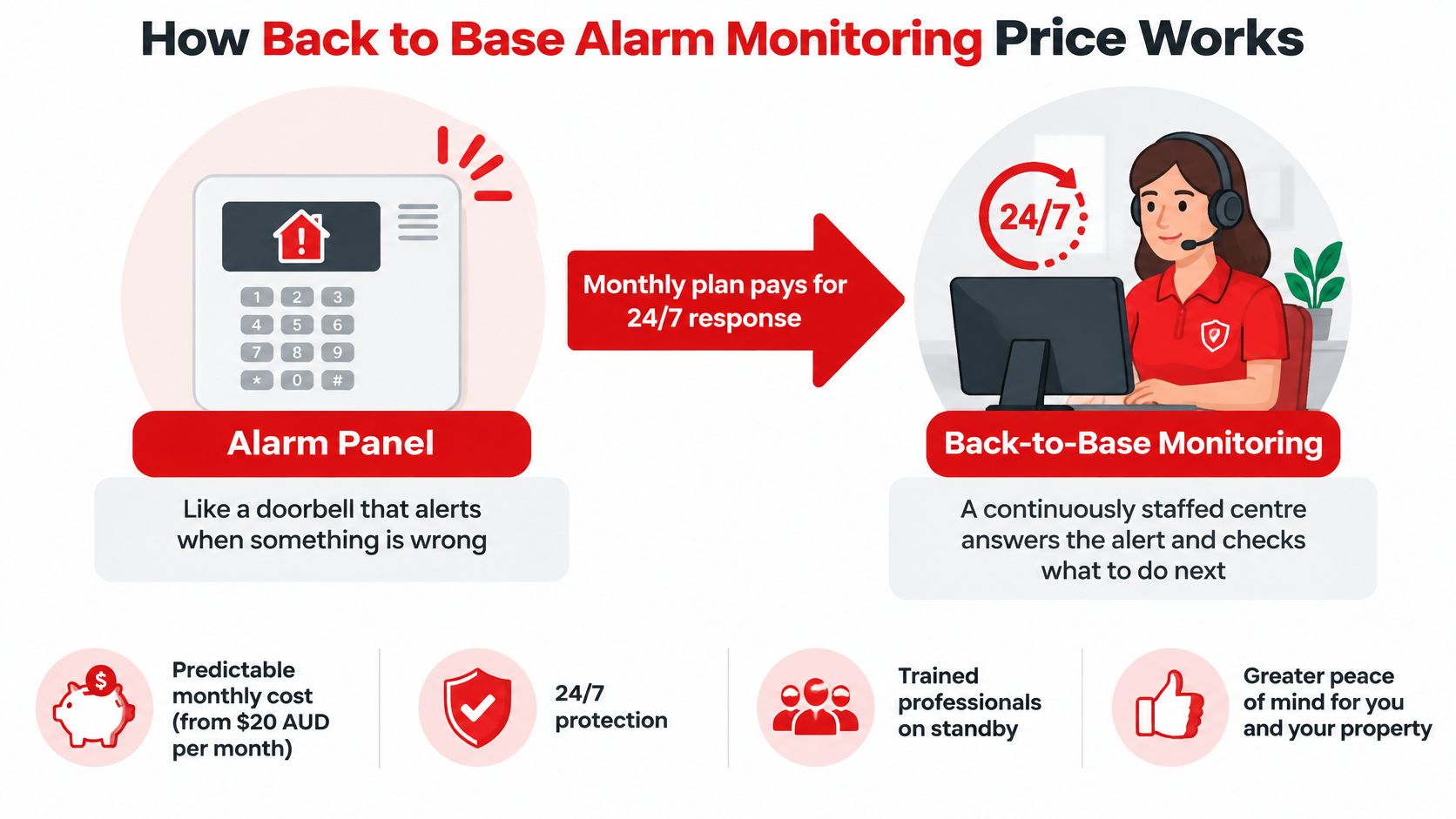
Think of the alarm panel as a doorbell and back-to-base monitoring as a staffed reception desk. The panel announces a problem. The monitoring centre receives the alert and checks the written instructions for the account.
The monthly plan pays for people to receive signals and follow that process. It doesn't, by itself, promise that a guard will arrive or that police will attend.

What the subscription buys
A monitoring operator typically contacts nominated keyholders and escalates according to the account instructions. That's different from an app notification, which might sit unread while a manager is supervising a bump-in, serving customers or asleep after closing.
Castle Security's alarm-cost guide describes setup examples of roughly $500–$1,200, monitoring of about $25–$70 a month, and an installed example pairing approximately $2,100 upfront with $40 monthly monitoring. Its comparison also shows that a $20 monthly saving is $240 annually, a saving that a separately charged technician visit, replacement communicator or patrol dispatch can eliminate.
The installed example in the price table is therefore not an all-inclusive protection package. It combines an upfront job with an ongoing service, while later work may still attract charges.
Standing service versus incident charges
Say a restaurant closes for the night and a rear-door detector activates. The operator receives the signal, reads the account instructions and calls the duty manager.
If the manager confirms an authorised cleaner is onsite, the operator can follow the agreed cancellation procedure. If nobody answers, the next action depends on the contracted escalation sequence.
The bill can contain different charging styles:
- Subscription: Payment for the standing monitoring service, whether or not an alarm occurs.
- Patrol attendance: A charge when a mobile officer is sent, unless attendance is explicitly included.
- Technical attendance: A separate visit to diagnose a detector, power or communications fault.
- Emergency-service charges: Potential liabilities under the relevant service and jurisdiction, not a routine subscription inclusion.
Don't assume setup includes new detectors, electrical repairs, battery replacement and every communications component. Ask the provider to describe the activation work and identify anything excluded.
The useful buying unit is the complete response system, not the subscription line alone.
What Drives Back to Base Alarm Monitoring Price for Venues and Sites
The panel brand doesn't tell you enough about the bill. The signalling path, and the equipment your site can keep powered, determine whether the control room can receive an alert.
DynData's published GST-inclusive rates list telephone-line monitoring at $6.95 weekly, IP at $7.95 weekly, and GPRS at $11.95 weekly, equivalent to $361.40, $413.40 and $621.40 annually; it also lists $450 installation for the GPRS unit.
Signalling paths and what they cost
| Signalling path | Weekly price (yearly) | Install cost | What stops it working |
|---|---|---|---|
| Phone line | $6.95 per week ($361.40 a year) | Obtain a panel and line-connection quote | Telephone line outage |
| IP over internet | $7.95 per week ($413.40 a year) | Obtain a panel and network-connection quote | Internet failure or site power cut |
| GPRS or cellular | $11.95 per week ($621.40 a year) | $450 for the communicator | No fixed line or internet needed; cellular coverage and equipment power still matter |
A phone-line offer is only useful if the quoted pathway is available and compatible with the premises. Don't approve it solely because it occupies the cheapest row.
IP monitoring can suit a stable venue with dependable internet and a properly supported power arrangement. But a router switched off during maintenance can interrupt the same connection the alarm needs.
Match communications to actual site conditions
A hotel with permanent infrastructure faces different practical constraints from a construction compound. At a festival, generator changeovers, temporary cabling and pack-down can affect equipment that worked during commissioning.
Cellular communications avoid reliance on the site's fixed internet, but cellular doesn't mean power-independent. The panel and communicator still need a suitable power supply and tested battery backup.
Security Wholesalers' monitoring-cost guide describes a GPRS option using two mobile networks. Ask whether a quoted dual-network arrangement also provides the pathway redundancy your site needs, rather than assuming those terms mean the same thing.
For an unattended yard, decide what must remain operational after the office network or temporary distribution board is shut down. Have the installer demonstrate the failure condition, not merely confirm normal operation.
Before approving the communications line item, ask:
- Included path: Which signalling method is in this price?
- Failure behaviour: What happens if internet or site power fails?
- Backup hardware: Are the communicator, battery backup, installation and testing separately charged?
Response Pathways That Change Back to Base Alarm Monitoring Price
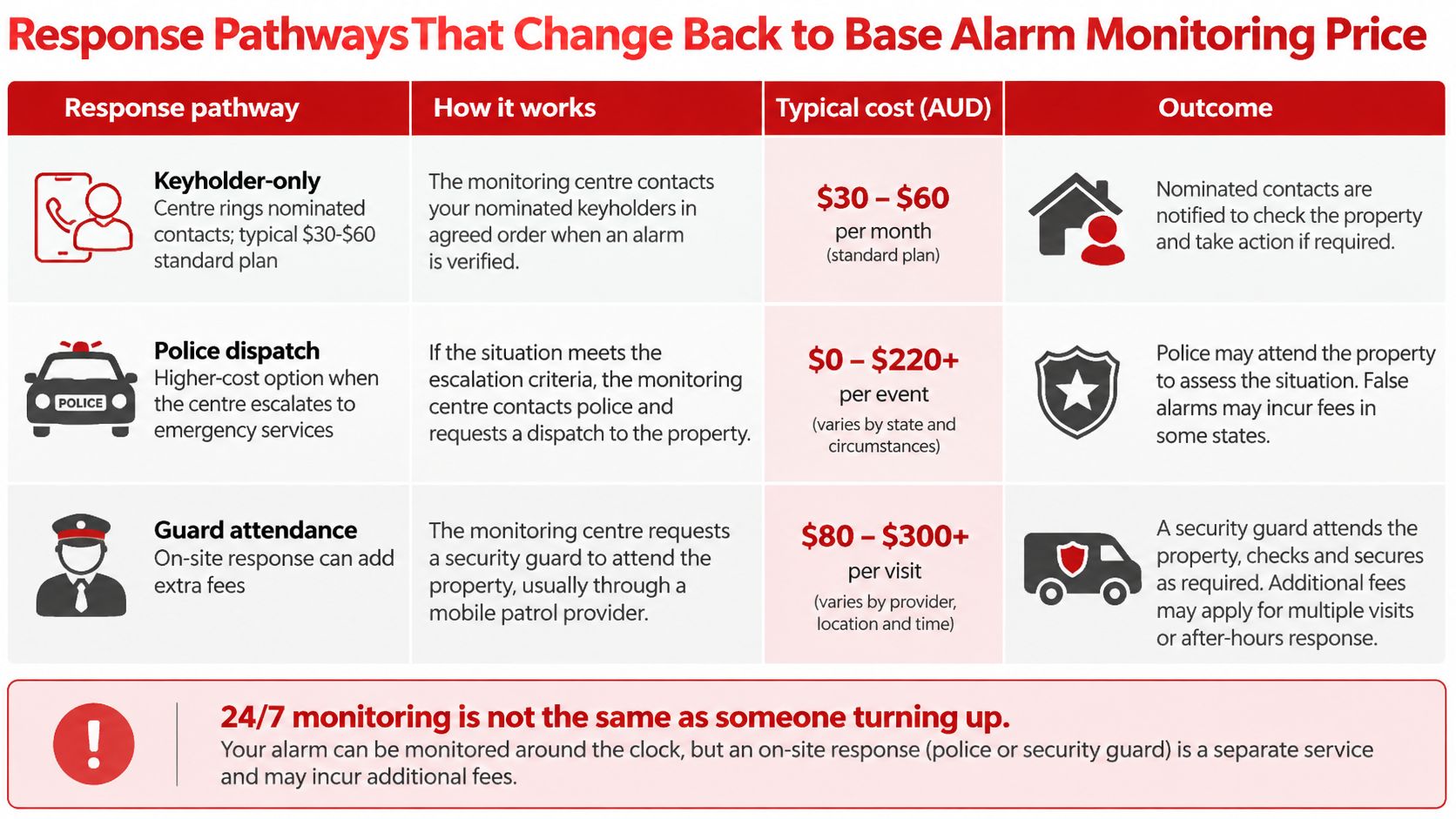
| Pathway | Typical price signal | What the centre does | Extra cost risk |
|---|---|---|---|
| Keyholder call only | Inside about $30–$60 a month | Rings nominated contacts and follows the account list | No patrol unless added |
| Verified police or fire request | Monitoring fee, not a dispatch guarantee | Escalates after the agreed checks | Possible emergency-service false-alarm invoice |
| Private patrol or guard | About $80–$130 a month for plans including response | Arranges a mobile officer under the contract | Per-incident attendance may still be extra |
| No physical action until verified | Can look cheapest | Holds physical escalation pending confirmation | Delay, with no guard unless contracted |
For the price signals in this comparison, Leadkit's Australian alarm-cost guide places standard residential monitoring around $30–$60 monthly and plans including patrol or guard response around $80–$130 monthly, with attendance fees potentially additional.
Continuous monitoring isn't the same as someone turning up. A control room can receive an alarm and complete its contracted duties without sending anyone to the property.
Ask what happens after the unanswered call
For keyholder-only monitoring, ask who is called first, how the contact order works, and what happens when nobody answers. Check whether an operator stops escalation once a nominated person accepts responsibility.
For verified emergency escalation, ask what evidence or checks are required before the operator requests attendance. A request isn't a guarantee of police or fire attendance, and the provider shouldn't describe it as one.
For private patrol, ask how dispatch works, what attendance assumptions apply, and which stage creates a charge. Clarify whether the officer checks the exterior, can access the building, or needs a keyholder to attend.
For verification-first arrangements, ask who can verify the alarm and what happens if that person can't be reached. An instruction to wait may be inappropriate for an isolated site with nobody available to confirm an intrusion.
Monitoring answers the signal; response is a separate purchase.
Buy a response that someone can actually deliver
Say a retailer's nominated manager lives well away from the store. A call-only plan may notify the right person without providing a practical way to inspect the premises safely.
A venue, construction compound or festival yard may reasonably pay more for a defined mobile response. The value lies in the agreed action when staff aren't available, not in a higher subscription.
For multi-site operators across NSW, Victoria, Queensland and the ACT, match each pathway to unattended hours, access arrangements and keyholder availability. Don't impose the cheapest account instructions on every location.
First-Year Back to Base Alarm Monitoring Price on Real Australian Sites
An existing panel can make a takeover look inexpensive, but activation changes the first-year total. Metwide's Sydney monitoring example lists $39.95 monthly including GST plus $300 activation, producing $779.40 in year one, $479.40 annually thereafter before extras, and an effective first-year rate of $64.95 monthly.
Worked first-year back to base alarm monitoring totals
| Example | Recurring | Once-off | First-year total | Later years |
|---|---|---|---|---|
| Takeover of an existing panel | $39.95 a month ($479.40 a year) | $300 activation | $779.40 | $479.40 a year before extras |
| Same plan, setup spread over year one | Effective $64.95 a month | $300 already included in the effective rate | $779.40 | $39.95 a month before extras |
| Low standard monitoring, three years | $25 a month | Not included | $300 monitoring only | $900 over three years |
| High standard monitoring, three years | $60 a month | Not included | $720 monitoring only | $2,160 over three years |
| Cellular path on a compound | $11.95 per week ($621.40 a year) | About $450 communicator | $1,071.40 before other charges | $621.40 a year before extras |
The standard and cellular rows apply the published bands and pathway rates to worked scenarios. They're not site-specific offers, and the cellular row shouldn't be added to another subscription without checking whether that would count monitoring twice.
What the activation work should achieve
For the existing-panel takeover, activation includes checking compatibility, programming the communicator to the site profile, conducting staged test alarms with the control room and completing go-live approval. You're paying to establish a working account, not merely to change the name receiving invoices.
A small venue comparing the low and high standard bands should keep installation and patrol outside its subscription calculation unless explicitly included. That makes the long-term commitment visible without pretending the monitoring fee covers everything.
A compound that can't rely on fixed internet needs a different calculation. Its communicator installation belongs in the first-year budget even when the recurring pathway charge looks affordable.

Use a consistent comparison method
- Annualise the subscription. Multiply the monthly fee by twelve.
- Add upfront work once. Include activation and any required communicator installation.
- Spread setup across the contract. Divide the upfront charge by the contract months.
- Allow for attendance. Use the quoted patrol rate and a stated planning assumption.
- Compare effective monthly costs. Keep exclusions visible beside the result.
For a short event, ask for a defined deployment and response package before accepting a long monitoring commitment. The appropriate purchase may be temporary protection with clear start, handover and finish arrangements.
False Alarm Charges and the Real Back to Base Alarm Monitoring Price
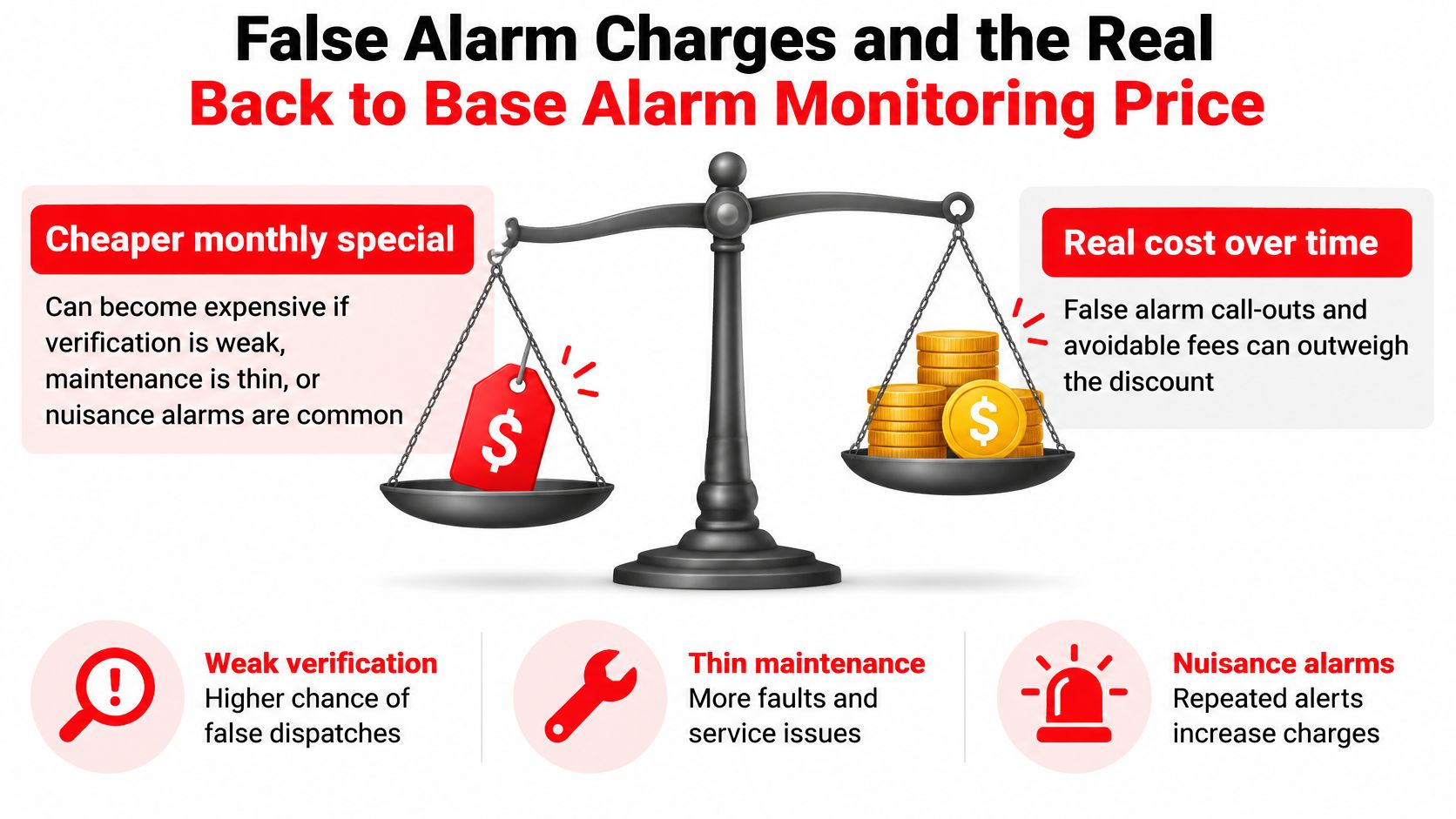
A low monthly fee can still lead to a higher annual bill if nuisance alarms trigger chargeable attendance or the plan excludes maintenance. The subscription is only one part of the cost.
Western Australia's DFES direct brigade alarm guidance lists $1,337 per false fire-alarm attendance for 2025–26. This is a fire-service charge, not a standard burglar-alarm monitoring fee. A brigade is not called for every security activation, and the charge should not be treated as an automatic penalty for every detector fault.
Control avoidable attendance without delaying real emergencies
False-alarm charging rules and exemptions vary. Check the current rules and the circumstances behind any invoice rather than assuming every attendance will be charged.
Never ask operators to delay a genuine fire response to avoid a charge. Instead, maintain equipment, investigate repeated nuisance activations and follow approved procedures for building works or testing.
For security alarms, review the activation log with the technician. A repeated event may point to a particular detector, closing procedure, access door or communications fault.
Other costs can sit outside the subscription:
- Patrol dispatch: Attendance billed separately.
- Maintenance: Labour, parts and travel excluded from the plan.
- Communicator failure: Replacement hardware and recommissioning.
- Passed-through invoices: Charges the provider does not absorb.
Contractual test: Will the provider absorb false-alarm or emergency-service charges, or will I receive the invoice?
Build the annual cost stack
Estimate the full bill with this formula: annual subscription + setup allocated across contract years + realistic attendance allowance + testing and maintenance + applicable false-alarm exposure.
Keep potential false-alarm charges separate from routine spending. They are a risk to understand and manage, not a bill every site will receive.
Ask who authorises chargeable attendance, how cancellations work and how disputed incidents are documented. A clear event log and written account instructions help you assess any resulting invoice.
Choosing a Back to Base Alarm Monitoring Plan That Holds Its Price
Start with an operational brief, not a request for the lowest subscription. A supplier can price a more useful service when you describe the premises, access restrictions and what staff can realistically do after closing.
Use this buying sequence:
- Record unattended hours and assets. Identify when staff leave and what requires protection.
- Choose the response pathway. Decide between keyholder calls, verified emergency escalation and contracted mobile attendance.
- Specify communications resilience. Describe what must keep working during an internet or power interruption.
- Demand separate line items. Request monitoring, activation, communicator, maintenance, contract term and attendance charges.
- Assign invoice responsibility. Establish who pays for false alarms and what verification precedes escalation.
- Allocate upfront costs. Spread once-off charges across the proposed commitment before comparing offers.
- Challenge long terms for short events. Request a temporary guard and response option where appropriate.
Check the specification before comparing totals
Make the suppliers quote against the same monitoring-centre grading, transmission method, response assumptions and nominated-contact requirements. Include verification, after-hours escalation, false-alarm handling, maintenance responsibilities and attendance charges.
Ask for an example activation sequence written against your own site. It should identify who receives the call, who can access the property and who can authorise additional expenditure.
Where monitoring needs to connect with licensed guards, patrols or event response, GM GROUP Services is one option across NSW, Victoria, Queensland and the ACT. Its services cover venues, festivals, hospitality, retail and construction environments, allowing the response arrangement to be discussed alongside onsite security needs.
Request monitoring-only and monitoring-plus-mobile-response options. Keep the proposal whose total cost of protection, exclusions and operational responsibilities are clear, not merely the one with the smallest advertised number.
Questions on Back to Base Alarm Monitoring Price
Will the monitoring company pay a false-alarm invoice?
Only if the contract says it will. Ask specifically about brigade charges, patrol cancellation fees and invoices passed through from another organisation.
Is monitored fire protection priced like a burglar alarm?
No. Queensland Fire's alarm contract schedule lists an annual alarm-management charge per connection of $2,954.82 before GST or $3,250.30 including GST, plus a connection charge of $429.58 before GST or $472.54 including GST. These are government fire-alarm service charges, not ordinary commercial burglar-alarm monitoring prices.
Does the monthly fee include police or a guard?
Not automatically. Emergency-service attendance is requested rather than purchased as a guaranteed dispatch, while private patrol attendance must be expressly included or separately priced.
How should several sites compare offers?
Use a common specification, but preserve each location's access and response needs. Compare installation, communications, maintenance and an agreed call-out scenario before deciding whether a small subscription difference matters.
GM GROUP Services offers back-to-base monitoring, vehicle patrols, and customized emergency-response planning for Australian venues, events, and business sites. Visit GM GROUP Services to discuss your unattended hours, communications needs, and response requirements, and request an itemised monitoring-only and mobile-response comparison.