


Aviation screening officer capability becomes relevant when your event has outgrown the limits of standard guard coverage. If you're organising a major festival, a corporate summit, a VIP launch, or a venue activation with tight entry control, you're probably balancing two pressures at once. You need a guest experience that feels organised and professional, and you need security controls that can withstand scrutiny if something goes wrong.
That's where many event plans fall short. A visible guard presence helps with access control, crowd guidance, and response. It doesn't automatically give you technical screening expertise. If your risk profile includes prohibited items, sensitive attendees, regulated environments, or heightened reputational exposure, you need people who can do more than observe and react.
An aviation screening officer brings a specialist layer to entry operations. The value isn't just the uniform or the checkpoint setup. It's the ability to use screening technology properly, apply consistent search protocols, and operate within a strict compliance framework. For Australian organisers and venue managers, that matters because weak screening isn't just a security issue. It's an operational and liability issue.
For search visibility, planning relevance, and practical decision-making, this guide focuses on the actual role of the aviation screening officer in Australian events and venues.
Introduction Why Standard Security Is No Longer Enough
You can run a well-staffed event and still leave a dangerous gap at the gate. That gap usually appears when organisers treat all front-line security roles as interchangeable.
At a busy venue entry point, a general security officer can check tickets, manage lines, and deter disorder. Those are important functions. But when the task shifts to identifying concealed prohibited items, interpreting scanner outputs, resolving alarms, and maintaining consistent checkpoint procedure under pressure, the skill set changes.
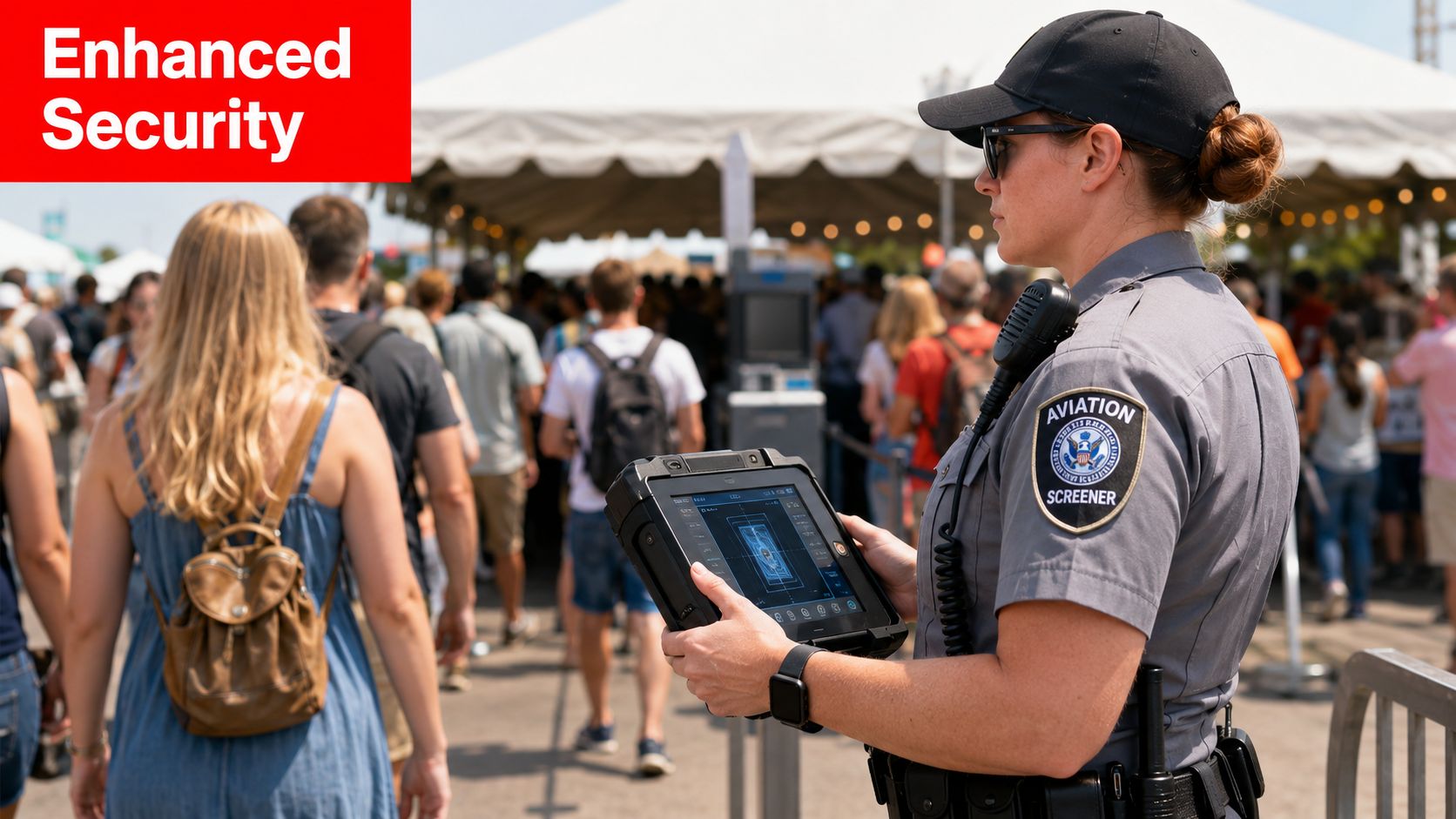

High-attendance events in Australia now face a more complicated operating environment. Patrons expect fast entry. Clients expect visible professionalism. Insurers, venue stakeholders, and public authorities expect sensible risk controls. If your entry plan relies only on bag checks performed at speed by staff without technical screening expertise, you may create the appearance of control without the substance of it.
Where the gap usually appears
The problem often sits in three places:
- Detection limits: Manual checks can miss items that screening equipment and trained interpretation are designed to detect.
- Inconsistent judgement: Different guards may make different decisions on the same item or alarm condition.
- Queue pressure: Once lines build, screening quality often drops unless the checkpoint is designed and staffed for throughput.
A useful companion read is Facility Management Insights on site safety, particularly if you're looking at screening as one part of a wider site-risk program rather than an isolated gate function.
Practical rule: If your event would suffer serious consequences from one prohibited item getting through, standard front-gate security alone probably isn't enough.
Why a specialist checkpoint changes the outcome
An aviation screening officer is trained for a technical detection role. That's the distinction organisers need to understand. You're not only adding another guard. You're introducing a controlled screening process built around equipment, procedure, and documented competence.
That changes how entry works. It also changes how the rest of your security plan should be built. Static guards still matter. Patrol units still matter. Supervisors still matter. But the checkpoint itself needs a different kind of operator if your aim is high-confidence screening rather than visual deterrence.
For venues hosting sensitive guests, high-profile speakers, restricted-access areas, or large public flows, that distinction is often what separates a credible security posture from a thin one.
Defining the Aviation Screening Officer Role
An aviation screening officer is a specialist screener trained to detect threats through structured screening procedures and advanced equipment use. That's different from the broader duties of a general security guard.
A general guard focuses on presence, patrols, access control, incident response, and behavioural observation. An aviation screening officer focuses on technical detection at a checkpoint. Their work centres on screening people and belongings, resolving alarms, and applying search procedures consistently.
Think specialist, not interchangeable labour
The simplest comparison is medical. A general practitioner and a radiologist both work in healthcare, but only one performs a highly specific diagnostic function using specialist tools. Security works the same way. A licensed guard may be excellent at de-escalation and perimeter control, but that doesn't mean they're the right person to operate an X-ray lane or body scanner checkpoint.
This matters for budgeting. Organisers sometimes assume they can rotate existing front-of-house security staff into screening duties. In lower-risk contexts, that may seem efficient. In higher-risk contexts, it creates a weak point because technical screening depends on trained judgement, not just a willingness to search bags.
What the role looks like in practice
An aviation screening officer typically works within a controlled process that includes:
| Function | General security guard | Aviation screening officer |
|---|---|---|
| Access control | Yes | Yes, within checkpoint flow |
| Crowd guidance | Yes | Yes, around screening lanes |
| Patrol and response | Yes | Usually limited or secondary |
| Technical screening equipment | Not the core role | Core role |
| Alarm resolution | Limited by site procedure | Central responsibility |
| Threat-item detection | Visual/manual only in many cases | Equipment-led and procedure-led |
The role originated in aviation, but the skill set has broader value anywhere the checkpoint itself is the security control that matters most.
For organisers who want a clearer sense of how tightly controlled airport environments are, this guide to airport airside management is useful context. It helps explain why aviation-derived screening roles are built around process discipline rather than improvisation.
The best screening officers don't just operate equipment. They maintain decision quality when the line is long, the crowd is impatient, and the pressure to wave people through is constant.
Why event organisers should care
If you're hiring for an event or venue, the main takeaway is straightforward. Don't write “screening” into a scope of works unless you're also defining who is qualified to perform it, what equipment they'll use, and how that checkpoint connects to the rest of your security operation.
That's the difference between a bag-check table and a true screening point. One is basic control. The other is specialist risk mitigation.
The Unmissable Guide to Australian Licensing and Certification
If you're engaging an aviation screening officer in Australia, compliance isn't an administrative detail. It's the core of the role.
As of 16 January 2022, every new aviation screening officer in Australia must hold the AVI20118 Certificate II in Transport Security Protection. For screeners employed on or after 1 July 2022, the Screener Accreditation Scheme requires a minimum of 40 hours of on-the-job training before accreditation testing, and all accredited screeners must complete at least 12 hours of Continuing Professional Development annually (Australian Aviation coverage of the national requirement).
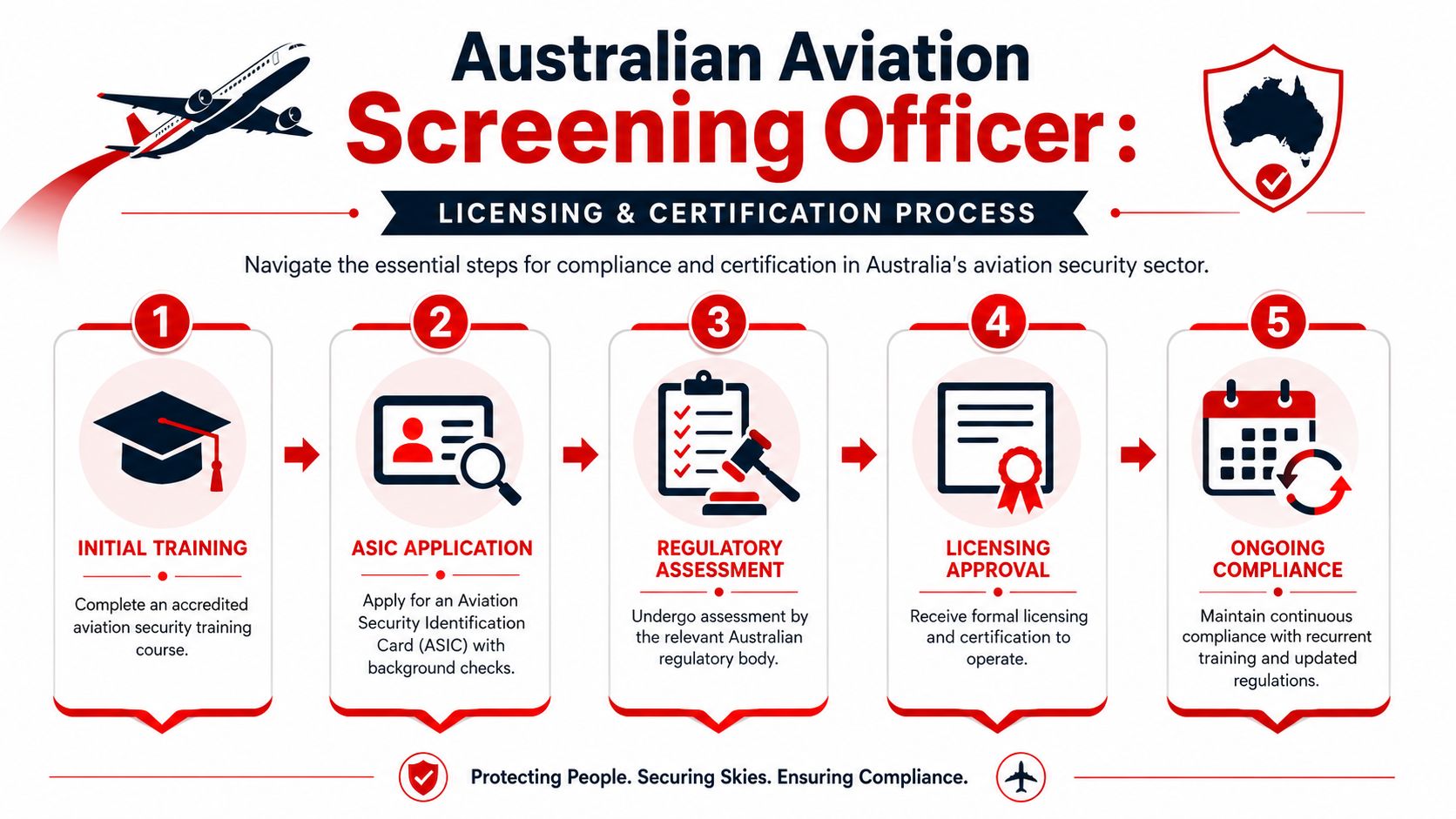
What organisers should verify before engagement
Don't accept vague assurances that staff are “trained up” or “airport experienced”. Ask for proof of current qualifications and role-specific compliance status.
Use this basic verification checklist:
- Certificate II status: Confirm the screener holds the required transport security qualification.
- On-the-job training evidence: For relevant hires, confirm the required training hours were completed before testing.
- Annual development record: Check that ongoing professional development is current.
- Function-specific competence: Confirm the person is authorised for the screening functions they'll perform on site.
- Record-keeping trail: Make sure your provider can produce documentation quickly if questioned.
Why documentation matters operationally
In practice, poor documentation creates two problems. First, it exposes the organiser if there's an incident and someone later asks who was authorised to perform screening. Second, it usually signals weak supervision behind the scenes.
The compliance burden isn't theoretical. The broader accreditation framework also requires annual accreditation testing for screening functions and powers, and the underlying records matter because failure to meet performance measures or record-keeping obligations can result in penalties of up to 100 penalty units for individual non-compliance, as outlined in the CISC screener accreditation scheme factsheet.
A compliant checkpoint is built twice. Once on the floor, and once in the paperwork.
What works and what doesn't
What works
- Pre-mobilisation credential audits: Review documents before rostering staff.
- Role matching: Assign only personnel whose accreditation aligns with the actual screening task.
- Supervisor sign-off: Have a responsible manager verify compliance before event day.
What doesn't
- Assuming aviation experience equals current accreditation
- Relying on verbal confirmation from labour-hire channels
- Checking documents after deployment has already started
For organisers, the trade-off is simple. Proper credential verification takes time upfront, but it prevents far more disruptive problems later. If a checkpoint is central to your risk plan, you can't afford to discover non-compliance after patrons are already in line.
A Look at Daily Duties and Screening Technology
A shift for an aviation screening officer starts before the first guest arrives. The team reviews the site layout, lane setup, escalation paths, prohibited item rules, and any patron-specific considerations such as VIP movement or sensitive access zones. Good screening operations begin with clarity, not guesswork.
Once the checkpoint opens, the work becomes repetitive in appearance but demanding in practice. The officer must maintain the same standard for the first guest and the hundredth guest. That means controlling queue flow, checking presentation, monitoring equipment output, and resolving issues without creating confusion at the lane.
The tools they use and what those tools require
The role is tied to equipment such as X-ray machines, body scanners, and explosive trace detectors. The equipment matters, but true value sits in the operator's judgement. A machine can produce an image or an alarm. The officer must interpret what that result means and decide the next lawful step.
That's why this role can't be reduced to “watching a screen”. It involves pattern recognition, concentration, procedure memory, and confidence under pressure.
Where identity checks and credential handling form part of a broader entry system, venue teams sometimes review tools such as an integrated document processing scanner to tighten front-end verification alongside screening operations. The key is integration. Technology only helps when staff know exactly where it fits in the workflow.
A typical checkpoint sequence
A well-run lane usually follows a clear rhythm:
- Guest presentation: The patron approaches the screening point and receives concise instructions.
- Property screening: Bags or personal effects move through the relevant screening process.
- Personal screening: The officer directs the person through the required lane or device.
- Alarm resolution: If an alert occurs, the officer follows procedure rather than improvising.
- Clearance or escalation: The person proceeds or is referred to the next control point.
All Australian aviation screening officers must hold an Aviation Security Identification Card, wear a recognisable uniform, and display their ASIC. If an officer selects a passenger for a body scan, the passenger can't opt out. Refusal means they won't be allowed through the screening point, as detailed in the industry profile for aviation ground operations.
The human factor organisers often underestimate
Most organisers focus on equipment specifications. Experienced operators focus on consistency. Fatigue, unclear SOPs, poor queue design, and conflicting instructions from event staff can all degrade screening quality even when the hardware is sound.
When checkpoint staff are forced to choose between speed and procedure, procedure usually loses unless the operation has been designed properly.
That's why the strongest event deployments treat screening as a whole system. The officer, the lane layout, the signage, the escalation path, and the supervisor all need to work together.
Five Essential Tips for Hiring an Aviation Screening Officer
Hiring an aviation screening officer is harder than many organisers expect. The candidate pool is narrower, the compliance burden is higher, and the wrong hire can weaken both safety and guest flow.
The recruitment barrier is real. For a new Australian aviation screening officer, the upfront cost is estimated at $1,817.20, with a 4–6 week licensing wait and an additional processing burden tied to the pathway. There's also a rigid three-chance testing policy, and a failed attempt can trigger a 12-month wait before re-application (Asset College overview of the pathway and barriers). That's one reason direct hiring often moves slower than organisers assume.
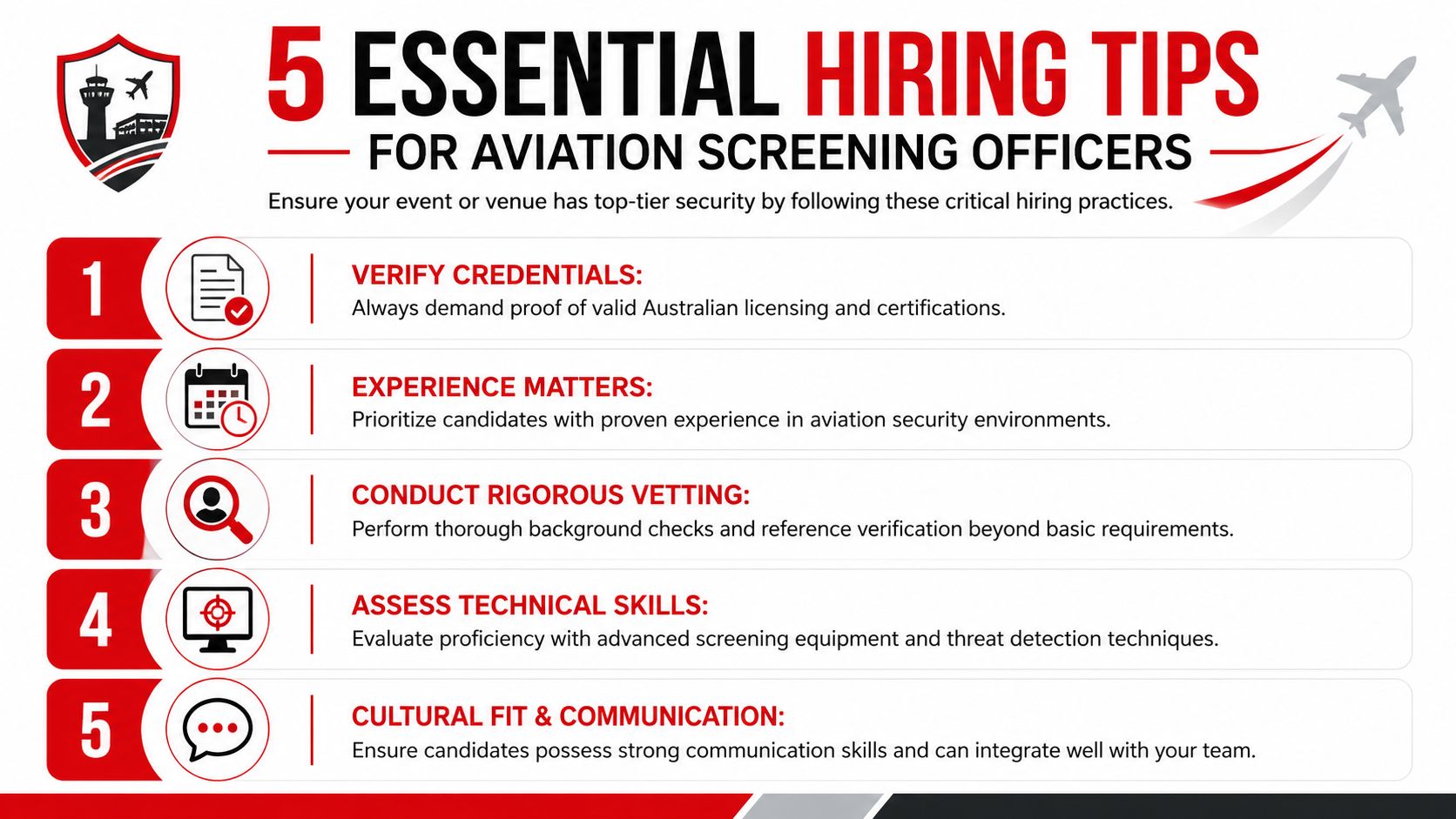
Tip one and tip two
Start with credentials, then move to context.
- Verify compliance before capability claims. Ask for documented proof of the qualification and current screening authority relevant to the role.
- Check event suitability, not just airport history. Someone can be competent in a fixed airport environment and still struggle in a temporary event setup where space, crowd behaviour, and stakeholder demands are less predictable.
Tip three
Ask how the candidate or provider reads your venue's risk profile.
A concert checkpoint, an exhibition hall, and a restricted corporate event don't present the same challenges. You want personnel who can explain how they would position screening, brief support staff, and handle exceptions without slowing the entire front gate.
Tip four and tip five
Communication skill often decides whether screening supports the guest experience or damages it.
- Look for calm, concise communicators. Every patron interaction affects flow. Officers need to give clear instructions without sounding confrontational or uncertain.
- Prefer providers that manage the full compliance lifecycle. Recruitment, credential tracking, refresher requirements, supervision, and replacement planning all matter. If you try to assemble this manually for a short lead-time event, you'll spend too much time chasing documents and not enough time designing the operation.
What works better than direct last-minute recruiting
A direct-hire approach can work for permanent operations with long planning cycles. It's far less efficient for organisers with fixed event dates, variable attendance, or shifting risk conditions. In those settings, specialist providers usually reduce administrative friction because they carry the burden of recruitment, compliance monitoring, scheduling depth, and supervision.
Hire for documented competence first, technical fit second, and manner third. If any of those are missing, the checkpoint will feel it.
The practical takeaway is simple. Don't recruit this role as if you're filling a generic security shift. You're staffing a specialist function with legal, operational, and reputational consequences.
Best Practices for Integrating Screening at Your Venue
Even the best aviation screening officer won't perform well inside a poorly designed entry operation. Integration is what turns a capable screener into a reliable checkpoint.
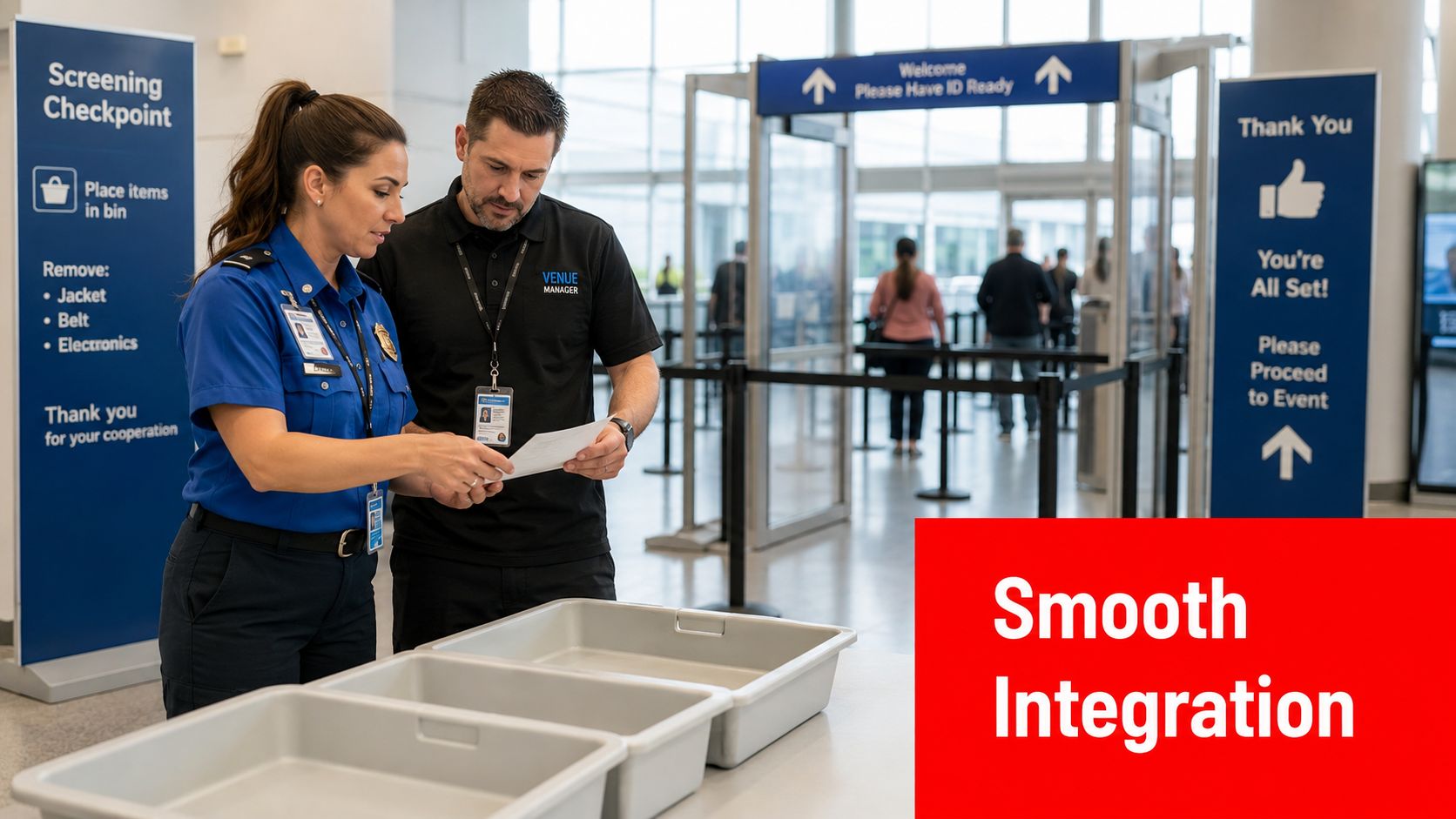
The first decision is location. Place screening far enough from the main entry to allow queue build-up without crushing circulation, but close enough that cleared patrons don't drift into uncontrolled space. At temporary events, this often means creating a layered approach: outer guidance, checkpoint control, then final access validation.
Build the lane around flow, not just control
A technically sound checkpoint can still fail if guests don't understand what to do. People need clear visual cues, simple instructions, and room to prepare their belongings before they reach the point of inspection.
A practical setup usually includes:
- Pre-queue messaging: Tell guests what to expect before they arrive at the lane.
- Preparation space: Give people room to organise bags, devices, and personal items.
- Secondary resolution area: Keep alarm resolution out of the main throughput path.
- Visible supervision: A checkpoint lead should manage exceptions so screening officers can stay focused.
Connect screening with the wider security plan
Screening should never operate in isolation. Static guards manage perimeter discipline. Event staff answer general guest questions. Supervisors handle exceptions and escalation. Response personnel remain available if a prohibited item or refusal triggers a broader incident.
That coordination needs to be rehearsed in briefings. If a screening officer identifies an issue, everyone around the lane should know who steps in, who records the incident, who communicates with the guest, and who protects flow for everyone else.
What seamless screening looks like
Guests move confidently because the process is obvious. Staff use consistent language. Bottlenecks are handled before they become crowding problems. Secondary checks happen discreetly. The checkpoint feels firm, not chaotic.
What doesn't work is a lane built as an afterthought. That usually produces mixed instructions, visible delays, frustrated patrons, and pressure on screening staff to cut corners.
For venue managers, the best result is a checkpoint that supports both safety and brand. Strong screening shouldn't feel theatrical. It should feel organised.
Frequently Asked Questions About Aviation Screening
Can an aviation screening officer screen guests with medical implants or medical devices
Yes, but the process needs care and consistency. Australian aviation screening officers use body scanners regulated by ARPANSA that do not emit ionising radiation. For people with medical implants, officers must follow strict protocols, and the individual should present supporting medical documentation so the most appropriate screening method can be selected, as outlined by the Department of Home Affairs guidance on airport security screening.
Is airport-style screening too rigid for an event environment
Not if it's adapted properly. The principle stays the same: detect prohibited items using trained personnel, equipment, and consistent process. What changes at an event is the surrounding operational design. The checkpoint must fit the venue layout, patron profile, and customer-service expectations.
Can an aviation screening officer also do general guarding duties
Sometimes, but it's usually a mistake to treat the role as a spare pair of hands. Screening is a specialist task that depends on focus and procedural consistency. If you keep pulling screening staff into unrelated duties, checkpoint quality tends to slip.
What should organisers ask before approving a screening deployment
Ask four things. Who is qualified to screen. What equipment is being used. How alarm resolution will be handled. How the screening point connects with the wider event security team. If those answers are vague, the deployment probably isn't ready.
Does a stronger checkpoint slow guests down
Poorly planned screening does. Well-designed screening improves control without unnecessary friction. The difference comes from layout, briefing quality, staffing mix, and clear pre-event communication.
For organisers who need dependable event and venue security across NSW, Victoria, Queensland and the ACT, GM GROUP Services can help design a practical security deployment that aligns screening, guarding, access control, and incident response into one coordinated plan.