



Asset protection strategies matter most when your operation is exposed in actual operations, not just on paper. If you run festivals, bars, clubs, retail sites, construction projects, or public venues, you're probably balancing risk every day: contractors on site, customers on premises, staff turnover, equipment moving in and out, and the constant possibility that one incident turns into a legal, financial, and reputational problem.
A lot of owners only look at asset protection after a scare. A patron falls. Tools disappear from a site. A subcontractor cuts corners. A crowd issue escalates. By then, your options are narrower. The strongest asset protection strategies are built early, layered properly, and matched to how your business operates.
What works in Australia is rarely a single product or a single legal structure. It's a combination of risk assessment, physical controls, reliable personnel, clean business structuring, disciplined contracting, and a response plan that holds up under pressure.
SEO Title: 7 Unbeatable Asset Protection Strategies for 2026
SEO Meta Description: Asset protection strategies for Australian events, venues, construction and retail. Learn practical legal, physical and operational steps to protect assets.
Suggested URL: /asset-protection-strategies-australia
Why Generic Asset Protection Strategies Fail in the Real World
A Perth venue operator can have the right company structure, public liability cover, and a solicitor-drafted set of documents, then still lose money fast when a contractor walks off site, a staff member props open a restricted door, or a ticketing outage creates a crowd control problem at the gate. That is how asset loss usually happens in event, hospitality, construction, and retail operations. It starts on the ground, under time pressure, with a breakdown in control.
Generic advice misses that point. It treats asset protection as a paperwork exercise, focused on entities, trusts, and insurance policies. Those tools matter, but they do not stop stock shrinkage in a busy bar, plant theft from a poorly controlled site, chargebacks after an event disruption, or a licensing issue triggered by poor incident handling. In Australian operating environments, exposure usually moves from physical failures to financial loss, then into regulatory or legal trouble.
The gap is even wider in businesses that rely on casual staff, multiple contractors, and public access. A retail group may have separate entities for each store but still leave itself exposed through weak key control, poor CCTV coverage, and inconsistent store opening procedures. A hospitality operator may protect one asset pool on paper while carrying phoenixing risk through sloppy director decisions, unpaid creditors, or intermingled operations across venues. I see this often. Owners spend on structure, then underinvest in supervision, access control, reporting discipline, and clean separation between trading risk and ownership risk.
Cyber and physical threats now overlap as well. A compromised access system, a payment outage, or interference with communications can quickly become a safety incident at a live event or high-traffic venue. That is one reason generic legal advice does not go far enough for operators managing crowds, contractors, cash handling, and public liability at the same time. For a practical view of local risk conditions, see Securitec Security for Perth threats.
Generic asset protection advice usually starts too late and stays too narrow.
Strong asset protection strategies are built around how the business runs. Who has access. What can be removed. Which failures create liability. Which incidents put licences, revenue, or reputation at risk. Once those questions are answered properly, the legal structure, insurance position, site controls, and security plan can work together instead of leaving gaps between them.
The Foundation: A Specific Risk Assessment
A proper asset protection plan starts on the ground, not in a boardroom template.
If you run a venue, retail chain, construction site, or live event, the first job is to identify what keeps the business trading safely and profitably. Owners often focus on obvious assets first. Cash, stock, vehicles, plant. In practice, the bigger exposure is often operational. A lost master key, a failed access control process, a suspended licence, a contractor breach, or a payment outage during peak trade can do more damage than a single theft.
Use this checklist as the starting point for a risk assessment that reflects how the site really operates.
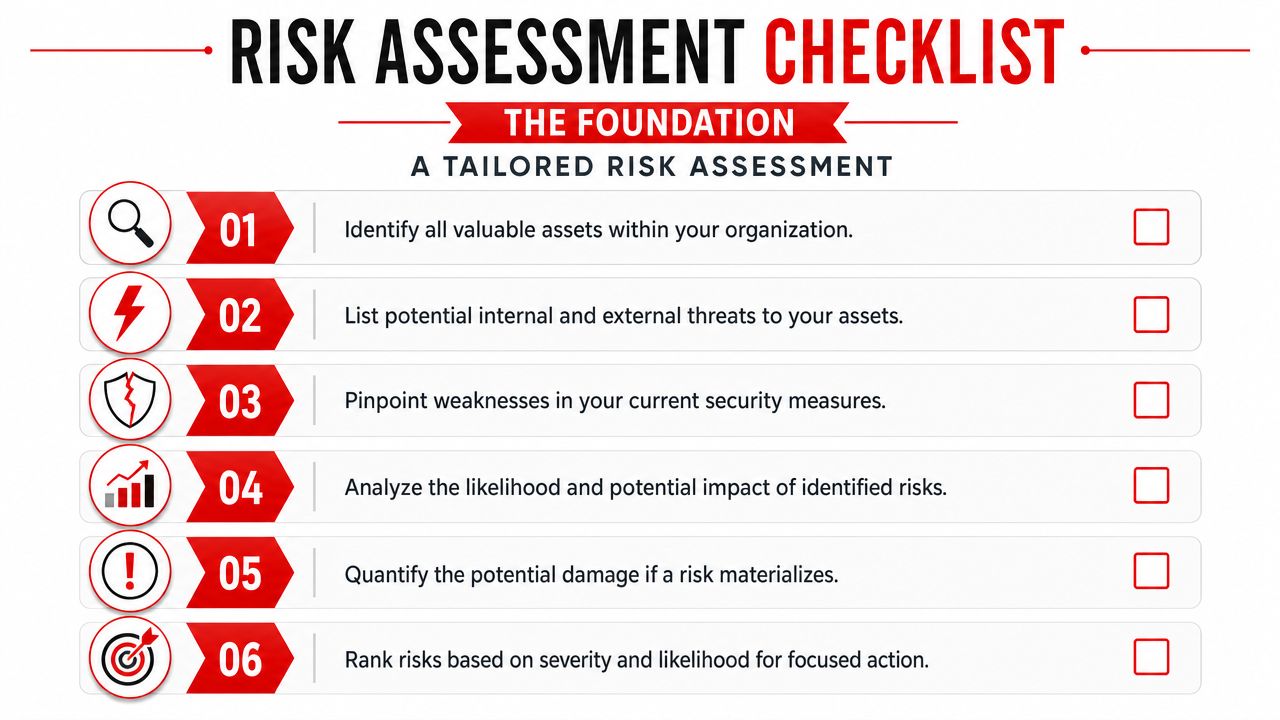

Start with the assets that drive operations
List assets in three groups, then test what happens if each one is lost, interrupted, misused, or exposed.
- Physical assets: tools, plant, staging, POS devices, liquor stock, fit-out, fencing, keys, radios, and vehicles
- Operational assets: licences, permits, booking systems, supplier access, roster continuity, alarm codes, and opening or closing procedures
- Intangible assets: reputation, customer confidence, commercial contracts, and trust from landlords, councils, or regulators
That distinction matters. A hospitality group may be insured for stolen stock but still be badly exposed if poor director practices create phoenixing risk across venues. An event operator may secure fencing and entry points but still lose control of the site if communications fail or contractor access is poorly managed. In Australian high-footfall settings, physical and financial exposure usually sit in the same incident chain.
Rank threats by likelihood and consequence
A long risk list is not enough. Prioritisation decides where money and supervision go.
For each risk, ask two questions. How likely is it? What is the business impact if it happens? Measure impact in practical terms. Can it stop trade, cause injury, trigger a claim, affect a licence, expose directors, or damage relationships with clients and regulators?
A simple four-part ranking works well:
High likelihood, high impact
Act on these first. Examples include uncontrolled contractor access, poor intoxication management, weak key control, missing incident records, or gaps in crowd entry procedures.High likelihood, lower impact
Fix these through tighter process and supervision. Repeated stock loss, delivery discrepancies, and casual access rule breaches usually sit here.Low likelihood, high impact
Build contingency plans for these. A serious crowd incident, major systems outage, or coordinated theft falls into this category.Low likelihood, lower impact
Monitor these and review them regularly, but do not let them consume the budget meant for top-tier risks.
If an issue can stop trading or put the business into a legal or regulatory fight, it belongs near the top of the list.
Assess the environment, not just the industry
Two sites in the same sector can need very different controls. A suburban bottle shop, a CBD fashion retailer, a late-night bar, and a regional construction compound all face different combinations of theft, aggression, access abuse, and after-hours intrusion.
Location, trading hours, crowd behaviour, contractor traffic, nearby transport links, cash handling, and existing site design all change the risk profile. Live events add another layer because cyber and physical failures can overlap quickly. A compromised credential system, radio interference, or payment outage can become a crowd management problem within minutes.
If you want a practical example of how local conditions change security planning, Securitec Security for Perth threats offers a useful reference point.
Build a risk register that leads to action
A useful assessment does more than describe problems. It assigns ownership and deadlines.
For each risk, record the asset, the threat, the current weakness, the likely consequence, the person responsible for the fix, and the required completion date. That gives managers something they can act on next week, not just discuss at the next quarterly review.
I look for one test. Can the duty manager, venue operator, or site supervisor read the register and know exactly what has to change before the next shift, delivery, or event day? If not, the assessment is still too generic.
Layering Your Defences Physical and Technical Controls
Buying one security measure and hoping it solves the problem is one of the most expensive mistakes I see. Effective asset protection strategies rely on layers. Consider a castle. The moat slows intruders. The walls restrict movement. The keep protects what matters most. Your site needs the same logic.
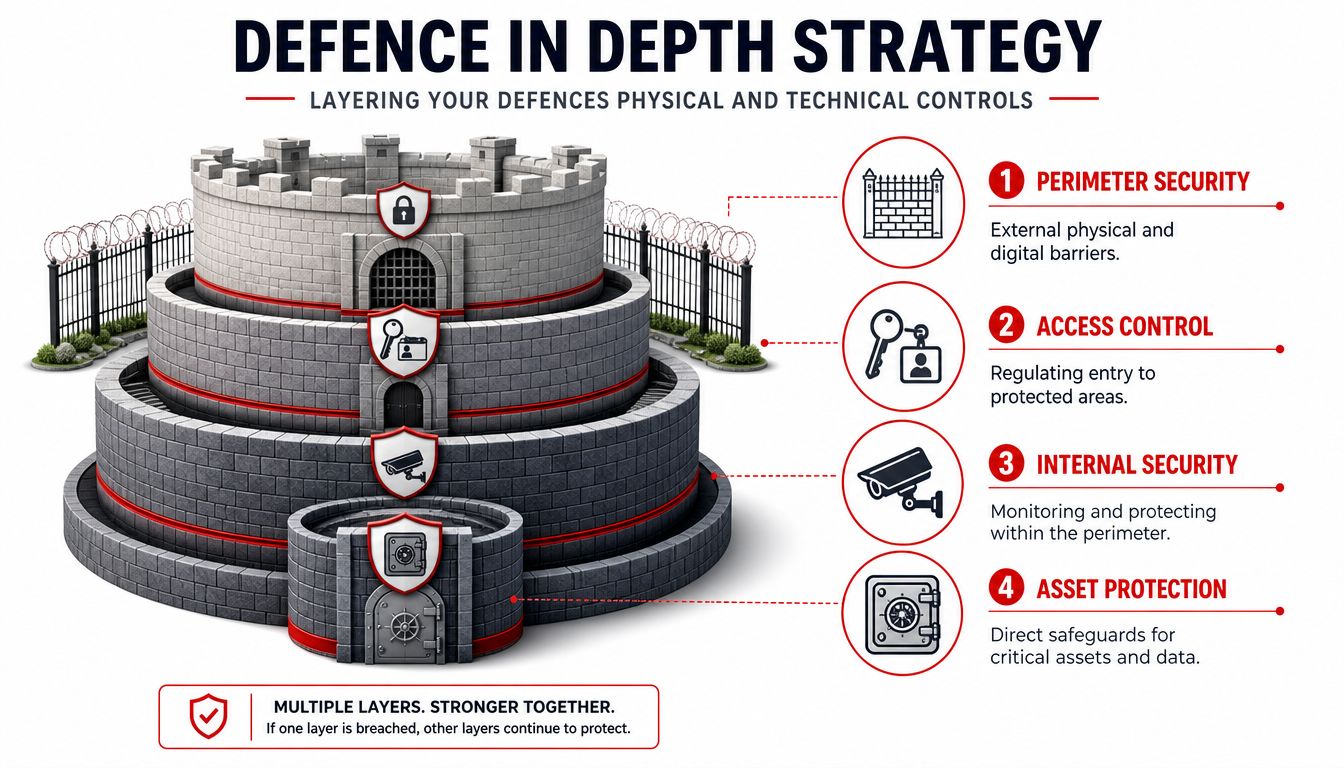

Perimeter first, then controlled access
The outer layer should deter and delay. On a construction site, that means fencing, gates, lighting, lockable compounds, and visible signage. In retail or hospitality, it may mean managed entry points, bollards, secure delivery access, and clearly separated public and staff zones.
The second layer controls who gets in and where they can go. That's where swipe access, coded doors, key registers, visitor logs, wristband control, and loading dock protocols matter. Weak access control turns every internal asset into an easy target.
If you operate from storage compounds, temporary event infrastructure, or container-based site storage, practical hardening measures matter. Quickfit's container security solutions offer a useful example of how physical barriers and lock protection reduce opportunistic entry points.
Internal monitoring closes the gap
Once someone is inside the perimeter, you need visibility. CCTV, alarms, duress points, sensor coverage, and back-to-base monitoring should support human decision-making, not replace it.
Here's where many businesses underperform. They install cameras with poor positioning, no review process, and no incident escalation protocol. That gives a false sense of control. Cameras don't protect assets by themselves. People, procedures, and response capability make the system work.
Use technical controls to answer practical questions:
- Can we detect unauthorised entry quickly?
- Can we verify what happened without relying on memory?
- Can staff escalate an issue without confusion?
- Can we isolate a problem area without shutting the whole operation down?
Insurance belongs in the same conversation
Structural and physical controls reduce exposure. Insurance helps absorb the financial impact when prevention isn't enough. It's a separate tool, but it belongs in the same planning cycle.
According to Everglow's overview of business asset protection measures, insurance remains a key part of asset protection beyond structural tools, including professional indemnity, public liability, directors' and officers' insurance, and business interruption insurance.
If your insurer asks what controls you had in place after an incident, “we had cameras somewhere” won't help much.
Build the core around critical assets
Your innermost layer should protect the assets that would hurt most to lose. That may be cash handling, liquor inventory, confidential records, high-value tools, event control systems, or intellectual property tied to a venue or brand.
For example:
- Retail sites: secure stock rooms, monitored receiving zones, and exception reporting for shrinkage
- Hospitality venues: controlled cash procedures, key management, and restricted access to service corridors
- Construction sites: lockable compounds, tracked equipment sign-out, and strict after-hours access rules
- Events: isolated control rooms, device access controls, and protected comms equipment
Defence in depth works because each layer gives the next one time to function. When one control fails, another is ready.
The Human Element Strategic Personnel Deployment
A venue can have cameras, locks, alarms, and access controls in place and still lose money because the wrong people are on the floor. In events, hospitality, construction, and retail, personnel decisions shape how risks are detected, documented, and contained in real time.
Match the role to the environment
Security deployment starts with the operating environment, not the roster template.
A hotel lobby needs officers who can read behaviour early, de-escalate, and protect guest experience while keeping clear records. A concert entry line needs staff who can process queues, spot intoxication, manage refusals, and relay issues fast. A construction site needs gatehouse discipline, contractor verification, and after-hours patrols that thoroughly test the perimeter instead of just ticking a box. In retail, a visible guard may deter some theft, but covert loss prevention often does more to identify internal theft, refund fraud, and organised shoplifting.
This is also where many businesses miss the cyber-physical overlap. At live events, the person controlling access to a production office or control room may be protecting radios, laptops, credentials, payment devices, and show systems at the same time. One weak handover or one unverified contractor can create a physical breach that turns into data loss, payment fraud, or operational disruption.
Good deployment decisions usually come down to four practical questions:
- Who are they dealing with? Guests, patrons, contractors, drivers, performers, or staff
- What decisions will they need to make quickly? Refusal of entry, detention, evacuation support, incident escalation, or key access
- What records must stand up later? Incident notes, CCTV references, body-worn footage handling, sign-in logs, or witness details
- What business risk sits behind the post? Theft, aggression, licence breaches, safety failures, stock loss, or unauthorised system access
The officer on that post is part of your asset protection system, not an add-on.
Contractors can create liability as well as coverage gaps
Security labour bought on price alone often creates the very exposure the business was trying to reduce. I see this regularly in hospitality and events. A venue fills shifts quickly, assumes the subcontractor has done the checks, and only tests the arrangement after an incident, an underpayment claim, or a regulator asks for records.
The operational risk is obvious. Poor briefing, weak supervision, and high turnover produce missed patrols, inconsistent access control, and incident reports that are too thin to defend a claim. The legal risk is less obvious but just as serious. If a provider cuts corners on licensing, payroll, training, or subcontracting structure, the client can still be pulled into the fallout, especially where public safety duties and wage issues overlap. In hospitality, that can sit alongside wider insolvency and phoenixing problems that expose owners and directors long after one contractor disappears.
For businesses with interstate operations or US exposure, understanding Florida liability risks is a useful reminder that liability often follows the incident chain, not the original procurement assumption.
Cheap coverage is expensive when it fails under scrutiny.
Personnel choices shape evidence, compliance, and reputation
Well-deployed personnel do more than stand at a door. They preserve evidence, support licence conditions, keep staff honest, and give management a clear picture of what happened.
That matters after any serious incident. If an intoxicated patron is removed, if stock goes missing from a receiving bay, or if unauthorised people enter an event control area, the business needs more than a vague verbal account. It needs times, names, actions taken, camera references, witnesses, and a report written by someone who understands what will matter to police, insurers, regulators, or lawyers.
The mix of personnel should reflect that reality:
- Static guards: best for entry points, concierge-style control, loading docks, and gatehouse posts where consistency matters
- Mobile patrols: suited to larger footprints, after-hours checks, plant yards, and multi-point lockup verification
- Loss prevention officers: useful in retail and licensed venues where discreet observation is more effective than visible confrontation
- Crowd control officers: necessary where patron behaviour, RSA issues, and rapid intervention are part of normal operations
- VIP or close protection staff: appropriate for performers, executives, and sensitive guest movements
- K9 teams: effective for large perimeters, rapid area clearing, and visible deterrence at selected sites and events
The trade-off is straightforward. Highly visible personnel can deter opportunistic behaviour, but they can also shift problems to blind spots. Covert personnel can identify patterns and offenders, but they do less to reassure staff or discourage impulsive theft. Strong operators choose the mix that fits the site, the trading conditions, and the loss pattern.
The right people in the right positions protect property, revenue, licences, and the business itself.
Advanced Structural Asset Protection Strategies for Your Business
Physical security reduces loss. Business structure determines where loss lands. If you operate in events, hospitality, construction, or retail, that distinction matters. A well-run site can still face claims, disputes, or insolvency pressure. That's why serious asset protection strategies need a structural layer.
The problem and the structure that addresses it
A common failure looks like this: the same person owns the trading business, holds valuable assets personally, signs broad personal guarantees, and assumes incorporation is enough. It isn't. One claim, one debt issue, or one badly drafted contract can cut through that setup quickly.
A more effective approach in Australia is a discretionary trust with a corporate trustee. In simple terms, the trust holds the asset and the corporate trustee manages it. The key advantage is the separation between legal ownership and beneficial interest. According to Property Tax Specialists on discretionary trust structures, this structure makes trust assets inaccessible to creditors of individual beneficiaries and is used in over 70% of family wealth protection cases in NSW and VIC.
That doesn't make it magic. It has to be established properly, documented properly, and used for legitimate planning rather than panic-driven transfers after trouble begins.
Separate trading risk from asset ownership
If your operating entity runs events, employs staff, invoices clients, or signs supplier agreements, that entity is where risk accumulates. Valuable assets should not automatically sit there as well.
A cleaner model is to separate:
- Trading entity: the business that contracts, employs, invoices, and carries day-to-day operating risk
- Asset-holding entity or trust: the entity that owns valuable assets such as equipment, intellectual property, or property interests
For a venue group, that might mean the trading company runs operations while branding assets or high-value equipment sit elsewhere under appropriate advice. For a construction business, plant ownership and trading activities may need separation depending on the overall structure.
Personal guarantees can undo good planning
I've seen sensible structures weakened by one signature. Personal guarantees are often the leak that sinks the boat. If a director personally guarantees the debt, supplier line, or lease obligation, the protection created elsewhere can narrow fast.
This doesn't mean never signing anything. It means understanding what you're giving away, narrowing the guarantee where possible, and getting advice before signing major finance, lease, or supplier documents.
Even if your business is in Australia, it can help to look at how other markets frame umbrella exposure and personal liability. This short piece on understanding Florida liability risks is useful as a comparison because it highlights the broader principle that legal structure and insurance only work when liability pathways are understood in advance.
Business Structure and Asset Protection Level
| Structure | Asset Exposure Level | Best For |
|---|---|---|
| Sole trader | High | Very small operations with low asset value and low litigation exposure |
| Company only | Moderate | Trading businesses needing separation between business liabilities and personal assets |
| Discretionary trust with corporate trustee | Lower for properly held trust assets | Family wealth protection, investment holding, higher-risk owners seeking stronger separation |
| Separate trading entity plus asset-holding entity or trust | Lower when structured properly | Events, hospitality, construction, and other businesses with meaningful operational risk |
Strong structure doesn't replace good operations. It makes sure one operational failure doesn't automatically put everything else at risk.
Beyond Prevention Incident Response and Continuous Improvement
Even strong asset protection strategies get tested. The question isn't whether you can prevent every incident. You can't. The question is whether your business responds in a way that limits damage, preserves evidence, protects people, and improves the system afterwards.
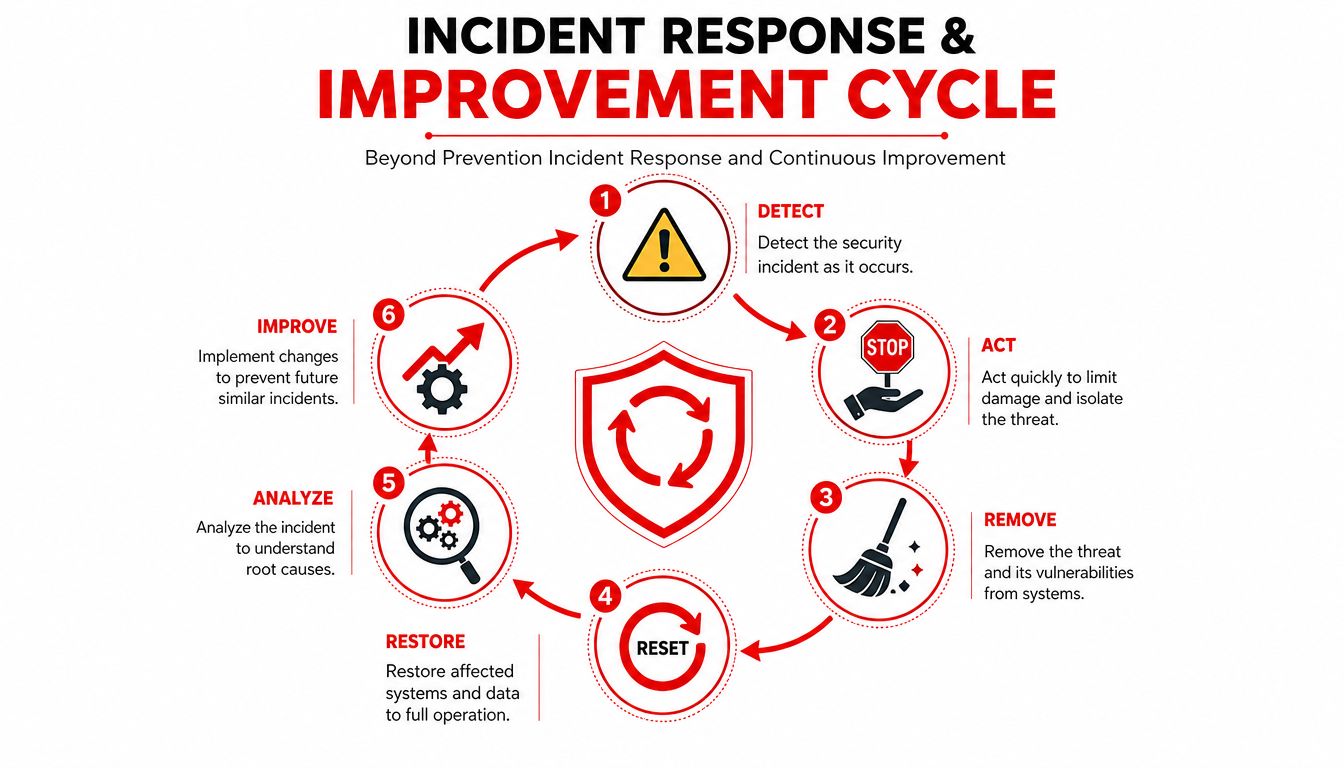
Use a simple response cycle
In practice, teams perform better with a short framework they can remember under stress:
Detect
Notice the issue early through staff observation, alarms, CCTV review, customer reports, or irregular system activity.Respond
Isolate the threat, protect people first, and stop the problem spreading. On a site, that might mean locking down an area. In a venue, it may mean removing access, preserving footage, and escalating to management.Remove
Deal with the immediate cause where possible. That could be ejecting offenders, revoking credentials, securing breached points, or shutting down a compromised process.Restore
Return critical operations safely. Don't rush this. Partial reopening with clean controls is usually better than a messy return to normal.Review and improve
Work out what failed, who knew what, what evidence was captured, and what needs to change.
Early planning gives you better legal footing
One of the reasons incident response matters is that rushed action often creates a second problem. Records are incomplete. Decisions aren't consistent. Asset transfers or structural changes happen under pressure.
That's why timing matters structurally as well as operationally. According to Nexia's guidance on asset protection planning, transferring ownership of assets to a discretionary family trust is a primary asset protection strategy, and it is most effective when implemented before any financial dispute arises. A structure created at the start is significantly easier to defend than one created under creditor pressure.
Review with hard questions
After any incident, ask:
- What failed first? Was it personnel, process, physical control, or supervision?
- What slowed the response? Confused authority, poor communications, missing keys, poor system access?
- What evidence do we have? Logs, footage, witness notes, contractor records?
- What changes are now mandatory? Not desirable. Mandatory.
A review is only useful if it changes the next shift, the next roster, the next induction, or the next contract. Otherwise, it's paperwork.
Frequently Asked Questions About Asset Protection
A venue operator finishes a busy Saturday with cash accounted for, no injuries reported, and the site locked down. By Monday, a contractor dispute, missing stock, and a social media complaint have turned a normal weekend into a liability issue. That is how asset protection works in practice. Loss rarely arrives as a single clean event.
Does insurance count as a complete asset protection strategy
Insurance helps absorb part of the financial hit after a claim, theft, outage, or injury. It does not fix weak site access, poor contractor controls, careless rostering, bad recordkeeping, or a business structure that leaves the wrong entity carrying the risk.
For event, hospitality, construction, and retail operators, insurance works best as one layer inside a wider plan. The plan should also cover who holds assets, who signs contracts, who controls keys and credentials, how incidents are reported, and who has authority to act when a problem starts.
What's the simplest legitimate step a business owner can take first
Start by mapping exposure. Identify what the business owns, what is leased, what is personally held, where cash moves, which entity signs contracts, and where liability could land if an incident or dispute occurs.
In Australia, lawful ownership and structuring decisions can materially reduce exposure when they are made early and supported by proper legal and accounting advice. The point is not to reshuffle assets in a panic. The point is to understand what is exposed before a creditor, regulator, or claimant forces the issue.
How do I protect intangible assets like brand reputation and operating goodwill
Treat reputation as an operational asset. In live events and hospitality, reputational damage often starts with a physical failure. Poor entry control, an aggressive removal, an intoxication incident handled badly, or a payment system outage can become a public problem within minutes.
The same applies to cyber-physical incidents. A compromised ticketing system, unauthorised access to CCTV, or a staff member posting incident footage can damage trust even where the direct financial loss is limited.
Practical protections include:
- Contractor standards: Set clear conduct, reporting, and escalation requirements before contractors come on site
- Evidence discipline: Keep logs, footage retention, and witness notes consistent and usable
- Decision authority: Make it clear who can close an area, remove a patron, call police, or brief stakeholders
- Message control: Assign one trained spokesperson for serious incidents
- System access hygiene: Restrict who can access cameras, ticketing, POS, alarms, and incident records
When should I bring in legal, financial, or security specialists
Bring them in before the pressure starts. The right time is when you are taking a new lease, changing ownership, opening late-night trade, scaling an event, engaging labour hire, adding high-value stock, or moving into a higher-risk operating model.
I give the same advice to hospitality groups and event managers regularly. Early advice costs less than cleaning up a bad structure, a failed response, or a rushed decision made after an injury, theft, insolvency threat, or phoenixing concern.
FAQ
| Question | Answer |
| Is a company enough on its own? | Usually no. A company can separate some business liabilities, but higher-risk operations often need clearer entity separation, tighter contracts, and stronger site controls. |
| Can I fix asset protection after a dispute starts? | You can still improve procedures and security controls, but structural changes made under pressure are harder to justify and often less effective. |
| Should I rely on one security measure? | No. Access control, staffing, surveillance, reporting, and ownership structure should support each other. |
| Do people decisions affect asset protection? | Yes. Supervisors, contractors, cash handlers, crowd controllers, and managers all influence loss exposure and liability. |
If your business runs events, venues, hospitality operations, retail sites, or construction projects in NSW, VIC, QLD, or the ACT, get a proper review of your physical controls, personnel deployment, incident process, and ownership exposure. The goal is straightforward. Protect people, reduce preventable loss, and stop one operational failure from becoming a wider business problem.