

Hiring armed security personnel is a significant step towards safeguarding your assets, event, or premises. But what exactly are they? In simple terms, they're highly trained and licensed professionals who are legally authorised to carry a firearm. Their role goes far beyond simple observation; they provide a serious layer of protection in high-risk environments, for valuable assets, or in response to specific threats.
Hiring armed security isn't a casual decision. It's a strategic move for situations where just having "eyes on the ground" isn't enough to deter a serious criminal act or respond effectively to an immediate danger. This guide offers practical, actionable insights to ensure you make the right choice.
Understanding the Role of Armed Security Personnel
Bringing armed security personnel onto your site is a massive step up for any venue, event, or business. It fundamentally shifts your security posture from a passive "watch and report" model to an active one, focused on deterring major threats and being ready for a decisive response.
Think of it this way: an unarmed guard is like a vigilant neighbourhood watch. They're fantastic for presence, observation, and being a first point of contact. An armed officer, on the other hand, is more like a specialised response team, equipped and trained to handle critical, high-stakes incidents. For example, at a large music festival, unarmed staff manage crowd flow, while armed security personnel are strategically positioned to counter a coordinated threat.
This guide is for the event organisers, hospitality managers, and site supervisors who have to make this call. We'll give you a clear framework for figuring out if armed security is the right—and necessary—choice for protecting high-value assets, managing credible threats, or securing a major event. It's a decision that should come from careful planning, not just a reaction to fear. A solid understanding event management is a crucial part of this process, as it helps you see the bigger picture of your security needs.
Distinguishing Key Differences
The firearm is the most obvious difference, but the real distinction runs much deeper. The training, legal authority, and day-to-day responsibilities are fundamentally different, which is what makes one type of security perfect for one scenario and completely wrong for another.
An unarmed guard at a shopping centre is focused on customer service and loss prevention. An armed officer at a bank is focused squarely on one thing: preventing and responding to a potential robbery.
The true value of professional armed security personnel isn't just their weapon; it's the advanced training, sound judgment, and de-escalation skills that prevent a situation from ever requiring its use.
To get a clearer picture, let's break down the core functions and typical deployments. This should help you pinpoint which service best fits your risk profile.
| Feature | Armed Security Personnel | Unarmed Security Personnel |
|---|---|---|
| Primary Role | High-level threat deterrence and response; protecting high-value assets and key personnel. | General deterrence, access control, customer service, and property monitoring. |
| Authorised Equipment | Firearms, plus standard gear like batons and handcuffs. | Radios, torches; sometimes batons or handcuffs, depending on state licensing. |
| Typical Deployment | Banks, government buildings, VIP protection, high-risk events, major asset transport. | Retail stores, corporate lobbies, concerts, festivals, construction sites. |
| Training Required | Extensive, specialised firearms training, psychological screening, and advanced security qualifications. | Standard security licence, First Aid, and site-specific training. |
Getting this foundational difference right is the first, and most important, step in building a security plan that's both robust and appropriate for your operation.
When Is an Armed Security Personnel Presence Necessary?
Deciding to bring in armed security personnel is a serious step. It’s a move you make when the risk profile of your event, venue, or site crosses a critical line. This isn’t a decision based on gut feelings; it's a calculated response to specific, identified threats. You’re essentially shifting from general deterrence to a state of high-level, proactive protection.
For many businesses, the private security industry is an indispensable partner. In Australia, it's a massive sector, employing over 180,000 people—with more than 153,000 of them being licensed security officers—and pulling in over $11 billion in annual revenue. To put that in perspective, this workforce is larger than the nation's police and defence forces combined, making professional security a cornerstone for anyone managing events or properties. The ASIAL Security 2025 report offers a deep dive into just how vital this industry is.
Conducting a Thorough Threat and Vulnerability Assessment
The starting point is always a formal threat and vulnerability assessment. This is what takes you from vague worries to concrete, evidence-based decisions. It’s about asking tough questions and giving honest answers to figure out if an armed response is truly justified.
Think of it like a doctor diagnosing an illness. You wouldn't prescribe powerful medication without running tests and understanding the symptoms. In the same way, you don't deploy armed guards without first methodically analysing the specific risks you're facing.
Actionable Insight: Create a simple risk matrix. List potential threats (e.g., robbery, active aggressor, organised theft) on one axis and their likelihood/impact on the other. Threats falling into the "high-impact, high-likelihood" quadrant are your priority and may justify engaging armed security personnel.
To kick off your assessment, you need to look at a few core factors:
- Credible Intelligence: Have you received direct threats aimed at your event, people, or property? This could be anything from online chatter and direct warnings to intelligence passed on by law enforcement.
- Location Vulnerability: Is your venue located in a high-crime area? Does its layout create vulnerabilities, like multiple unmonitored entry points or a remote, isolated setting that makes it an easy target?
- History of Incidents: Has your site, or similar events nearby, been hit by serious security breaches, violence, or targeted criminal activity before?
This decision tree gives you a simple visual for working through the logic.
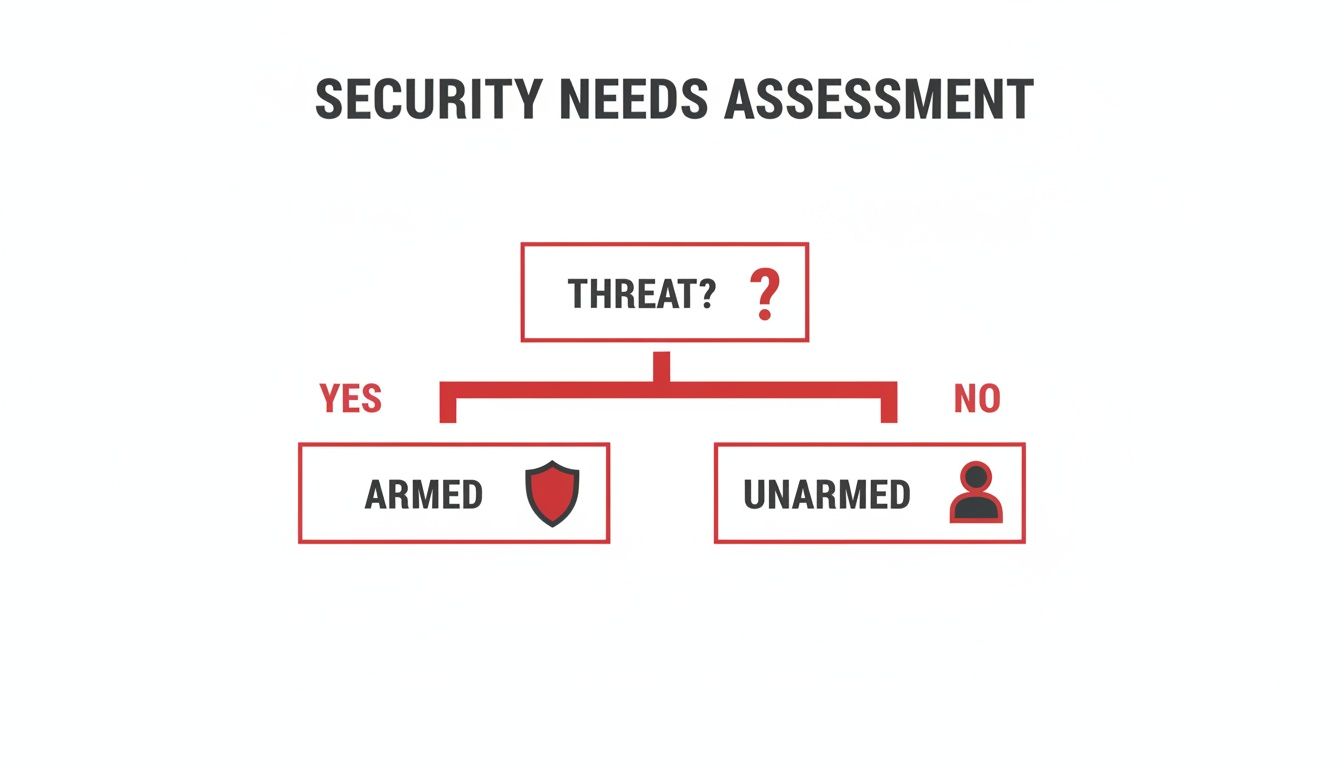

As the flowchart shows, the choice to bring in armed officers is almost always a direct response to a significant and credible threat. It's not the default; it's the necessary escalation.
Protecting High-Value Assets and Key Personnel
Beyond general threats, the sheer value of what you’re protecting can be the main reason for engaging armed security personnel. When the potential for loss is exceptionally high, a standard security presence just might not be enough to deter sophisticated or determined criminals.
The presence of an armed guard sends a powerful, unambiguous message to would-be aggressors: this asset is protected by a professional prepared for a high-stakes confrontation. It dramatically raises the risk of any criminal attempt.
Here are a few real-world examples where armed protection becomes a necessity:
- High-Value Goods: Think of a remote construction site storing millions of dollars in copper wiring or a warehouse filled with high-end electronics. These are prime targets for organised theft.
- Cash Handling: A massive music festival with dozens of cash-heavy vendors and significant amounts of cash being moved around is an obvious and tempting target for robbery.
- VIPs and High-Profile Individuals: A corporate gala hosting internationally known executives or a charity function with celebrity guests automatically has a higher risk profile that demands specialised protection.
In every one of these scenarios, the potential loss—whether it's financial, reputational, or personal—justifies the heightened security posture that only armed security personnel can deliver. It all comes down to matching the level of protection to the level of risk.
Navigating State Licensing and Legal Compliance
Hiring armed security personnel in Australia isn't as simple as picking a contractor. It’s more like navigating a maze of strict, state-specific laws. Each state has its own rulebook, and getting it wrong can expose your event, venue, or site to massive legal and reputational risks. Making sure your security provider is fully compliant isn’t just a good idea—it’s non-negotiable.
This complex legal landscape is precisely why you need to partner with a proven security provider. A good one takes the burden off your shoulders by ensuring every single officer holds the correct, up-to-date licenses. Your job is to double-check that your chosen partner has a rock-solid and transparent compliance system in place.


Licensing Requirements for Armed Security Personnel in New South Wales
New South Wales probably has one of the most rigorous licensing structures in the country, all governed by the Security Industry Act 1997. An officer can't just decide to carry a firearm; they have to hold a very specific licence subclass that authorises it.
For a guard to be legally armed in NSW, they must possess a Class 1F Security Licence. This isn't a standalone licence; it's an add-on to their other security qualifications (like a 1A for unarmed guards) and requires a separate, intensive process to get.
The path to getting—and keeping—this licence is tough. It involves:
- Specialised Training: Applicants have to complete approved firearms safety and training courses designed specifically for security work.
- Genuine Reason: They must prove a genuine need for the licence, which is almost always tied directly to their job, like cash-in-transit or protecting high-value assets.
- Psychological Evaluation: A thorough psychological assessment is usually part of the deal to ensure the officer has the right temperament and judgment for such a high-stakes role.
This means when you hire a provider in NSW, you need to ask for proof that their armed security personnel hold a valid Class 1F licence, on top of all their other credentials.
Understanding Victorian and Queensland Regulations
While the core principles are the same, Victoria and Queensland have their own distinct laws. If you're an event organiser or manager working across state lines, you need to know the differences.
In Victoria, the Private Security Act 2004 is the key legislation. An individual needs to hold the "Armed Guard" and "Cash-in-Transit" private security licence sub-activities to be armed. This is all overseen by Victoria Police's Licensing & Regulation Division and, just like in NSW, involves comprehensive background checks and specific training.
Queensland's system is just as stringent, governed by the Security Providers Act 1993. Here, security officers must have a specific licence function for "Cash-in-Transit (Armed)" to legally carry a firearm. The Office of Fair Trading manages the applications and requires proof that there’s a clear occupational need.
The bottom line is the same everywhere: the authority to carry a firearm is an earned specialisation, not a standard part of a security licence. It’s only granted after someone has cleared numerous legal, training, and psychological hurdles.
Compliance Framework in the Australian Capital Territory
The Australian Capital Territory works under the Security Industry Act 2003. Much like the other jurisdictions, the ACT requires security personnel carrying firearms to be specifically licensed for it. This isn't a general security guard licence—it's a special authorisation that's very difficult to get.
The process involves:
- Extensive Vetting: ACT Policing conducts rigorous background checks.
- Mandatory Training: Officers must complete approved firearms training courses that are recognised in the territory.
- Employer Justification: The security company has to provide a strong case for why their employee needs a firearm for their duties.
When you bring in armed security personnel in the ACT, it’s vital to confirm with your provider that their officers don’t just hold a security licence, but also the specific firearms authorisation issued by ACT authorities. This is how you ensure every guard on your site is fully compliant, insured, and legally ready to protect your people and assets.
What to Look for in Elite Armed Security Personnel
When you hire armed security personnel, you’re not just paying for a person with a firearm. You're investing in their judgement, their temperament, and the hundreds of hours of training that allow them to make split-second decisions under pressure.
An elite officer’s real value isn’t just in reacting to a crisis—it’s in preventing one from ever happening. Their presence is a deterrent, sure, but their skill is in managing a tense situation with calm authority. The difference between a guard who just meets the licensing basics and a top-tier professional is night and day.
Practical Example: An experienced officer can often shut down a potential threat at your venue’s entrance using tactical communication and a commanding presence alone. The issue is resolved before it ever gets physical, and their firearm never even leaves its holster. That’s the calibre of professional you should be looking for.
Beyond the Firearm: De-escalation and Judgement Are Everything
The most critical skills an armed officer possesses have nothing to do with their weapon. A firearm is always the last resort. The tools they should be using day in, day out, are verbal de-escalation, conflict resolution, and tactical communication. A true professional's first instinct is to talk a situation down, not to escalate it with force.
It's like the difference between a good surgeon and a great one. A good surgeon knows how to operate, but a great one has the diagnostic skill to know when surgery isn't needed at all. An elite officer’s primary value is their judgement—the ability to accurately read a situation and use the absolute minimum force necessary to regain control.
They're trained to rapidly process body language, tone of voice, and other environmental cues to decide the right course of action. This is the kind of situational awareness that separates a genuinely effective security asset from someone who is simply armed. It ensures they’re a source of safety, not another risk factor.
How to Evaluate a Provider's Training and Vetting
To make sure you’re getting elite armed security personnel, you need to dig deeper than just a licence. You have to scrutinise the provider’s recruitment process, their ongoing training programs, and how they manage performance. A reputable security firm won’t hide this stuff—they’ll be proud of it.
Australia’s private security workforce is massive, significantly outnumbering our defence personnel. Recent data shows there are over 180,000 private security employees nationally, with more than 153,000 holding a licence. That’s a bigger workforce than the Australian Defence Force’s combined full-time and reserve members, which you can read more about in these Australian Defence Force service statistics. With such a large pool of guards, it’s the rigour of a provider's internal standards that really sets them apart.
When you’re vetting a potential security partner, go in with a checklist of tough questions to get a clear picture of how they operate.
The quality of your security is a direct reflection of the provider’s commitment to continuous training and stringent vetting. Never settle for minimum compliance; demand a partner who invests heavily in their team's skills and professionalism.
Essential Questions for Any Security Provider:
- Recruitment: What does your screening process involve beyond the basic licence and police checks? Do you use psychological assessments or scenario-based interviews to gauge temperament?
- Ongoing Training: How often do your officers train and requalify? Ask specifically about firearms requalification, de-escalation drills, and crisis management exercises.
- Rules of Engagement: Can you show me your company's documented rules of engagement and use-of-force policy for armed security personnel? It should be crystal clear.
- Performance Management: How do you supervise and review officers once they’re on the job? Are there regular spot checks from supervisors and formal performance reviews?
Asking these pointed questions helps you cut through the sales pitch. It allows you to really assess whether a provider’s team has the proactive, problem-solving mindset needed to keep your people and property safe.
Integrating Armed Security into Your Operations
True security isn't just about having armed security personnel on-site; it’s about how seamlessly they fit into your entire operation. A common mistake is to simply post a guard at the front door and call it a day. But to really tap into their expertise, you need to weave them into the fabric of your existing teams, creating one unified security front.
This approach stops you from having a bunch of separate, siloed teams and instead creates a layered, intelligent system. It’s about making sure everyone, from the person scanning tickets to the armed officer on overwatch, is on the same page. The aim is to build a security net where information is shared instantly and every response is coordinated.
Strategic Positioning for Maximum Deterrence and Response
Figuring out where to place your armed security personnel is one of the biggest strategic calls you'll make. It's a real balancing act. You want a visible deterrent, but you also don't want to create an intimidating, fortress-like atmosphere for your guests. The right answer always comes back to your risk assessment and the vibe you're trying to create.
For instance, a highly visible officer at the main entry sends a clear "don't try anything" message. On the flip side, a plainclothes officer watching the crowd from a raised vantage point can spot trouble and respond quickly without anyone even knowing they're there.
Here are a few common positioning strategies to think about:
- Visible Deterrence: Station uniformed officers at high-traffic spots like main entrances, ticketing desks, or VIP lounges. This is fantastic for stopping opportunistic troublemakers in their tracks.
- Discreet Overwatch: Place plainclothes or low-profile officers where they have a wide view of the area. This is a great tactic for monitoring crowd dynamics and catching potential issues before they blow up.
- Mobile Patrols: Have armed officers run unpredictable patrols around the perimeter and through quiet back-of-house areas to prevent anyone from getting where they shouldn't be.
The best security plans usually blend these tactics, creating a multi-layered defence that covers all your bases.
Building a Cohesive Plan Between Armed and Unarmed Teams
The secret to a genuinely integrated security plan comes down to two things: communication and crystal-clear roles. Your unarmed guards, event staff, and armed officers need to operate like a single unit. This kind of synergy doesn't just happen; it's built through solid protocols and, crucially, a thorough pre-deployment briefing.
Think of it like an orchestra. The event manager is the conductor, and each security team is a section of instruments. They might all be brilliant musicians, but without the same sheet music, you'll get chaos, not a symphony. That pre-deployment briefing is where everyone learns the score.
A pre-deployment briefing is the single most critical element for operational success. It is the non-negotiable step that aligns all stakeholders on the operational plan, communication channels, and rules of engagement before the doors ever open.
During this briefing, you absolutely must lock down:
- Clear Communication Channels: Set up a dedicated radio channel just for security. Agree on simple, unambiguous codes for reporting incidents to prevent any confusion in a crisis.
- Defined Rules of Engagement: Everyone needs to know what their job is and what it isn't. Your unarmed staff must know exactly when and how to call in the armed team.
- Escalation Protocols: Map out a step-by-step process for handling everything, from a simple verbal warning by event staff right up to the intervention of armed security personnel.
When every single person understands their role and how it fits into the bigger picture, you create a security detail that is responsive, professional, and effective. This unified approach makes sure your security measures enhance the guest experience, rather than getting in the way of it.
Frequently Asked Questions About Armed Security Personnel
Thinking about bringing in armed security? It’s a big decision, and it’s natural to have questions. We’ve put together some straight-to-the-point answers to the most common queries we get from event organisers, venue managers, and business owners like you.
What can an armed guard actually do legally?
This is probably the most critical question to understand. An armed guard’s authority is very specific and is a world away from a police officer's. They operate under what’s known as ‘citizen’s arrest’ powers. This means they can legally detain someone they see committing a serious offence on your property until the police arrive. The firearm is a tool of last resort, used only in self-defence or to protect others from an immediate threat of death or serious injury.
Won't an armed presence make my guests feel uncomfortable?
It’s a fair question, and the answer comes down to one word: professionalism. The right armed security personnel team knows how to be a reassuring presence, not an intimidating one. For a black-tie gala, for example, a discreet officer in plain clothes is a better fit than a guard in a high-visibility uniform. It’s all about matching the approach to the environment.
How much notice do I need to give to book armed security?
The more notice, the better. We strongly recommend booking at least 4-6 weeks in advance, especially for bigger events or ongoing contracts. This gives a quality security provider time for a detailed risk assessment, operational planning, and assigning the best officers for your specific situation. A last-minute booking often means a rushed, one-size-fits-all solution.
How can I verify an officer's licence?
Most states have online public registers where you can look up a security licence to check its validity and class. Your security provider should also readily provide copies of the relevant licenses for any personnel they assign to your site. Actionable Insight: Make this a mandatory clause in your service agreement.
What should I look for in a security contract?
Your contract is your safety net, so read it carefully. Before you sign anything, make sure it clearly spells out a few non-negotiables:
- Licensing and Insurance: It must confirm that the company and every single officer assigned to you are fully licensed and insured for armed work in your state.
- Scope of Duties: The contract should be crystal clear about what the armed security personnel are expected to do—their specific responsibilities, post orders, and rules of engagement.
- Liability and Indemnification: You need to know exactly who is responsible if something goes wrong. A good contract defines liability clearly.
- Reporting Procedures: How will you be kept in the loop? The contract should detail the process for receiving incident reports and updates from the team on the ground.
For multi-award-winning security solutions tailored to your specific needs across NSW, VIC, QLD, and the ACT, partner with the trusted professionals at GM GROUP Services. We provide licensed, experienced, and customer-focused protection for any event, venue, or business. Secure your peace of mind by visiting us at https://www.gmgroupservices.com.au.