

An alarm with monitoring is your 24/7 security service, a direct link from your property to a command centre staffed by trained professionals. This vital connection elevates a simple siren into an active, responsive security shield, ensuring every alert is expertly investigated and acted upon, day or night. Without it, an alarm is just noise; with it, you have a guaranteed response.
Understanding the Power of an Alarm with Monitoring
Imagine a standard, unmonitored alarm on a construction site. A sensor trips at 2 AM, and a siren blares. Who's there to hear it? Who will respond? While the noise might deter an amateur, a determined criminal knows no one is coming. The alarm becomes meaningless background noise.
Now, replay that scenario with an alarm with monitoring. The moment that sensor is triggered, a secure signal is sent to a specialised monitoring centre. A trained operator receives the alert, quickly verifies if it's a real threat or a false alarm, and then executes a pre-planned response. This could mean dispatching a mobile patrol, calling designated keyholders, or contacting the police or fire brigade directly. A practical example is a retail store after closing: a window breaks, triggering a sensor. The monitoring centre can access CCTV, confirm the break-in, and dispatch both police and a patrol unit with a verified report, increasing the chance of apprehension.
This critical shift from a passive siren to an active response is the entire point of back-to-base monitoring. It guarantees that every potential threat gets immediate, professional attention, elevating your security from a hopeful deterrent to a reliable, managed solution.
Why Professional Oversight Is the Gold Standard
The true value of a professionally monitored alarm is the certainty it provides. You're no longer crossing your fingers and hoping a neighbour or a random passer-by will step in. Instead, you have a dedicated team whose only job is to watch over and protect your assets. This kind of professional oversight is essential for serious asset protection, especially in places like:
- Large Events and Venues: Managing crowd safety and securing large perimeters demands the instant response capabilities that only professional monitoring can deliver.
- Construction Sites: Expensive equipment and materials left overnight are a magnet for thieves. Monitored alarms ensure any breach is met with a fast, physical response.
- Retail Businesses: Protecting your stock from after-hours break-ins and vandalism is fundamental to staying profitable. Monitoring gives you peace of mind and significantly cuts down potential losses.
A Growing Trend in Australian Security
This move towards professional oversight highlights a major shift in how Australian businesses are thinking about security. The adoption of monitored systems is on the rise, driven by the simple fact that they offer far better protection. In fact, Australia's alarm monitoring market is a significant piece of a global industry valued at $63.09 billion. Here at home, growth is being pushed by rising security concerns and major infrastructure projects. It’s clear that businesses are moving away from passive measures and embracing proactive, managed security.
At the end of the day, an alarm with monitoring closes the security loop. It doesn't just flag a potential problem; it kicks off the solution. By combining smart technology with trained human expertise, it creates a powerful shield for any business, event, or construction site. While the tech is more advanced in a commercial setting, you can explore the basics of how the components work together in guides to smart home security systems, which operate on similar principles. Ultimately, this system is the difference between hoping your assets are safe and knowing they're being protected.
How an Alarm With Monitoring Responds to Threats
So, what actually happens when a sensor on your site is tripped at 3 AM? An alarm with monitoring isn’t just about making a loud noise. It’s about transforming a potential crisis into a managed, professional event. This is where technology and human expertise come together to turn a simple alert into a decisive response.
Let's imagine a breach at your locked-down construction site well after hours. A motion sensor picks up unauthorised movement. Instantly, a secure, encrypted signal shoots from your alarm panel directly to a 24/7 monitoring centre. This is the crucial difference—it’s not just a local siren; it’s a direct line to a team of trained security operators ready to act.
Within seconds, an operator has the alert on their screen, showing exactly which sensor was triggered and when. Their first job is critical: verify the threat. This single step is what filters out the vast majority of false alarms, saving you from unnecessary call-out fees and helping maintain a strong relationship with local police.
The Verification and Action Protocol
Once that signal hits the monitoring centre, the operator kicks off a pre-agreed verification protocol. This isn't a generic, one-size-fits-all checklist; it's a custom plan we build specifically for your site and your needs.
This process usually involves a few key steps:
- Initial Contact: The operator might first call the site or a designated keyholder, using a predetermined password to confirm their identity. It’s a quick, simple way to check if someone accidentally triggered the system.
- Audio/Visual Verification: If your system is equipped with microphones or CCTV cameras, the operator can listen in for tell-tale sounds of a break-in or access live video feeds to get eyes on the situation and confirm an intruder.
- Cross-Referencing Sensors: A single sensor trip could be an anomaly. But if other nearby sensors also trigger, it’s a much stronger indicator of a genuine threat.
If the alarm is confirmed—or if verification attempts go unanswered—the operator immediately escalates. This is where the real power of an alarm with monitoring shines. They don't just blindly call the police; they activate your entire security response plan.
This coordinated response is what truly sets professional monitoring apart. It guarantees that every genuine alarm is met with a swift, appropriate, and decisive action, bridging the gap from detection to intervention in mere minutes.
The process is a simple but powerful flow, moving from your property to the experts and back again with a physical response.
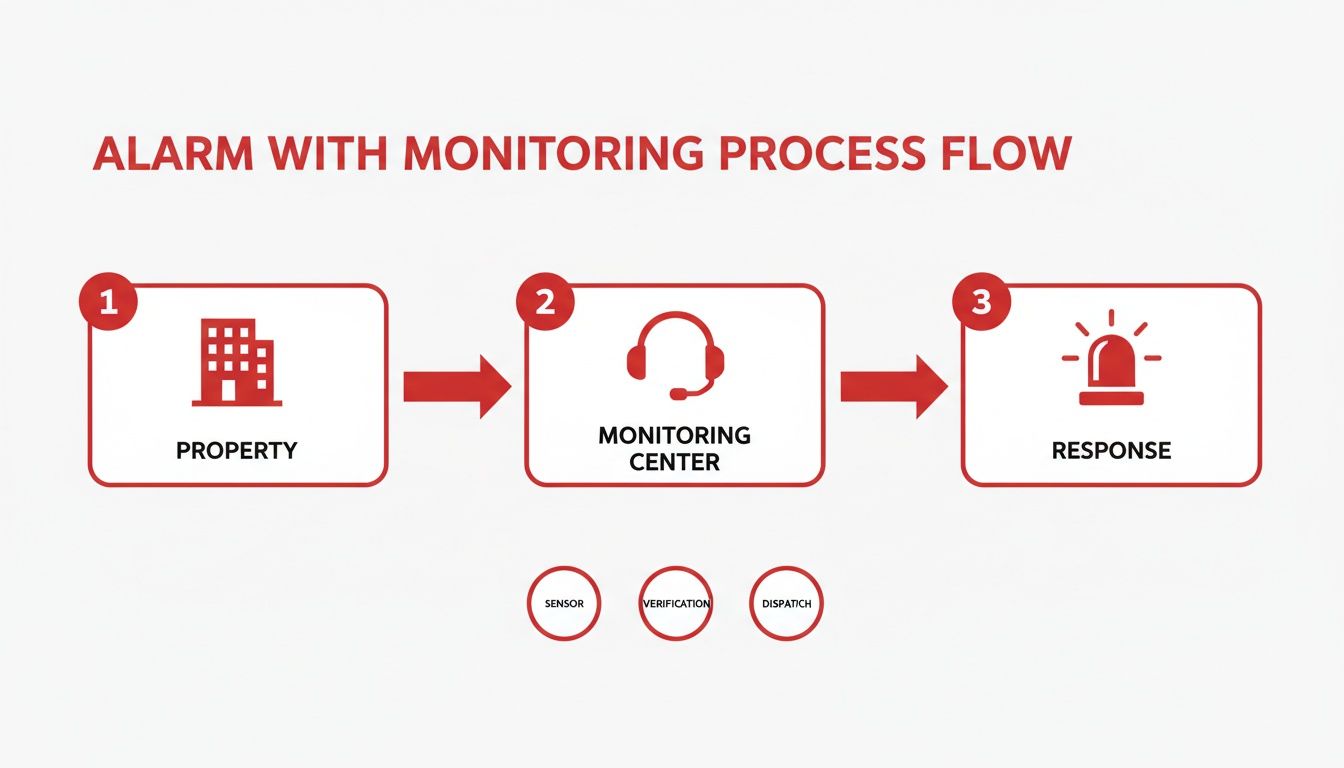

This visual really hammers home how an incident is instantly communicated, professionally assessed, and met with a real-world security response.
From Alert to On-Site Resolution
The moment an alarm is triggered, a clock starts ticking. The goal is to move from a digital alert to a physical presence on-site as quickly and efficiently as possible. The following table breaks down exactly what our monitoring team does behind the scenes.
Anatomy of an Alarm Response
| Stage | Action Taken by Monitoring Center | Typical Timeframe | Example Scenario (Retail Store) |
|---|---|---|---|
| 1. Signal Received | An encrypted signal from a tripped sensor (e.g., door contact, glass break) arrives at the Grade A1 monitoring centre. | Under 10 seconds | A window is smashed at a high-street boutique at 2:15 AM. The glass break sensor sends an immediate alert. |
| 2. Verification | The operator follows the site-specific protocol. They might call the premises or review linked CCTV footage to confirm a genuine threat. | 30-90 seconds | The operator accesses the store's camera feed and visually confirms an intruder inside, bypassing the need for a phone call. |
| 3. Dispatch | With the threat confirmed, the operator dispatches the closest mobile patrol unit and simultaneously contacts emergency services with verified details. | Under 2 minutes | The operator dispatches a GM GROUP patrol car and provides police with the intruder's description and exact location within the store. |
| 4. Notification | The operator contacts the primary keyholders on the call list to inform them of the confirmed breach and the response actions underway. | 2-5 minutes | The store manager receives a call explaining that a break-in has been confirmed and a patrol unit is en route. |
| 5. On-Site Action | The mobile patrol arrives, assesses the situation, secures the perimeter, and liaises with police. They can also apprehend offenders if safe. | Varies by location | The patrol car arrives before the police, secures the exit, and assists law enforcement in apprehending the suspect. |
| 6. Reporting | The patrol officer provides a detailed incident report, including photos and a timeline, which is sent to the client. | Post-incident | The store manager receives a full digital report by morning, detailing the damage, the actions taken, and the resolution. |
This step-by-step process ensures nothing is left to chance. Every action is deliberate, logged, and designed to protect your assets.
Let’s go back to our construction site scenario. The operator has just visually confirmed an intruder on CCTV. Based on the action plan we’ve set up for that site, a few things happen almost at the same time:
- Dispatching Mobile Patrol: The operator immediately dispatches the nearest mobile security patrol unit to your site. This ensures a trained professional is first on the scene, ready to assess and secure the premises.
- Contacting Keyholders: Your site's key contacts are notified right away about the confirmed breach and the response in progress. You’re kept in the loop every step of the way.
- Liaising with Emergency Services: The operator contacts the police, but instead of a generic alarm call, they provide critical, verified intelligence—the intruder's location, description, and actions. A verified report like this gets a much higher priority response.
When our patrol arrives, they are trained to manage the situation, secure the site, and provide you with a detailed incident report. This seamless chain of command—from sensor to signal, verification to dispatch—is what makes an alarm with monitoring such an essential security tool. It provides a guaranteed, professional reaction, every single time.
The 7 Key Benefits of Professional Alarm Monitoring
An alarm system with professional monitoring is so much more than just a loud siren. It’s a complete security solution that delivers real, tangible benefits—protecting your assets, cutting down on operational headaches, and ultimately strengthening your bottom line.
When you move beyond a simple, unmonitored alarm, you're transforming your security from a passive deterrent into a responsive, intelligent shield. Let’s break down the seven core advantages that make this service a true game-changer for any serious organisation.
1. Unmatched Peace of Mind with 24/7 Protection
Perhaps the most immediate benefit is the simple certainty you get from knowing your property is being watched by trained professionals, 24 hours a day, 7 days a week. It doesn't matter if it's a public holiday, the middle of the night, or a weekend; a dedicated team is always on standby.
This constant vigilance means you're never truly "off the clock" or alone in managing security. An alert from your construction site at 3 AM doesn't just trigger a siren anymore. It triggers an immediate, expert-led response, giving you and your stakeholders genuine peace of mind.
2. Rapid and Coordinated Emergency Response
When a real threat occurs, every single second counts. With a professional alarm with monitoring service, you’re not just hoping a neighbour or passerby calls the police. Instead, a trained operator verifies the threat and dispatches the right response—be it a mobile patrol, the police, or the fire brigade—with verified, actionable information.
Think about a large festival, for example. A perimeter breach alarm can be instantly verified via CCTV by the monitoring centre. They can then direct on-site guards and mobile patrols to the exact location. This level of coordination is simply impossible with a standalone system and is crucial for minimising potential damage or loss.
3. A Proven and Powerful Criminal Deterrent
Criminals are always on the lookout for an easy target. Signage and stickers that clearly state your premises are protected by professional monitoring act as a powerful psychological deterrent. Opportunistic thieves know that a monitored alarm means a fast, professional response is on its way, which dramatically increases their risk of getting caught.
A visible, professionally monitored alarm system signals that your site is a hard target. This simple fact can persuade potential intruders to move on before they even attempt a break-in, making it one of the most cost-effective security measures you can implement.
This is especially effective for high-value targets like retail stores and warehouses, where preventing the break-in from happening in the first place is always the best outcome.
4. Drastic Reduction in False Alarm Fees
False alarms aren't just an annoyance; they can be incredibly costly. Local councils and police departments across Australia often issue hefty fines for repeated false call-outs. A key job of a monitoring centre is to verify alarms before dispatching emergency services.
By using proven methods like calling keyholders or reviewing live CCTV footage, operators can filter out the 90% or more of alarms triggered by employee error, faulty equipment, or even wandering animals. This crucial verification step all but eliminates false alarm fees, saving your business a significant amount of money over time.
5. Potential for Lower Insurance Premiums
Insurance providers know a good risk when they see one, and they absolutely recognise the value of professionally monitored security. An alarm with monitoring demonstrates that you are taking proactive, effective steps to mitigate potential losses.
As a result, many insurers offer substantial discounts on business insurance premiums for properties with a back-to-base monitored system. The annual savings on your policy can often offset a good chunk of the monitoring service cost, making it an even smarter financial decision.
6. Comprehensive Environmental and Safety Monitoring
Modern security systems can do a lot more than just detect intruders. When they're professionally monitored, they can also alert you to a range of environmental threats, providing a complete safety solution for your site.
- Smoke and Fire Detection: Integrated smoke detectors can trigger an immediate fire brigade dispatch, protecting not just your property but, more importantly, people's lives.
- Flood and Water Damage: Water sensors placed in basements, server rooms, or other critical areas can prevent catastrophic damage from leaks or floods.
- Temperature Alerts: For venues or warehouses with sensitive equipment or stock, temperature sensors can alert you the moment conditions fall outside a safe range.
7. Detailed Incident Reporting and Insights
After any incident, a professional monitoring service provides detailed, time-stamped reports of exactly what happened and what actions were taken. This documentation is invaluable for police reports, insurance claims, and your own internal security reviews. Over time, this data helps you identify vulnerabilities and strengthen your security protocols for the future.
The broader security market in Australia clearly reflects this value. The Australian home security systems market, which includes alarm with monitoring, was valued at USD 2.03 billion and is projected to hit USD 5.16 billion by 2033, growing at a healthy 9.80% annually. This growth is driven by businesses recognising the clear benefits of integrating technology with professional human oversight. You can discover more insights about the Australian security systems market on IMARC Group.
Integrating Monitoring with Your On-Site Security
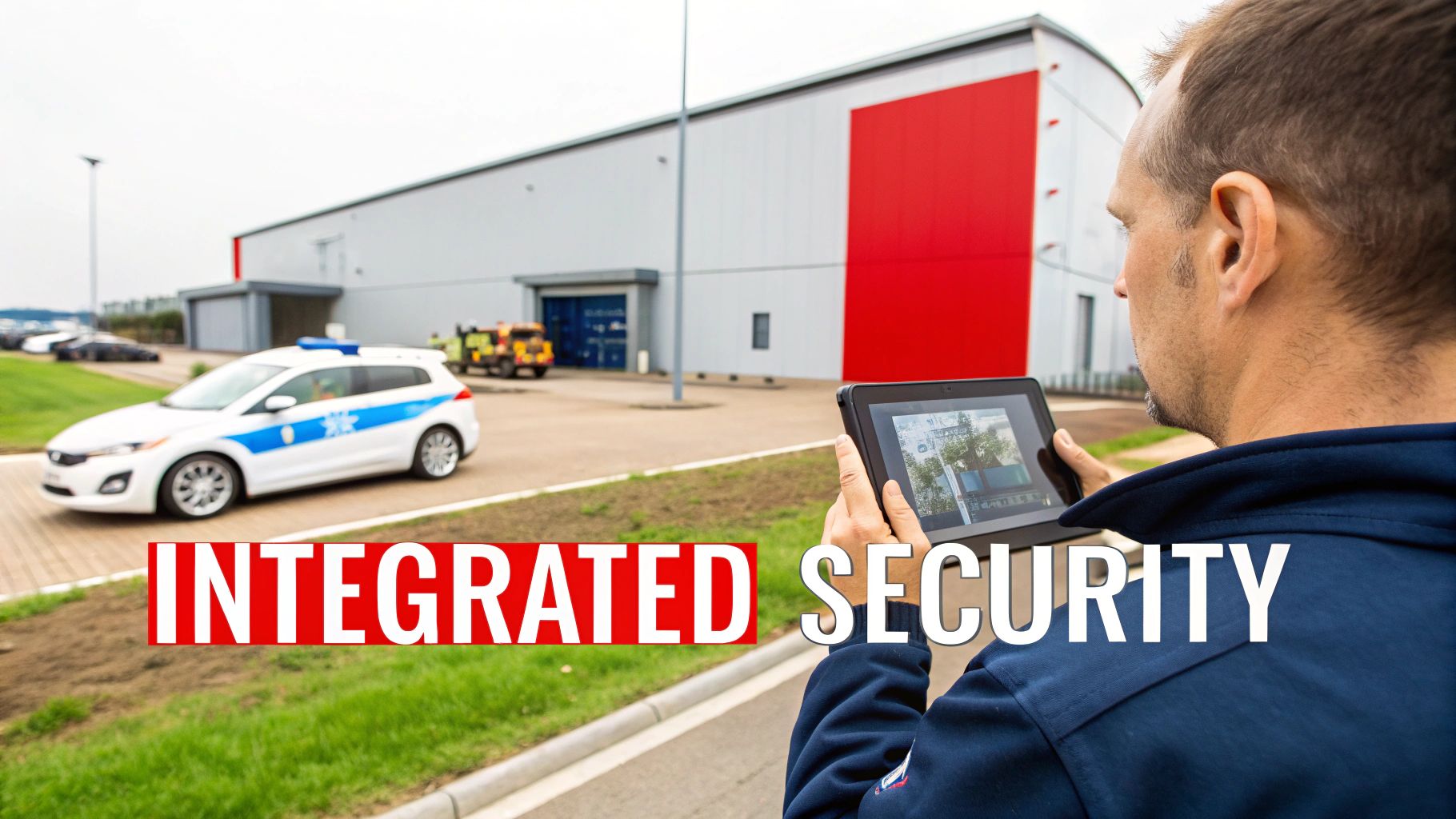
A monitored alarm is powerful, but its true strength is unlocked when it acts as the central nervous system for your entire security operation. It’s not a standalone gadget; it’s a system designed to integrate directly with your on-site physical security teams. This creates a formidable, layered defence that combines smart technology with immediate human intervention. In essence, it transforms a simple alert into actionable, real-time intelligence for your people on the ground.
Think about a large construction site after hours. A motion sensor is triggered in a restricted area. Instead of just a siren wailing into the night, the back-to-base monitoring centre gets the alert and instantly pulls up the linked CCTV cameras. The operator visually confirms an intruder. Within seconds, they dispatch the nearest mobile patrol unit, feeding them the suspect's exact location and description before they even arrive on site.
This seamless flow of information is what makes an integrated strategy so effective. The monitoring centre becomes a force multiplier, giving your on-site personnel the critical advantage of foresight and coordination.

Unifying Technology with On-the-Ground Response
True security isn't just about having the gear; it's about making your technology and your people work in perfect harmony. The monitoring centre is the crucial link in that chain, turning digital alerts into coordinated, real-world action.
Here’s how this integration actually plays out:
- Dispatching Mobile Patrols: A verified alarm is the green light for an immediate dispatch. Operators don’t just send a car to a pin on a map; they provide patrol officers with verified intelligence, ensuring they arrive prepared and informed, not just chasing a random siren.
- Supporting Static Guards: For sites with guards already on duty, the monitoring centre is their lifeline. It provides vital backup, remote visual verification for incidents happening out of their line of sight, and an independent way to call for assistance if a guard is ever compromised.
- Deploying K9 Units: When dealing with high-level threats, a verified alarm can trigger the deployment of a specialised K9 unit. This is invaluable for securing large perimeters or when dealing with multiple intruders, where a dog's speed and senses are a game-changer.
This integrated approach is fast becoming the standard in Australia. The nation's security market is projected to surge from USD 4,591.7 million to USD 7,713.7 million by 2030, with alarm monitoring and emergency response services leading that growth. This isn't just a number—it’s a clear sign that businesses at venues, events, and industrial sites are moving towards smarter solutions that blend physical security with intelligent technology.
The Power of Real-Time Intelligence
One of the biggest wins of an integrated system is the flow of live intelligence. Monitoring operators aren't just passive observers; they become active participants in managing an incident from start to finish.
By using live CCTV feeds, operators can guide on-site teams with incredible precision. They can track an intruder's movement, warn guards of hidden dangers, and direct response teams to the most effective entry points, all while the event is unfolding.
This real-time guidance effectively gives your on-site personnel eyes everywhere. It dramatically increases their safety and effectiveness, turning a reactive scramble into a controlled, proactive engagement.
Creating Your Integrated Security Ecosystem
Building this ecosystem requires smart planning. It all starts by ensuring your alarm system can communicate seamlessly with your physical security provider. The goal is to create a closed loop: technology detects, the monitoring centre verifies and directs, and the on-site team responds with precision. As you plan your on-site security, it's worth considering all the tools available, like a trail camera with remote viewing, which can be another useful layer in a comprehensive strategy.
Ultimately, integrating your monitored alarm with on-site services like mobile patrols and static guards creates a solution that is far greater than the sum of its parts. It ensures every single alert is met with a swift, intelligent, and decisive physical response, offering the highest level of protection for your people, property, and assets.
Choosing the Right Alarm Monitoring Partner
Picking a provider for your alarm with monitoring is a serious decision. You’re not just buying a service; you're placing the safety of your people, property, and assets in someone else's hands. It’s easy to get lost in marketing slogans, but true security comes from a partner with proven capabilities, the right certifications, and complete operational transparency.
This isn’t about just comparing prices. It’s about finding a security partner whose response is as reliable as their technology. We’ll walk you through the essential questions to ask and the key criteria to look for, helping you cut through the noise and find a provider who delivers genuine protection.

Are They Properly Licensed and Certified?
First things first: check their credentials. This is non-negotiable. Any security provider in Australia must hold current, state-specific security licences to operate legally. This is your baseline assurance that they meet regulatory standards for professionalism and accountability. Don't be afraid to ask for their licence numbers and check them with the relevant state authority.
But licensing is just the entry ticket. The real gold standard for a monitoring centre is Grade A1 Certification. This is the highest possible rating from the Australian Security Industry Association Limited (ASIAL), and it's a big deal. It means the facility has been independently audited and meets extremely strict standards for:
- Physical Construction: The building itself is a fortress, hardened against physical attacks.
- Operational Redundancy: They have backup power, communications, and servers to ensure the monitoring centre stays online 24/7, no matter what. Power grids can fail, but a Grade A1 centre won't.
- Staff and Procedures: The operators are highly trained professionals who follow rigorously tested and documented response protocols for every conceivable event.
A Grade A1 certified monitoring centre is your ultimate guarantee of reliability. It tells you the facility has the resilience, technology, and expert team to handle any emergency without fail. When choosing your alarm monitoring partner, this certification should be at the top of your list.
How Good is Their Real-World Response?
A signal from a control room is useless without a swift, effective physical response on the ground. This is where you need to dig deeper than vague promises of "fast response times." You need to understand their real, on-the-ground operational capacity.
Get specific with your questions:
- Who are the patrols? Do they run their own dedicated mobile patrol fleet, or do they subcontract to the lowest bidder? An in-house team almost always means better communication, accountability, and a more consistent service.
- How close are they? Ask them how many patrol vehicles they have in your specific area, both during the day and overnight. The density of their patrols directly impacts how quickly an officer can get to your site when an alarm goes off.
- Can they get inside? Do they offer secure keyholding services? This is crucial. It means their patrol can enter your premises to do a full internal sweep, rather than just doing a quick lap of the perimeter and leaving.
What Technology and Protocols Do They Use?
The tech behind the service is just as vital as the people. You need a provider who uses modern, reliable communication systems and who can tailor their response protocols to fit your business’s unique risks and requirements.
Here’s what to look for:
- Fail-Safe Communication: The system should never rely on a single point of failure. Look for dual-path communication, which typically uses your NBN or internet connection as the primary line, with a 4G cellular module as an immediate backup. If your internet goes down, the signal still gets through.
- Customised Response Plans: Can you actually customise the response? A one-size-fits-all approach doesn't work. You should be able to set different instructions for a fire alarm versus a break-in, or for an incident that happens after hours versus during the workday.
- Eyes on the Target (Visual Verification): Does their monitoring platform talk to your CCTV system? Giving control room operators the ability to visually confirm an intruder in real-time is a game-changer. It turns a potential false alarm into a verified crime-in-progress, which gets a much higher-priority police dispatch.
Your Monitoring Provider Selection Checklist
Choosing the right partner requires a structured approach. Use this checklist to compare potential providers and ensure you're covering all the critical bases. It will help you move beyond the sales pitch and evaluate what truly matters.
| Evaluation Criterion | What to Look For | Why It Matters | Questions to Ask |
|---|---|---|---|
| Licensing & Certification | ASIAL Grade A1 Certification and valid state security licences. | Guarantees the highest level of operational reliability, redundancy, and professionalism. It's an independent stamp of approval. | "Can you provide your ASIAL Grade A1 certificate and state security licence numbers for verification?" |
| Response Fleet | In-house, company-owned mobile patrol vehicles. | Ensures direct accountability, better command and control, and consistent training and service standards. | "Do you operate your own mobile patrols, or do you use subcontractors? How many vehicles serve my area?" |
| Keyholding & Access | Secure, audited keyholding service. | Allows patrols to conduct thorough internal inspections of your property, not just a perimeter check, leading to better outcomes. | "What are your procedures for secure key management and what access will your patrols have?" |
| Communication Tech | Dual-path communication (e.g., NBN/Internet + 4G). | Provides critical redundancy, ensuring alarm signals are always transmitted, even if one communication path fails. | "What communication pathways does your system use to ensure the signal always gets through?" |
| Protocol Customisation | Ability to create tailored response plans for different alarm types, times, or zones. | Your security response should match your specific operational risks, not a generic template. | "Can we customise the response protocols for different scenarios? What does that process look like?" |
| CCTV Integration | The ability for monitoring operators to access live or recorded video feeds for alarm verification. | Drastically reduces false alarms, confirms real threats, and ensures a priority police response. | "Does your monitoring platform support visual verification by integrating with our existing CCTV system?" |
| Contractual Terms | Clear, transparent contracts with no hidden fees, auto-renewal clauses, or excessive lock-in periods. | A trustworthy partner is upfront about all costs and terms. You should know exactly what you're signing up for. | "Can you walk me through the contract terms, particularly regarding fees, contract length, and cancellation policies?" |
By thoroughly vetting each potential provider against this checklist, you can be confident you’re making an informed decision. Remember, the goal is to build a long-term security partnership, not just to buy a service. A reputable provider will welcome these questions and be transparent with their answers.
Ready to Take the Next Step?
Deciding on an alarm with monitoring isn't just about buying another piece of security hardware. It's a strategic move towards genuine, proactive protection. It's the difference between a loud noise that might scare someone off and having a team of experts ready to act the second a threat is detected, day or night.
Throughout this guide, we've walked through how a simple sensor trigger is transformed into a coordinated, professional response. This is what truly safeguards your assets from theft, vandalism, and other unforeseen risks. It’s about swapping hope for a plan.
Don't leave the security of your venue, construction site, or retail space to chance. The most important step is the one you take right now. By partnering with a professional security provider for a managed alarm with monitoring solution, you're taking back control.
Secure your assets, protect your people, and get the peace of mind you deserve. Acting today is the best way to prevent loss tomorrow.
Frequently Asked Questions About Alarm With Monitoring
If you're considering an alarm with monitoring system, it's natural to have questions. As a business owner or site manager, you need absolute certainty. Here are straightforward answers to the most common queries we receive.
What happens if my internet or power goes out?
This is a critical question. A professional alarm with monitoring system is designed for resilience. It uses dual-path communication, meaning it has a primary connection (like NBN) and a 4G cellular backup. If your internet fails, the system instantly switches to the mobile network, ensuring an uninterrupted link to the monitoring centre. Additionally, the main alarm panel includes a backup battery that keeps the system running for hours during a complete power outage, so you are never left vulnerable.
Is professional monitoring really worth the monthly cost?
Absolutely. While there is a recurring fee, it's an investment in active protection, not just a piece of hardware. You are paying for a dedicated team of security professionals watching your property 24/7. Actionable Insight: Calculate the potential loss from a single break-in—stolen equipment, property damage, and operational downtime. When compared to this potential financial hit, the consistent, predictable monthly fee for guaranteed response and risk mitigation provides exceptional value and peace of mind. Many businesses also find that the reduction in insurance premiums helps offset the cost.
How fast is the response when an alarm is triggered?
Speed is essential. The moment a sensor is tripped, the signal reaches our Grade A1 monitoring centre in seconds. An operator immediately begins the verification process, which typically takes under a minute. This involves reviewing CCTV footage or contacting keyholders to rule out a false alarm. Once a threat is confirmed, a mobile patrol is dispatched, or emergency services are notified according to your pre-agreed plan. The entire workflow is optimised for rapid, decisive action.
Can an alarm with monitoring be used for more than just break-ins?
Yes, modern systems offer comprehensive protection. Beyond intrusion detection, they can be integrated with:
- Smoke and Fire Detectors: For an immediate fire brigade dispatch.
- Flood/Water Sensors: To prevent catastrophic damage in critical areas like server rooms.
- Temperature Sensors: To protect sensitive stock or equipment from environmental damage.
- Panic/Duress Buttons: To provide instant help for staff in an emergency.
This transforms your security system into a complete site safety solution.
Ready to secure your assets with a reliable, responsive security solution? The team at GM GROUP Services provides expert back-to-base monitoring and rapid mobile patrol response tailored to your needs. Secure your site today with our professional monitoring services.