


Active back-to-base monitoring is a verified, standards-aligned escalation service. Under Australian response benchmarks, standard alarm response can be expected within 45 minutes, dedicated site patrol response within 30 minutes, and static officer response within 20 minutes when the required deployment is in place.
At 2am, a Perth construction site triggers an after-hours alarm. The control room operator doesn't just forward a notification to a manager who may be asleep. The operator checks the alarm zone, opens the available camera view, reviews the site instructions and confirms whether the event looks genuine. If an intruder is visible, the operator dispatches the agreed patrol response and records each action while the site manager receives a clear update.
That distinction matters for construction sites, festivals, hospitality venues, retail properties and corporate facilities. A passive alarm tells someone that something happened. Active back-to-base monitoring helps decide what happened, who needs to respond and what information they need before they arrive.
What Active Back to Base Monitoring Really Means
The word active changes the workflow
A monitored alarm begins with a signal from an intruder detector, duress button, access-control system or other connected device. The important question is what happens next.
A basic self-monitored system might send an SMS, email or app notification. The recipient must notice it, interpret it, decide whether to call someone and find a person who can attend. That process can fail when the recipient is asleep, travelling, working another shift or unsure whether the alarm is genuine.
With active back-to-base monitoring, a trained operator receives the event at a dedicated monitoring centre. The operator follows documented site instructions, checks the available evidence and starts the agreed escalation process. That may involve a mobile patrol, static officer, nominated keyholder or police, depending on the event and the response arrangement.
Why the Australian standards context matters
AS 2201.2:2022 defines back-to-base alarm monitoring as a monitored-centre service with requirements covering the centre's construction, equipment, staff and operation. It also includes a grading system for monitoring centres, so the provider's capability involves more than receiving an electronic signal. The control-room architecture, staffing model and procedures must be sufficiently resilient to preserve alarm handling during load or disruption. See the AS 2201.2:2022 monitoring-centre standard for the formal Australian requirements.
AS/NZS 4421 provides the response context. The monitoring centre and field team need a practical arrangement that connects alarm verification to an appropriate on-ground response. A system designed for a high-risk construction compound shouldn't be assessed using the same assumptions as a small office with a nominated keyholder.
Practical rule: Buy the complete workflow, not just the words “24/7 monitored”. Ask who receives the signal, who verifies it, who dispatches the responder and what gets documented afterwards.
If you're assessing cameras before connecting them to a monitoring service, Nutmeg Technologies' SMB security guide for cameras offers useful context on remote camera access and small-business security considerations. The monitoring decision still needs to account for centre resilience, response procedures and the risk profile of the site.
How the Signal-to-Response Workflow Actually Works
A reliable service should be explainable as a sequence. At 2am, the operator needs a repeatable process rather than a vague promise that “someone will look into it”.
From detector to monitoring centre
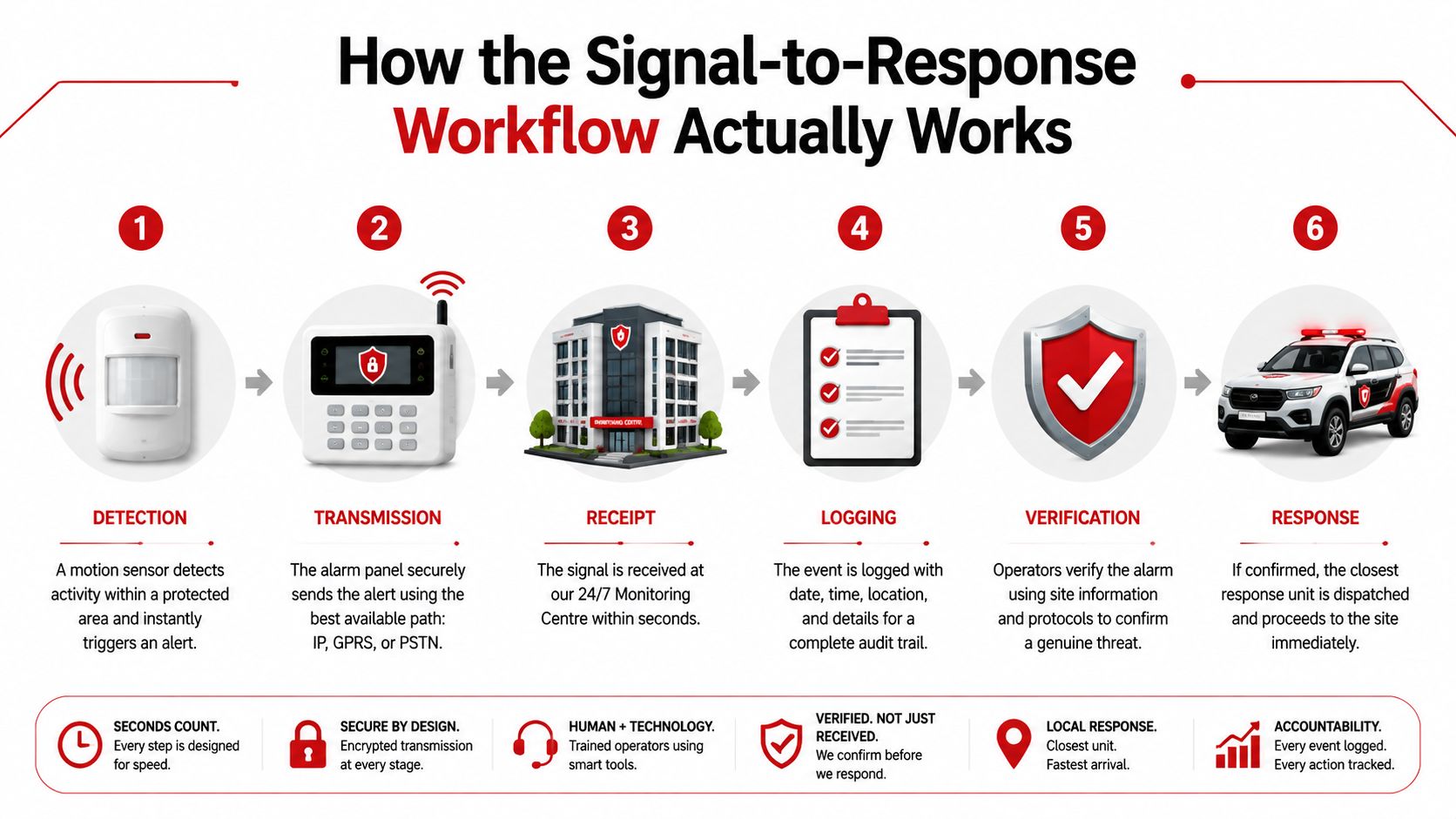
Detection begins the event. A motion detector, door contact, perimeter beam, duress device or other sensor activates. The alarm panel identifies the zone and signal type.
The panel transmits the signal. Depending on the installation, the panel can communicate over IP, GPRS or PSTN. The receiving system records the time, site identity, zone and event category.
The operator opens the customer file. The operator checks current site instructions, authorised contacts, access details, hazards, guard arrangements and the escalation order. Good instructions are specific enough to use under pressure, including gate locations, restricted areas and safe approach routes.
Verification adds context. If video verification is enabled, the operator checks live or recorded camera evidence around the activation. If the panel supports audio listen-in, the operator may listen or use a voice challenge. Sequential zone activations can also strengthen the assessment of a genuine intrusion.
Dispatch follows the agreed procedure. A confirmed event can be sent to the nominated patrol, static guard, patrol supervisor, keyholder or police pathway. The operator records who was contacted, when they were contacted and what information was provided.
The event is closed and reviewed. A cancellation code, guard confirmation or operator assessment may close the event. If the incident continues, the operator updates the escalation and preserves the relevant notes, video clips and response times.

What grading changes
AS 2201.2:2022 matters because it addresses the monitoring centre itself, including its equipment, staffing and operating requirements, and provides a grading system for centres. A resilient, appropriately graded centre with trained operators and suitable communications can support a more dependable workflow than a dialler that rings a phone.
The evidence trail also matters after the immediate event. Audit logs, time-stamped video clips and operator notes can help the client understand what occurred, support insurance discussions and provide useful information for police follow-up. The process runs whether the premises are occupied or empty, so the site doesn't depend on a manager noticing a push notification.
Why Verified Alarms Beat Passive Notifications
False alarms create a practical problem for everyone involved. A site may have nuisance activations caused by environmental conditions, equipment issues or user error, while the monitoring centre still needs to distinguish those events from a real break-in.
Australian-focused monitoring material describes traditional alarm monitoring as capable of producing false-alarm rates approaching 98%. That figure is cited in Aussec's explanation of back-to-base monitoring and verified alarms. The operational lesson is more important than the headline: notification alone doesn't tell the responder whether an intruder is present.
Verification supplies the missing evidence
A control room can use several forms of information, depending on the system:
- Sequential zones: A perimeter contact followed by an internal motion detector can show a developing movement path.
- Video evidence: A short clip can show whether a person is moving through a restricted area.
- Audio listen-in: A supported panel can provide additional context from the premises.
- Guard confirmation: A patrol officer can report forced entry, damaged fencing or signs of tampering.
- Duress information: A panic or duress event requires a different level of urgency from a routine access error.
The National Police Alarm Activation Response Guideline was implemented on 1 July 2018 to align police classification, requirements and response to alarms across Australian jurisdictions. It also aims to reduce non-genuine alarm activations and defines requirements for alarm monitoring providers, including confirmation of genuine activations.
That means active monitoring shouldn't be described as automatic police dispatch. The operator assesses and verifies the event, follows the agreed escalation and contacts the relevant service when the circumstances and jurisdictional process support it.
Verification is the difference between forwarding an alert and managing an incident.
A self-monitored dialler can tell an owner that a zone opened. It usually can't provide the same continuous triage, guard dispatch pathway or documented handover. Organisations considering personal safety systems can also review the broader ideas in 3rd-i's safe commute monitoring discussion, particularly the value of an active response rather than relying on someone to notice a message.
Matching Response Classes to Your Site Risk
Response selection should start with the consequences of delay, not the cheapest available package. A suburban office, a retail strip with repeated break-ins, a festival perimeter and a critical facility can all use alarms, but they don't have the same exposure or response requirement.
AS/NZS 4421 response practice is commonly used as an Australian benchmark. It describes standard alarm response within 45 minutes, dedicated site patrol response within 30 minutes and static officer response within 20 minutes. The AS/NZS 4421 response standard provides the formal reference point for discussing response arrangements.
AS/NZS 4421 Response Classes at a Glance
| Class | Responder Type | Arrival Window | Best Fit For | Verification Required |
|---|---|---|---|---|
| Class 1 | Keyholder-only response | Not specified in the verified data | Lower-risk premises where a keyholder arrangement is suitable | Confirm the site procedure and alarm status |
| Class 2 | Standard alarm response or dedicated keyholder arrangement | Standard response can be expected within 45 minutes, while dedicated site patrol response can be expected within 30 minutes | Sites needing an organised response without a permanently positioned officer | Define how the event is assessed before dispatch |
| Class 3 | Static or dedicated officer response | Static officer response can be expected within 20 minutes | Higher-risk premises requiring a faster on-site presence | Use verification and clear dispatch instructions |
| Class 4 | Critical or specialised deployment | The verified data doesn't specify a Class 4 arrival window | Sites requiring a risk-specific, critical response plan | Establish the exact deployment, authority and escalation conditions |
The class should reflect the site's location, asset exposure, occupancy pattern, existing guards and insurer requirements. A construction compound with fuel, plant and isolated boundaries may need a different arrangement from a small shop in a staffed centre.
Consider a suburban retail store with recurring after-hours glass-break activations. Moving from a basic keyholder arrangement to a faster dedicated patrol response may be appropriate if the risk assessment, insurer and provider's documented plan support it. The decision should be based on verified events, site vulnerabilities and the consequences of waiting, not on a class label alone.
Active Monitoring in Action Across Events and Venues
Active monitoring becomes easier to evaluate when the alarm is placed inside a real operating environment. Each site has different sensors, people, hazards and escalation instructions.
Four operating examples
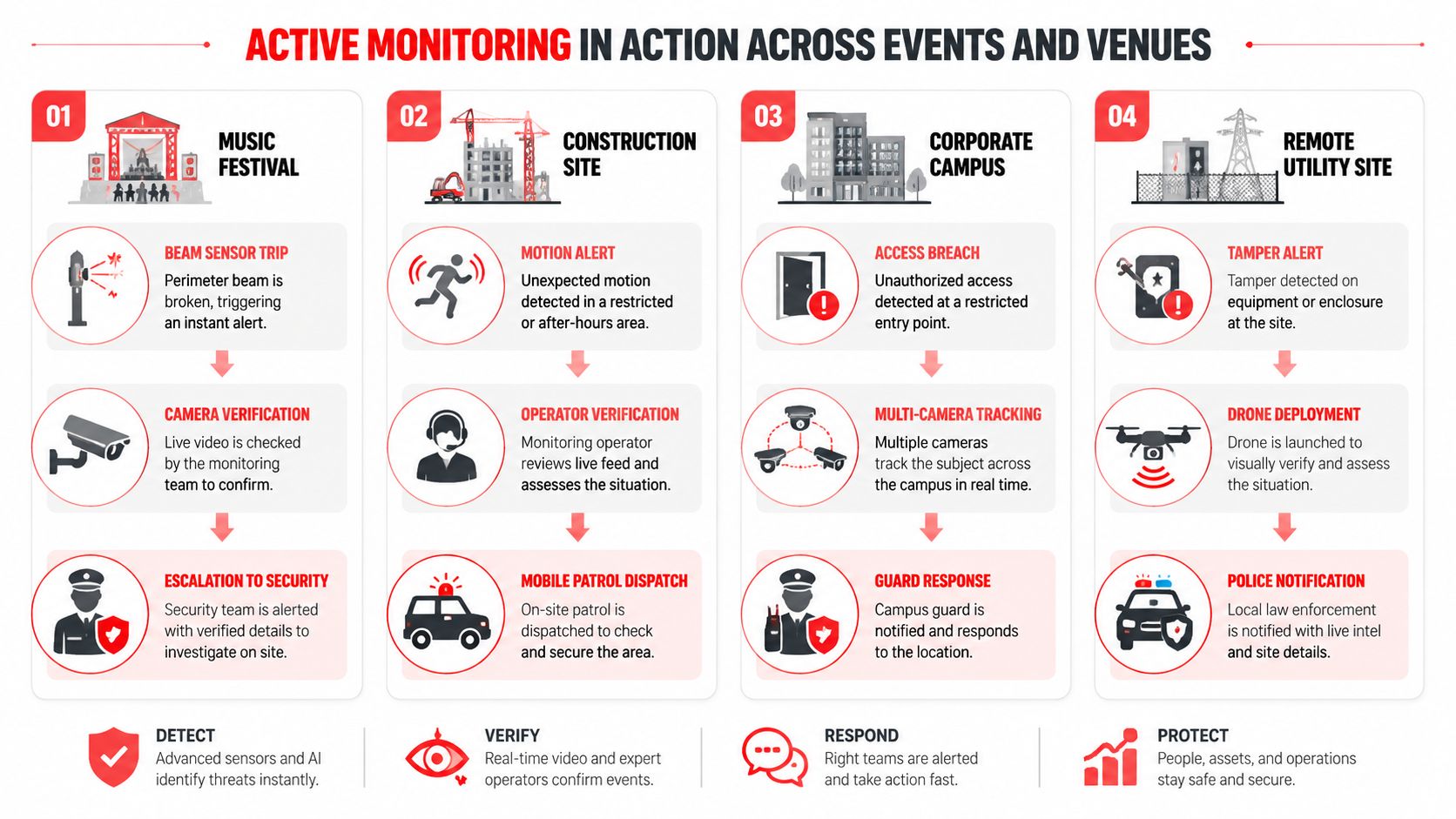
Music festival: A perimeter beam activates after the event has closed. The operator checks the associated camera view, confirms movement near the service road and sends the agreed patrol team to the perimeter. Event control receives a concise update rather than a vague alert, and the operator records whether the patrol found an intruder, an animal or a site condition.
Licensed hospitality venue: A staged close-down sequence begins as staff leave the premises. A door remains open outside the authorised period, so the operator checks the relevant zone and follows the keyholder sequence. If a guard attends, the briefing includes the floor plan, access point and known hazards, which is more useful than stating “alarm at the venue”.
Retail strip: Repeated after-hours PIR activations require triage against the site's event history and current instructions. A routine nuisance pattern can be assessed through the agreed process, while a panic or duress activation receives immediate priority because it represents a different threat.
Construction site: Fuel tank level sensors, perimeter devices and thermal cameras can feed the same control room. A verified intrusion near the compound can trigger a mobile or dog patrol response, with police engagement handled through the agreed escalation when the evidence supports it.
The report is part of the service
Each scenario should produce a clean incident report. The client needs the alarm time, affected zone, verification result, contacts made, responder actions and final outcome. That report helps identify recurring faults, refine the escalation plan and give site management a reliable account of the night's events.
Large venues also need operational accessibility and clear movement information for staff and visitors. The discussion of Lords Cricket Ground accessibility by Waymap provides useful context for thinking about venue navigation as part of the wider visitor and safety experience. Monitoring doesn't replace venue planning, but it can give the security team a clearer trigger for action when an incident occurs.
Integrating Active Monitoring With On-Site Guards
The control room should make the guard's job easier, not create another communication layer. A useful handover gives the person on the ground enough information to act safely and quickly.
The handover points
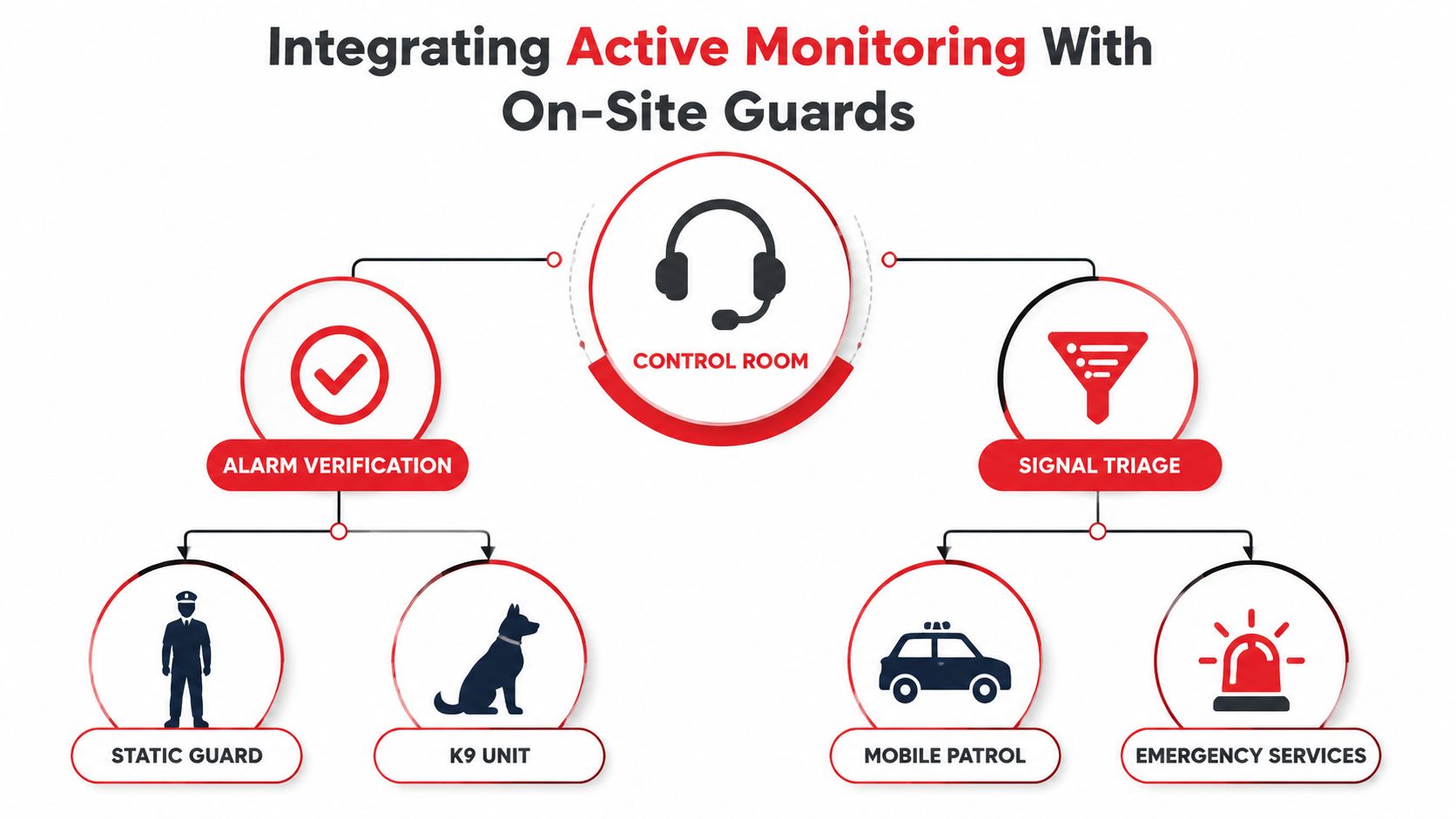
The control room operator receives and verifies the alarm. The operator then sends the event to the right operational role, which may be the site security lead, a static guard, a patrol supervisor or a specialist unit.
A static guard should receive the verified location, relevant camera snapshot or description, access instructions and known hazards through the agreed communications channel. The guard can then approach with context instead of searching the site without knowing which gate, building or zone activated.
If the static guard is occupied, the patrol supervisor can route the same event to the nearest mobile patrol. A K9 unit may be reserved for a higher-risk intrusion, a large perimeter or repeated incidents where a specialist deployment is justified by the site plan.
Escalating to emergency services
The monitoring centre's role doesn't end when a patrol is dispatched. If the event meets the agreed threshold for emergency escalation, the operator prepares an information pack with the site address, access point, alarm zone, verification evidence, hazards and the responder's current location. The operator then contacts 000 when appropriate and remains available to support the handover until police arrive.
The national guideline sets specific expectations for accredited Alarm Monitoring Providers. The provider must be a current member of a recognised security industry organisation, comply with AS 2201.2 monitoring-centre certification and operate a telephone link capable of showing Caller Line Identification to the relevant police jurisdiction. These criteria are outlined in the ASIAL Alarm Activation Guideline flyer.
The strongest handover is precise enough that the arriving guard knows where to go, what to look for and who remains responsible for the next update.
Choosing an Australian Monitoring Provider You Can Trust
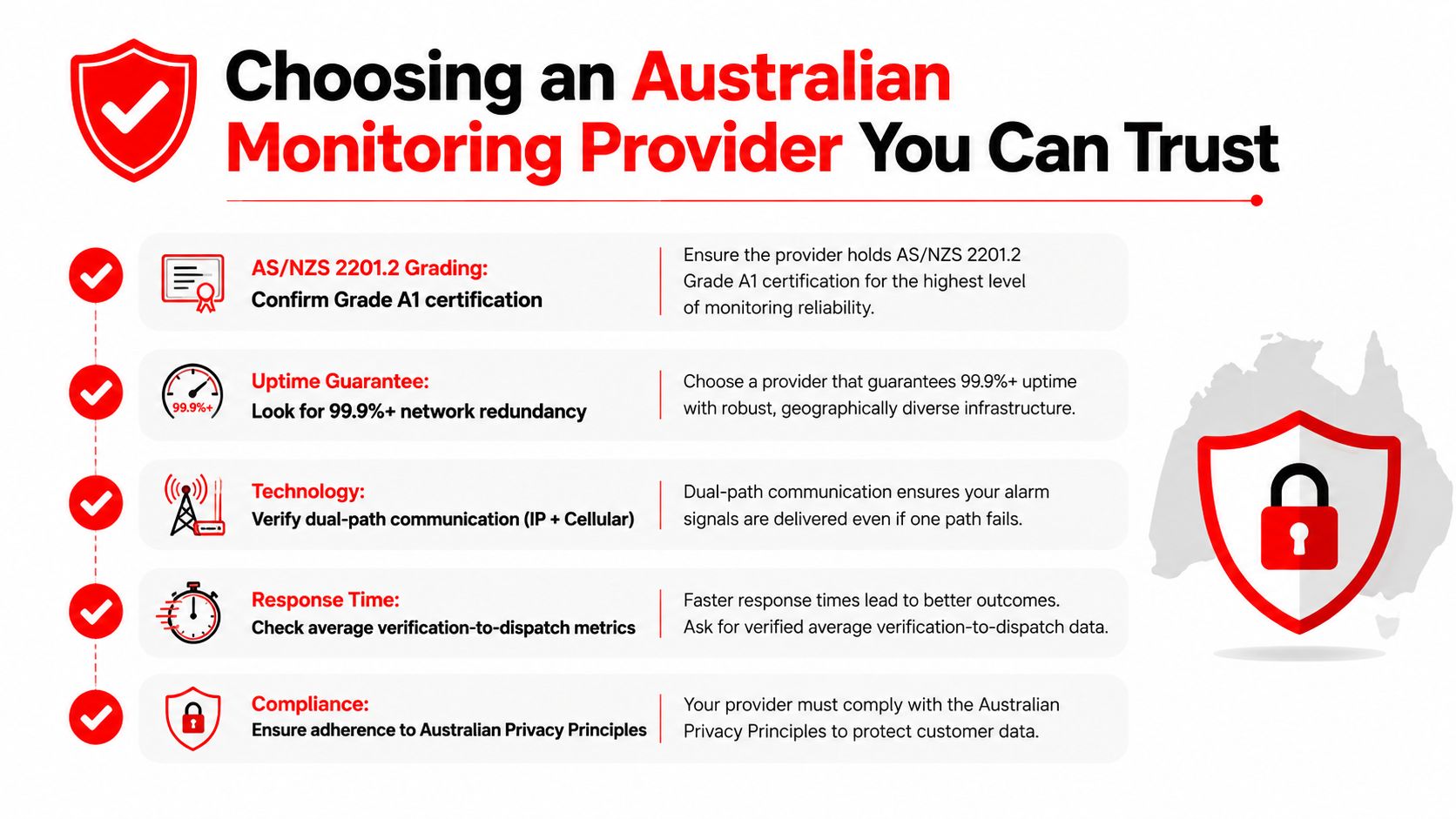
A provider's sales description should translate into documents, operating procedures and evidence. Ask for the monitoring-centre certification details, the applicable grading and the way the centre manages communications, staffing and disruption under AS 2201.2:2022.
Procurement checks that expose weak offers
- Centre capability: Confirm the provider can explain its monitoring-centre grading, staffing model, operating procedures and certification evidence.
- Response commitment: Match the written response arrangement to the class and deployment your risk assessment requires. Don't accept a general statement that “a team will be notified”.
- Dispatch ownership: Establish whether the provider can dispatch a patrol or guard directly, or whether it only forwards a call to a customer's phone.
- Verification process: Ask which cameras, audio functions, sequential zones or guard checks can support event verification.
- Event records: Require clear audit trails showing the signal time, operator actions, calls, dispatch details and closure notes.
- Field integration: Check whether the control room can work with your static guards, mobile patrols, K9 teams and site management without duplicate instructions.
Membership and compliance also deserve written confirmation. The ASIAL guidance identifies current membership of a recognised security industry organisation, AS 2201.2 monitoring-centre certification and Caller Line Identification-capable telephone handling as criteria for an accredited Alarm Monitoring Provider.
A single operational owner can reduce delays between the control room and the patrol team. GM GROUP Services offers back-to-base monitoring alongside static guards, K9 units, vehicle patrols and emergency response across New South Wales, Victoria, Queensland and the ACT, allowing clients to assess whether those functions fit within one coordinated arrangement.
Common Questions About Active Back to Base Monitoring
Typical buyer questions at a glance
| Question | Short answer |
|---|---|
| What does monitoring cost in Australia? | Pricing varies according to centre capability, site risk, communications, verification equipment, response deployment, number of premises and reporting requirements. A provider should quote the complete workflow rather than only a connection fee. |
| Is a Grade A1 service the same as a self-monitoring app? | No. A graded monitoring centre provides an operator-led process, while a self-monitoring app generally leaves assessment and escalation with the customer. Confirm the centre's actual certification and grading. |
| How long are contracts? | Contract length, renewal terms, exit clauses and equipment ownership vary by provider. Ask what happens to the panel, communicator, cameras and stored records if the arrangement ends. |
| Can one service cover multiple sites? | Yes, a multi-site plan can standardise alarm formats, escalation contacts, response instructions and reporting across a portfolio. Each site still needs its own risk profile and access details. |
| Will police automatically attend after an alarm? | No. The operator should verify the event and follow the relevant jurisdictional process. The national guideline was created to reduce non-genuine activations and support consistent alarm handling. |
| Can an existing alarm panel be retained? | Often, the migration may involve configuring compatible communications and monitoring rules rather than replacing every device. A technical survey should confirm panel compatibility, signal paths and verification options. |
A national retailer or venue group should ask for a rollout plan that covers site naming, contact hierarchy, access notes, camera permissions, alarm zones and state-specific escalation. Consistent reporting is valuable, but a remote warehouse, shopping-centre tenancy and licensed venue shouldn't receive identical response instructions.
For police response in NSW, Victoria and Queensland, ask the provider to explain how it confirms a genuine activation, records the evidence and manages the call with the relevant jurisdiction. The process should distinguish a verified intrusion from a user error or equipment fault, rather than promising automatic attendance for every signal.
Migration can be staged. Start by documenting the current panel, zones, keyholders and response gaps, then test the new monitoring path and escalation sequence before changing the full portfolio. That approach can preserve useful hardware while replacing the passive notification workflow with active verification and dispatch.
GM GROUP Services can help organisations assess back-to-base monitoring, alarm verification, mobile patrols, static guards and specialist security for venues, businesses, retail properties and construction sites. Visit GM GROUP Services to discuss your site risk, response requirements and a practical escalation plan.